
Museum Welcome House II
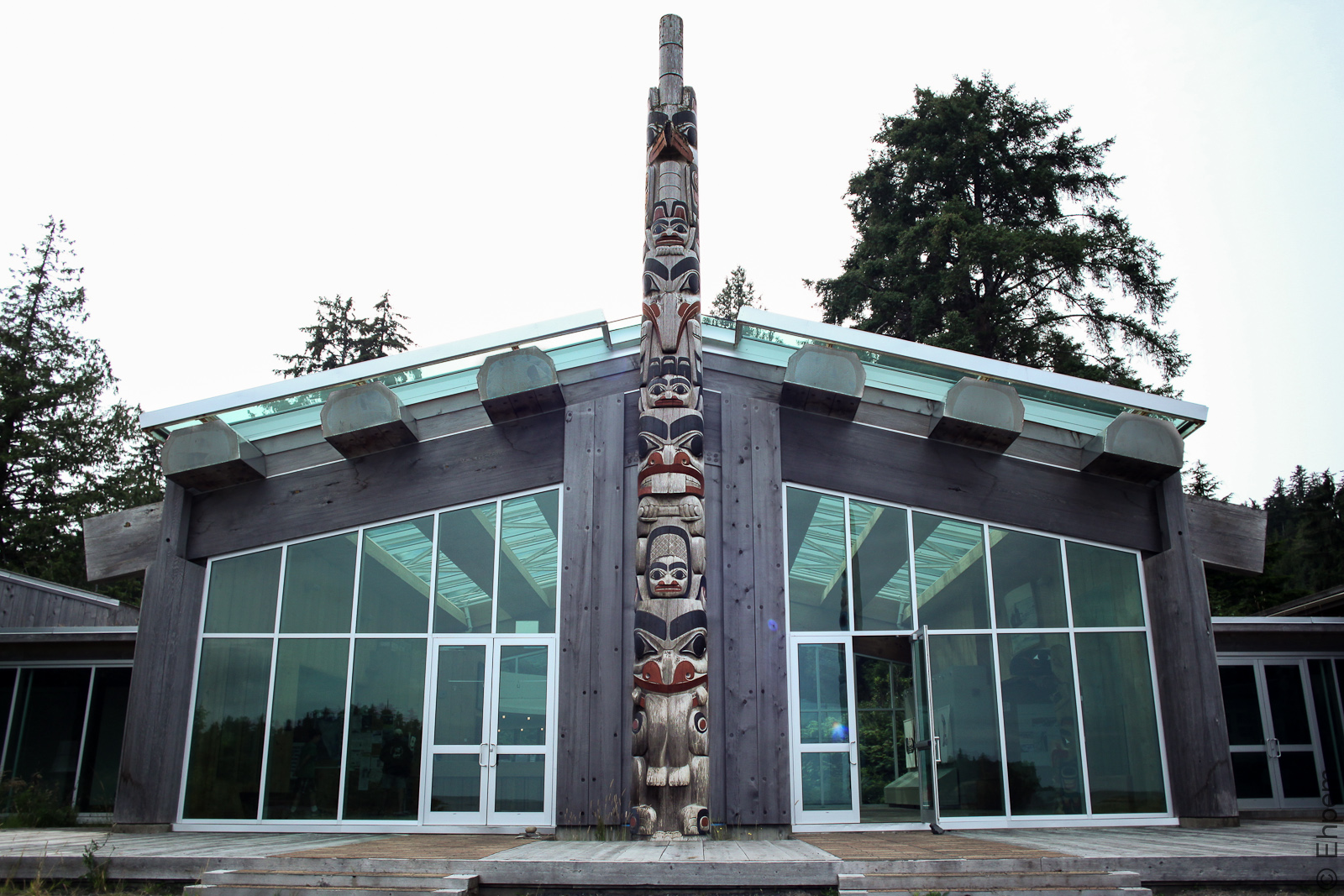
I already posted shots of the interior of Stlaay Daw Naay or the Welcome House at the Haida Heritage Centre. Today’s post shows the exterior including the back, which is in fact the main entrance, and the front (beach side) which seasonally one is able to exit from to look at the front of this village formed by the buildings of the Centre. Each of the five buildings has a carved pole in front facing the beach and there is another standing near the edge of the beach. I read somewhere that each pole represents one of six main Haida villages from the south end of Haida Gwaii. I cannot find out more information than that. I can’t even discover who carved which pole, though they were obviously done by different master carvers. The pole and details in this post are all from this single pole that graces the front of Stlaay Daw Naay.
Edit: I found a source of information on these poles and since I am having trouble getting that webpage to display properly, I am copying the information below. This pole represents the village of SGang Gwaay Llnagaay, formerly also known as Ninstints (see my earlier posts about this village here, here and here). I note that this source of information uses a different spelling for some of the Haida words, than do other pages on the same website, the source of my spellings and translation of name above.
Location: Slaay Daaw Naay – Greeting House
Carver: Laada (Tim Boyko)
Clan: K’ils XaaydaGaay (Peninsula People of Skedans)
Assistant: Derek White
Apprentice: Eric Olson
The figures from bottom to top:
• Taan or Bear with Human
• Ts’ing or Beaver
• K’yaaluu or Cormorant
• Guud or Eagle
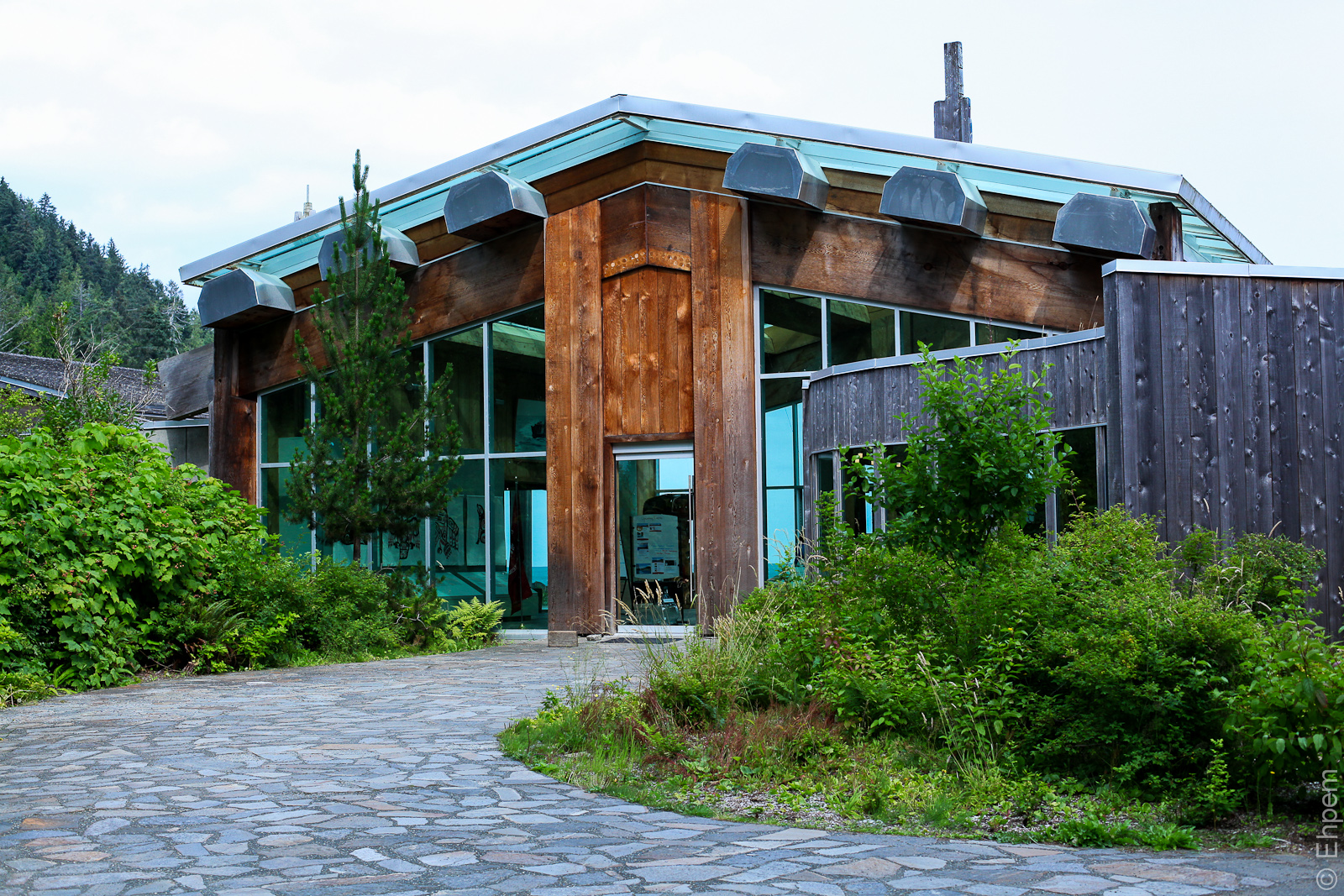
Entry way to Stlaay Daw Naay – back of building
.
I feel like this series is dragging out a bit. The reason for that is that while I am learning my new software, I am not processing images for the blog at nearly the same speed as normally, and thus this dribble of images is slowing down my intentions as well. I would have grouped more images into one post, had they been ready. At this rate there are several more posts about the Centre before I am done. At least its interesting and photogenic.

Stlaay Daw Naay pole detail
.
This is one of a series of eight posts about the Haida Heritage Centre, the others can be found through this link.
To open larger versions of the images below, click on any one of them, use the arrows to navigate and escape to return to this page.
-
- In foreground, corner post and beam of Stlaay Daw Naay

-

- Stlaay Daw Naay pole detail

-

- Stlaay Daw Naay pole detail
-

- Stlaay Daw Naay pole detail

-

- Stlaay Daw Naay pole base

-
- Stlaay Daw Naay front
-

- Entry way through back of building
.
.
Canon 5Dii, Nikkor-N (pre-AI) 24mm f2.8 lens (except rear entrance – Canon 50mm f1.4 lens), ISO640.


 burnt embers
What a handsome structure, Ehpem! As always, I love the poles.
LikeLike
Hi Lynn – glad you like it. Pretty wonderful building alright. Even more so for a very small and pretty isolated community.
LikeLike
Pingback: Museum: Eating and Performing Houses « burnt embers
I have edited this post to include information about the pole and its carvers.
LikeLike
I LOVE architecture, and your fabulous photos here today really share the wonderful character of this place with everyone here! Great work here, my friend, I am definitely looking forward to more!!
LikeLike
Hi Toad – thank you very much 🙂 And more you shall have…
LikeLike
Wonderful shots. I can appreciate the learning curve of an advanced software package, it can be a lot of work and a challenge. But soon it’ll become second nature and your processing will go very smoothly and even helpful in your creative process.
LikeLike
Hi Ken, thanks so much. I am already discovering some of the advantages that will speed things up, like using the previous treatment button on similar images – a great starting point with then only minor tweaks. I am really liking the new software and what it lets me do. Should have switched sooner.
LikeLike
These images are striking. I especially love the composition of the first one, it really gives the pole the majesty it deserves. I for one am thoroughly enjoying this series and look very forward to the next post!
LikeLike
Hello Mrs Toad – thank you for the comment. It is interesting how well these poles retain their dominance even when placed against the front of a massive building, much larger than the houses they once (and sometimes still do) stand in front of.
LikeLike
Gorgeous colours
LikeLike
Hi James! I very much prefer these simple painting schemes on the poles. Sometimes they have very elaborate sets of colours, especially with groups further south, but I prefer a subtle (from a bit of a distance) touch of colour against the natural greys of cedar.
LikeLike
You were right. The outside is amazing too!
LikeLike
More on its way! Sorry for the delays…
LikeLike