Sun Drain
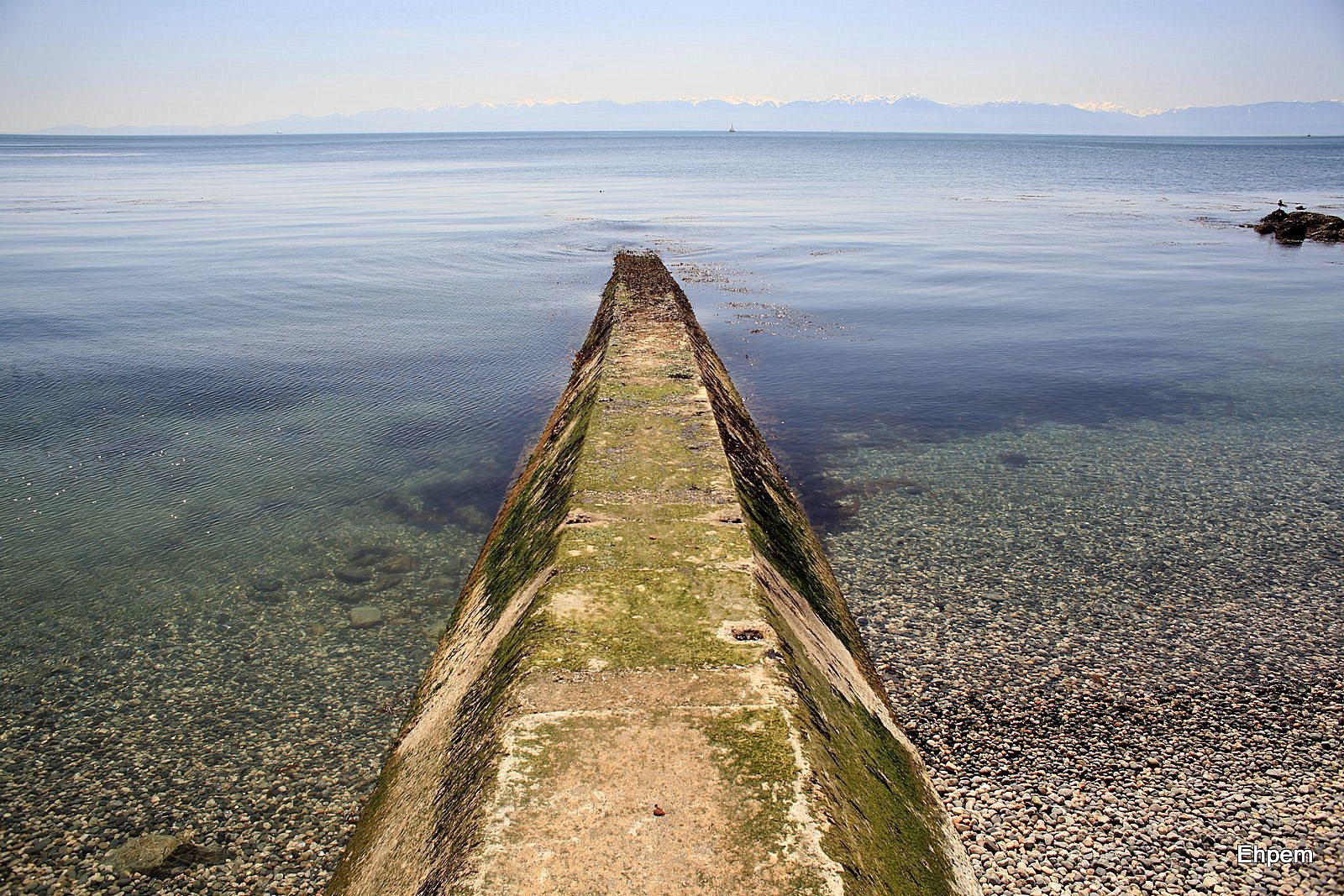
Looking south
Confession time – this blog has featured only one of the storm drains in Ross Bay. I think it is time for another one; I expect many of my subscribers will agree, though perhaps in moderation.
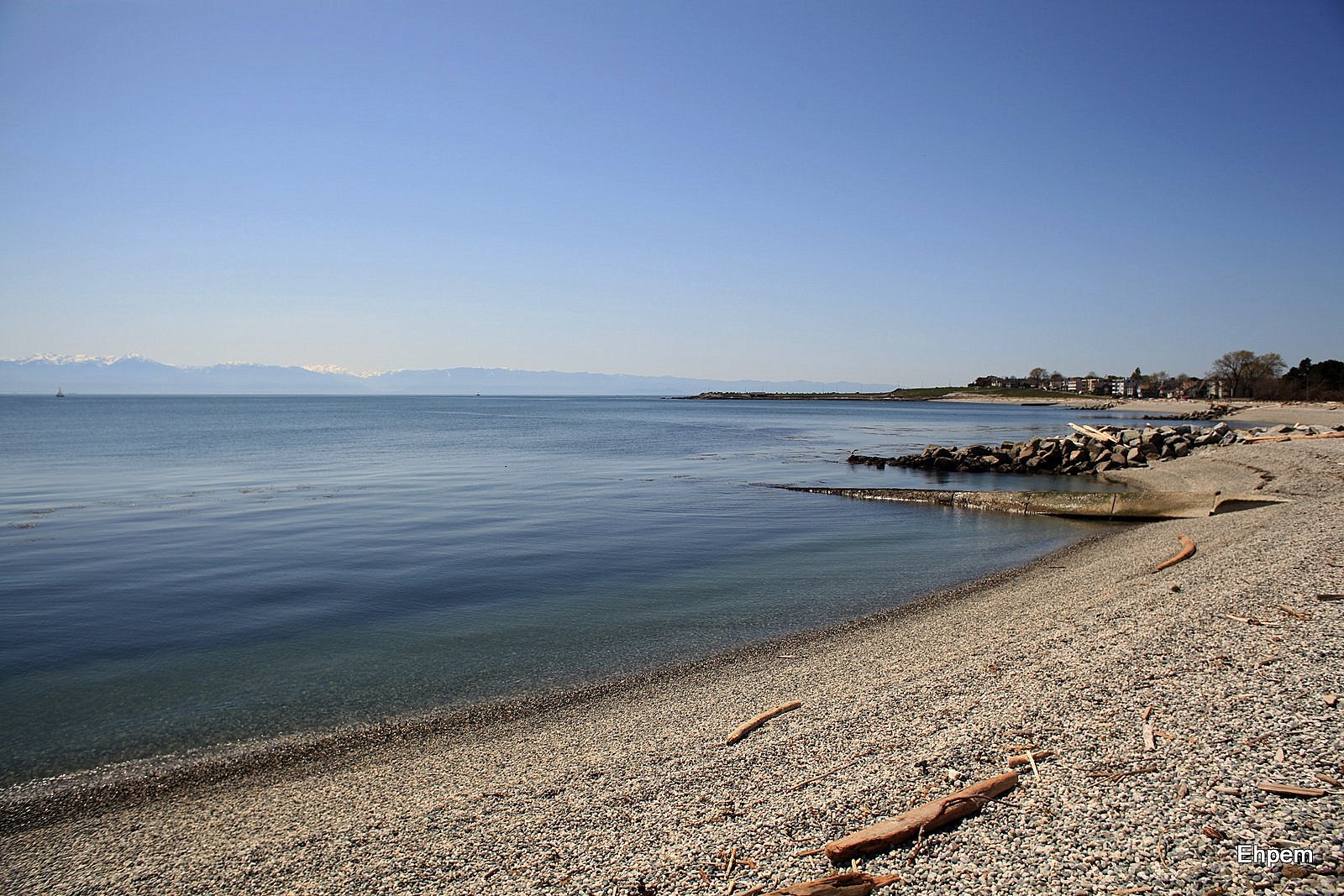
It was a lovely sunny day on Saturday – a day when people were sunbathing for the first time this year. We walked the length of the Ross Bay beach on our way to the Moss Street Market. The tide was lower than usual, and so this drain was well exposed against a perfectly calm sea. The Olympic Mountains still have a lot of snow in the distance – they were worthy of a telephoto shot, but that was not going to be.
I had brought my camera on the walk, but only with the 24mm lens attached and no camera bag. I took pictures here and there on the route, and some at the market too. This drain is located closer to the east end of Ross Bay – the one that I have posted about all winter is in the western half of the bay. This one is unlikely to be a frequent subject of photographs as it is not nearly so accessible and is underwater much of the time.
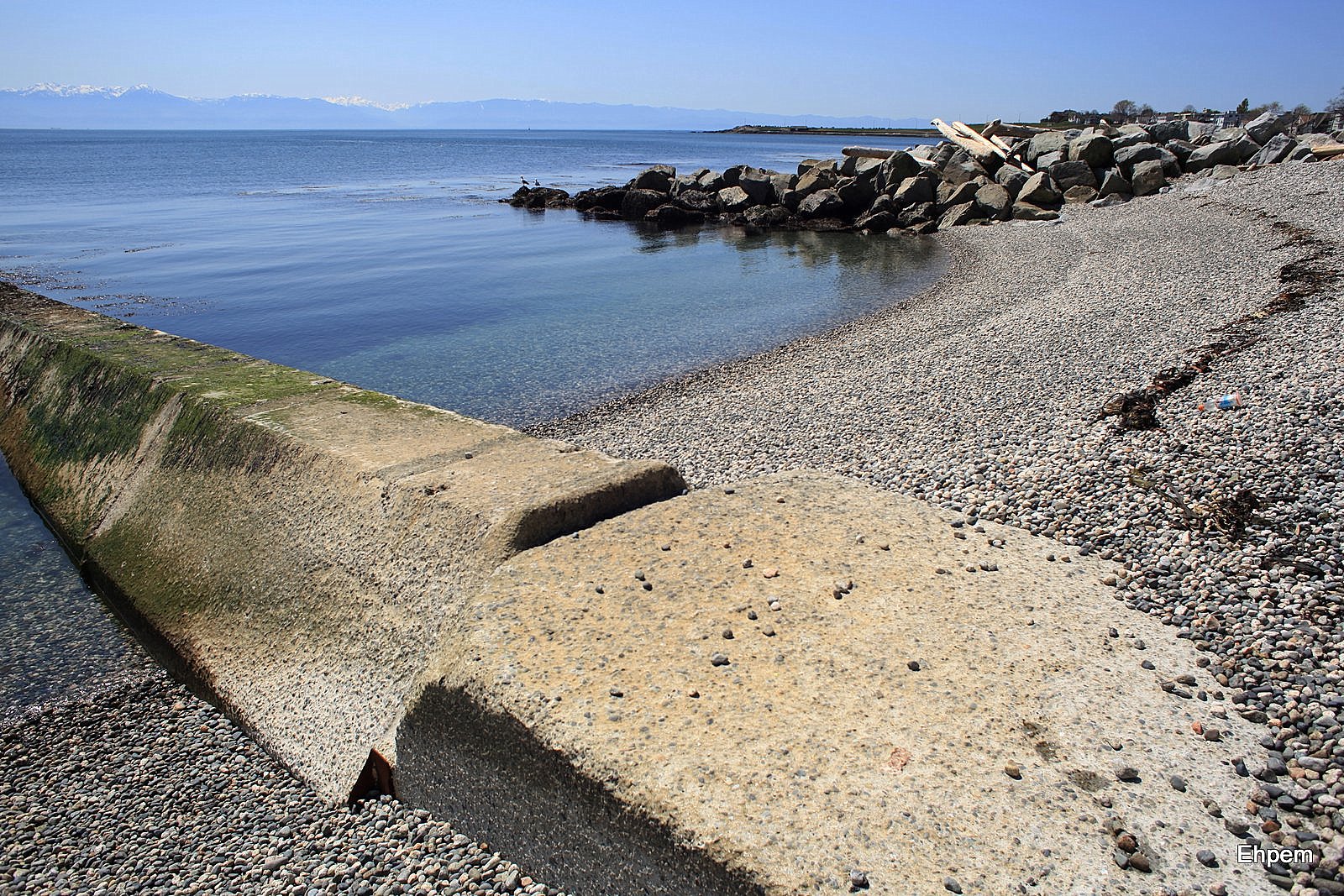
This drain is in front of the cemetery and lies beside one of the rip-rap groins that were put in to hold the pebbles in place. This is an artificial beach that was created 10 or 12 years ago as a solution to the crumbling sea wall in front of Dallas Road in Ross Bay. The earlier beach was rocky, weedy, slippery and exposed only at low tide, with a 10 foot or more sea wall holding up the road and the cemetery. In fact, it was installed many decades ago after the cemetery started to erode, and dropped coffins onto the beach where the road is now. This massive sea wall was considered too expensive to replace, and in any case, in winter storms waves would be thrown over the wall and across the road, sometimes carrying logs and rocks and other debris. Every winter the road was closed during big storms. The groins were put in to interrupt the long-shore drift and an endless stream of barges arrived for a month or two with these pebbles which were fed onto the beach. It was a really big operation, but it has worked out far better than I thought possible at the time. The old beach was unusable and this one gets a lot of use in nearly all weathers. The waves rarely make it onto the road and I can’t remember the last time it was closed due to a storm, though sometimes a few pebbles litter the road surface after a good blow.
Anyway, this storm drain dates to the old beach and would have laid low along the beach surface visible only at lower tides, and posing a bit of a slimy obstacle if trying to navigate the beach at a low tide.

Another thing of interest on the beach was a Japanese orange juice bottle – it can be seen in some of these photos near the drain at the end of the dark line of kelp that lies between the drain and the groin. The more northern coasts of British Columbia and Alaska are now experiencing a huge influx of the lighter weight debris from the Japanese tsunami of last year. These are the objects that float high enough in the water to act like a sail and have been blown across the Pacific Ocean first. Heavier materials are expected to make their way more slowly via the Japanese current and arrive in another year or 18 months. I suspect that this bottle is from this vanguard. We collected it, and other flotsam, and put them in the garbage container at the other end of the beach.
There is increasing concern about the amount of tsunami material coming – a recent radio interview with an Alaskan official suggests many billions of kilos of material is on its way to our shores. Given how remote most of them are, and how difficult they are to access, this could be an environmental disaster in the making. The plastics will get ground up on the beaches and enter the environment, the food chain, the sediments and so on. Those that are collected could fill up landfills in short order. Also, there are likely to be tens of thousands of containers of toxic materials on the way as well. It bodes ill for a largely unspoiled shoreline. I will be in Gwaii Haanas (southern end of Haida Gwaii – formerly called the Queen Charlotte Islands) in a few weeks and it will be very interesting to see how much more there is on the beaches than we observed last year.
To launch the gallery view click on any of the images below and then use the arrows to navigate, and escape to return to this page.
.
-

- Japanese bottle – tsunami wreckage?
-
- Looking south west, Japanese bottle at end of line of seaweed
-
- Drain and groin, looking west
-

- Drain looking east, white house in distance subject of my first ever post.

-

- Looking south, bent

-

- Looking south west with groin

-

- Looking south with groin

-

- Looking south
.
Canon EOS 5Dmkii, Nikkor-N 24mm f2.8 lens, ISO100, ~f8 for many of these shots, most at 1/320th or similar speed.
.
.


 burnt embers
Hmmm, perhaps some long exposure shots are called for? Could be interesting getting a low perseptive shot of those waves lapping up against the drain (then again, they could be too small for much of anything…meh, worth a shot?). 😀
LikeLike
Hi David – it is worth a shot, and I have recently got an adapter for my filter so it will fit the 24mm lens, though so far I have not tried it out to see if it vignettes, which it may. So now, timing – tides, weather, time of day, etc all have to come together.
LikeLike
Love the shifting transparency of the water in the first photo. I’m assuming that “groin” refers to the rocky arm into the water rather than to an anatomical part.
LikeLike
Hi Lynn, it is an unusual use of the word (or a technical engineering use), but yes, the rocky arm is the groin.
LikeLike
Beautiful! The sea looks so clm and inviting. And kudos for helping to keep the beach clean. Even a small amount of work now will help against the deluge to follow.
Beaches worlds removed
Anticipate the coming –
Homes destroying homes.
LikeLike
Thanks Ryan! I agree, if everyone who walked that beach took all that they brought with them, and a couple of other things too, it would be a better place. Mostly what we picked up were coffee cups (local ones). I can’t believe that people will take a coffee to the beautiful beach (that is why they go there after all) and then leave their garbage behind. It is a literally thoughtless act.
LikeLike
I would have been tempted to keep that much-traveled OJ bottle as a mantlepiece ornament or coffee table conversation piece. If you find any more please keep me one! Val
LikeLike
I hate to say this, but I think we are all going to get sick of them very soon. If you have a look around south beach, there will probably be some there. Perhaps the one we found was thrown off a ship at sea. Even if that is true, sounds like we will get inundated by an echo of the tsunami comprised of the debris of Japanese lives.
LikeLike
I like the perspective!
LikeLike
Hi Sonali – thanks so much. The 24mm lens really adds to that point of view.
LikeLike