Seedy Clematis

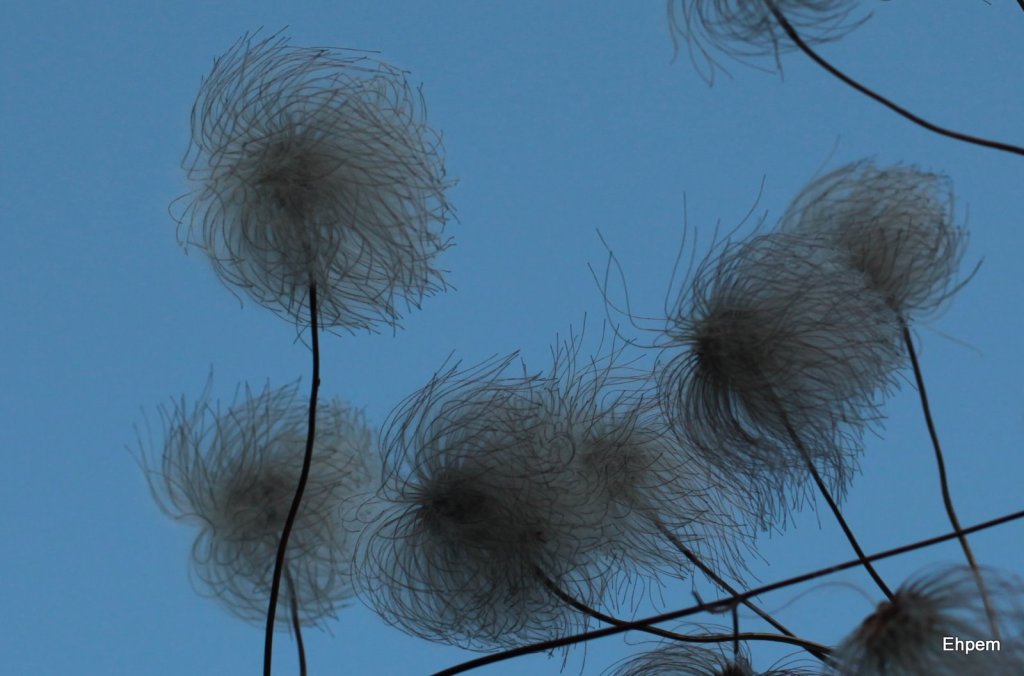
These are, I am pretty sure, the seed heads of a clematis vine, seen on an arbor in the front garden of a neighbour’s house. It was the end of the day, I had photographed the sunset and it had become quite dark out. This arbor is over their front gate, and is spectacular when in flower. But now that I look closely at it in seed, I think it is even more interesting.
.
I used the Canon 50mm/f1.4 lens, ISO 400, f5, 1/60th (top) and 1/100th (bottom). Both images cropped and tweaked for contrast.
.
.


 burnt embers
Pingback: Seedy Clematis II « burnt embers
Pingback: Clematis Seed « burnt embers
Reminds me of a wish. Or a dream. Maybe both.
LikeLike
What a great idea! I like it that a photo of mine can remind someone of a wish.
LikeLike
I, too have been fascinated by Clematis seed heads, specifically Clematis drummondii, which is common here in central Texas:
http://portraitsofwildflowers.wordpress.com/2011/07/23/clematis-drummondii-swirls/
As many times as I’ve photographed those fluffy heads, I still take more pictures each year.
LikeLike
Hi Steve – thanks for coming by and for commenting too. That is a really nice detail of a seed head – a bit different from these ones, but very photogenic. I expect that I too will be taking more pictures of them – now that I know to look more closely for them.
LikeLike
Actually I have plenty of pictures of Clematis drummondii photographed in a way that makes them look a lot like the ones in your photograph, but I haven’t posted any of those pictures so I couldn’t point you to them. The picture that I did link to is taken so close to a few of those fluffy seed heads that all you see is a portion of the interior and not the fluff at the extremities or any of the sky beyond that.
LikeLike
These are really beautiful shots, they remind me of an old childrens art toy called “Spirograph”, not sure if you had it in Canada. It was big here in Ireland back in the 80’s.
I’m really enjoying reading your blog.
You have a lovely way with colour.
Thanks for sharing
Dave
LikeLike
Hi Dave – thanks for dropping by, and for your really nice comments. We did have Spirographs when I was a kid, my sister had one that she was enthralled with for a while, more in the 70’s I think. I might have seen it still hanging around my parents place a few years ago. Thanks for the comment about colour – I am not sure that is me, I rarely fiddle with colours other than sometimes via enhancing contrast or something. I think they mostly just come to me that way.
LikeLike
I love nature and all the beauty she provides photographers. What a great pair of images, my friend!
LikeLike
Hi Toad, thanks for coming by again. I really like these seed heads, for me they have equal rank to the flowers that preceded them.
LikeLike
I love the seedpods of this Clematis. When we used to grow them, unfortunately, I didn’t own a camera. Great shots. Maybe we’ll start growing them again:)
LikeLike
Hi David – welcome to my blog, very nice to have you comment. They seem pretty easy to grow, at least on the west coast. We have had them on and off over the years – we currently have a small one (Duchess of Albany) that has small flowers and does not occupy a lot of space. We neglect it and yet it rewards us by decorating our front deck rail with trumpet like red flowers and greenery every summer.
LikeLike
Fun. They look like something from a Dr. Suess book.
LikeLike
Hi Danita – they do look very Suessian, as if they should be attached to a body and doing something nutty and unexpected. They do look quite unexpected all on their own.
LikeLike
Really nice…they look like something that you would see in a salt-water reef tank.
LikeLike
Jelly fish from one observer, reef dweller from another! There is something about them that is very marine. Now that is one type of photography I will never do, but I would love to have the diving skills and the right gear to photograph some of the underwater beauty which is really very extraordinary. One of the more extreme versions of nature photography.
LikeLike
This is a very interesting study. The seed heads look very soft and fluffy. I like how you captured them against the sky!
LikeLike
Hi dh – thanks for coming by again, and for your compliment too. They deserved a simple background and in any case they were above my head, so the sky was pretty much a given.
LikeLike
I love these, especially the first one. You might be interested in my clematis photo in one of my earlier posts – although it’s in the flowering stage. Like you, I think the seedy stage is really interesting too.
LikeLike
Hi Laurie – thanks for pointing me to that picture (link) – it is a terrific blossom, though the story of waiting so long for a single flower is a bit sad. Maybe you could move the plant to a better spot and then you might get clusters of interesting seed heads to enjoy at this time of year once the petals area gone. I think they move pretty readily.
LikeLike
Looking at these exquisite seed heads (and so many other things in nature) makes it hard for me to square it with pure evolution. I would put it in a classification of evolution PLUS. And why are our eyes designed to perceive the beauty in non-descript seed pods? Questions, questions…
LikeLike
Hi Barbara – exquisite is a very good word for these. I don’t share your doubts about evolution being able to produce such things – the closer we look, the more we discover it is normal, not special at all, at some level of detail. Sometimes you might have to get to the atoms or molecules to find it, but I think it is usually there. Its one reason I like macro photography, it can isolate and amplify such things. Though this is not a macro shot, it has something of the same feel to me.
LikeLike
Captivating, so tranquil 🙂
LikeLike
preobrazhenskii – welcome to my blog, and thank you for commenting as well. Definitely there is something “slow” about these.
LikeLike
Very beautiful, and soft. 🙂
LikeLike
Hi Nandini – thank you! They do look very soft. I did not touch them and you comment makes me wonder if they really are soft, and whether they have been used for anything other than looking at.
LikeLike
And a very quick internet search shows that they are toxic, though used in very small quantities as a medicine by some indigenous peoples of North America, and by early settlers as a pepper substitute (which could cause internal bleeding). I doubt they would be used for stuffing pillows or anything like that since they can be a respiratory and dermal irritant. Appearances can be pretty deceiving.
LikeLike
Vêtu beautiful, they look like jellyfish !
LikeLike
Very … (not vêtu) 🙂
LikeLike
Great analogy. Not only did I grow up with clematis, but I grew up with jellyfish. I even used to collect them for money (1 or 2 cents each) when I was a kid, for use in scientific experiments. Experiments which won the scientist (Osamu Shimomura) a nobel prize a few years ago. Thus, I have an old interest in jelly fish. Maybe that is why this image pleases me. 🙂
LikeLike
Waaaa you participated to the elaboration of a publication that won a Nobel price …
And funnier is that I even used his discovery many times … since I worked in science for almost 12 years !
I used GFP conjugated proteins in some of my studies sometimes !
LikeLike
Mathias – proof of a small connected world. I was just a child – 4 or 5 years old to maybe 9 or 10 years when I was collecting for him with my siblings so I have nothing to do with his research other than cheap labour for raw materials.
We have another small overlap in our worlds – I have been meaning to comment on your Cap Ferret photos which are great and which resonate with me – I lived on Cap Ferret when I was 7 years old and so it is a special place to me and very intersting to see pictures of it, though none of them really ring loud or clear bells in my head, the overall feel of the place is very familiar.
LikeLike
Indeed, world can be small !
If you can, let me know exactly where you’ve been at the Cap Ferret so next time I go there, I’ll take some pictures at these places and we’ll see if it sounds even more familiar to you !
LikeLike
Mathias – I have been doing a bit of research and looking at your photos again. I think I made a mistake – where I lived was Cap Ferrat in Provence, I think its proper name is Saint Jean Cap Ferrat. I am thinking you are in Cap Ferret on the coast west of Bordeaux? I think that the familiar feeling I am getting from your photos is the feel of France, rather than of the actual place that I looked. Oh well. Thanks for your offer to take pictures, but it sounds like it must be a different place.
LikeLike
😀
These names can be confusing, indeed !!
But the world is still small: I was born in Nice that is very near Saint Jean Cap Ferrat !
LikeLike
Indeed they can – especially when in a language I have no real understanding of. I see that you visit Cap Ferret to visit your sister. I have a sister who lives in Provence, between Aix and Marseille, though I have not been to visit her, yet.
LikeLike
The clematis is a beautiful flower in all of it’s life cycles. They are especially nice this time of year. I don’t have them anymore in the house we live in now, so thanks for posting these.
LikeLike
We used to have them too, but the neighbour pruned the one on our fence too hard (pretty much to the ground) and it never came back. I am wondering why I never noticed the seed heads before – I have been around these plants for much of my life. Maybe some varieties have better seed pods, or maybe I see the world differently with a camera in my hand.
LikeLike
I’ve never seen seed heads like this in our region. We have clematis but maybe our varieties don’t produce these feathery jewels. These are wonderful shots. If I took this shot with my point-and-shoot, it would be riddled with noise, so I’m doubly envious of what you’ve captured here.
And, yes, one sees the world differently with a camera hanging around your neck. I can attest to that. I’m walking to some stores this afternoon with my camera under my coat. I’m sure it will find interesting things before the day is done. It’s like a divining rod when it’s with me.
LikeLike
Hi Doug – thanks for your comment, it pleases me that you like these pictures as they are the kind of thing I can easily imagine showing up on your blog. As you know there are many varieties of clematis flower, but I have little idea about how that shows in their seed heads. I quick search of images for clematis seeds does provide a great deal of variety though, so I stands to reason that the differences in flower are expressed also in the seed heads. I think that these would probably respond well to a flash and could be easily captured, perhaps when the sky is still pretty bright, though they would look different. I hope that your walk this afternoon attracted some great reasons to pull your camera out of your coat.
LikeLike