Wildlife Photo Exhibit


OK – this is a very long post. If you don’t want to read my long-winded blather, then here is the take-home: Find the version of this exhibit that is near to you and go see it. If there isn’t one within reach, then the book promises to be a good buy. There. Now read the next paragraph for some useful links, skip over all the reasons why it’s a great show and look at the pictures far, far below. And say happy 100th post in the comments on your way past. Thank you.
_________________________________________________________________________________________________________________________________________________________________________
Last Friday the Royal British Columbia Museum launched a travelling exhibit called Wildlife Photographer of the Year which runs until April 9, 2012. Wildlife Photographer of the Year features the 2010 winners and runners-up in an annual contest sponsored by the Natural History Museum and BBC Wildlife Magazine in London, England (the last image of mine below includes local sponsors of this show). The exhibit will appear in many places around the world, lots of them simultaneously, (17 cities in 10 countries outside Britain, another 18 cities within Britain); you can search for ones near you through this link. The RBCM website has links to information about their version of this exhibit, and a few of the images released to the press, which are here.
I was lucky enough to get a quick look close to opening time when almost no one was viewing the gallery and took some pictures as I had my camera with me. I had to go back, because I spent more time figuring out (largely unsuccessfully) how to photograph this show than I did looking at the hundred plus images on display. On my revisit I was abashed to find that no photography of any kind is allowed inside the exhibit. No one had asked me to stop taking pictures on my first visit, and I was so focussed that I did not notice the signs inside the exhibit area saying ‘don’t’. I did read the notice outside the entrance that says photos allowed, but without flash, which I guess is intended as a general condition for that floor of the museum, and not for this temporary space full of copyrighted materials.
This discovery led to the delay of getting this post out. I decided to seek permission from the RBCM to post shots of the exhibit as I intended my pictures to be about the design and how they presented the photographs and not about the photographs on display. I did not take any photos square-on of individual displayed pictures as I felt that would not be right, and in any case it did not suit my purpose. The answer from the RBCM to my request was gracious approval, with a request that next time I go through the proper channels. I am very pleased about their decision because I like my design concept for this blog which makes use of the fantastic photo mosaic that the RBCM staff put together as part of their display. They feature it more than once in the exhibit and so do I! Also, since this is my 100th post what better way to mark the centenary of a photo blog than with a review of a photography exhibition?
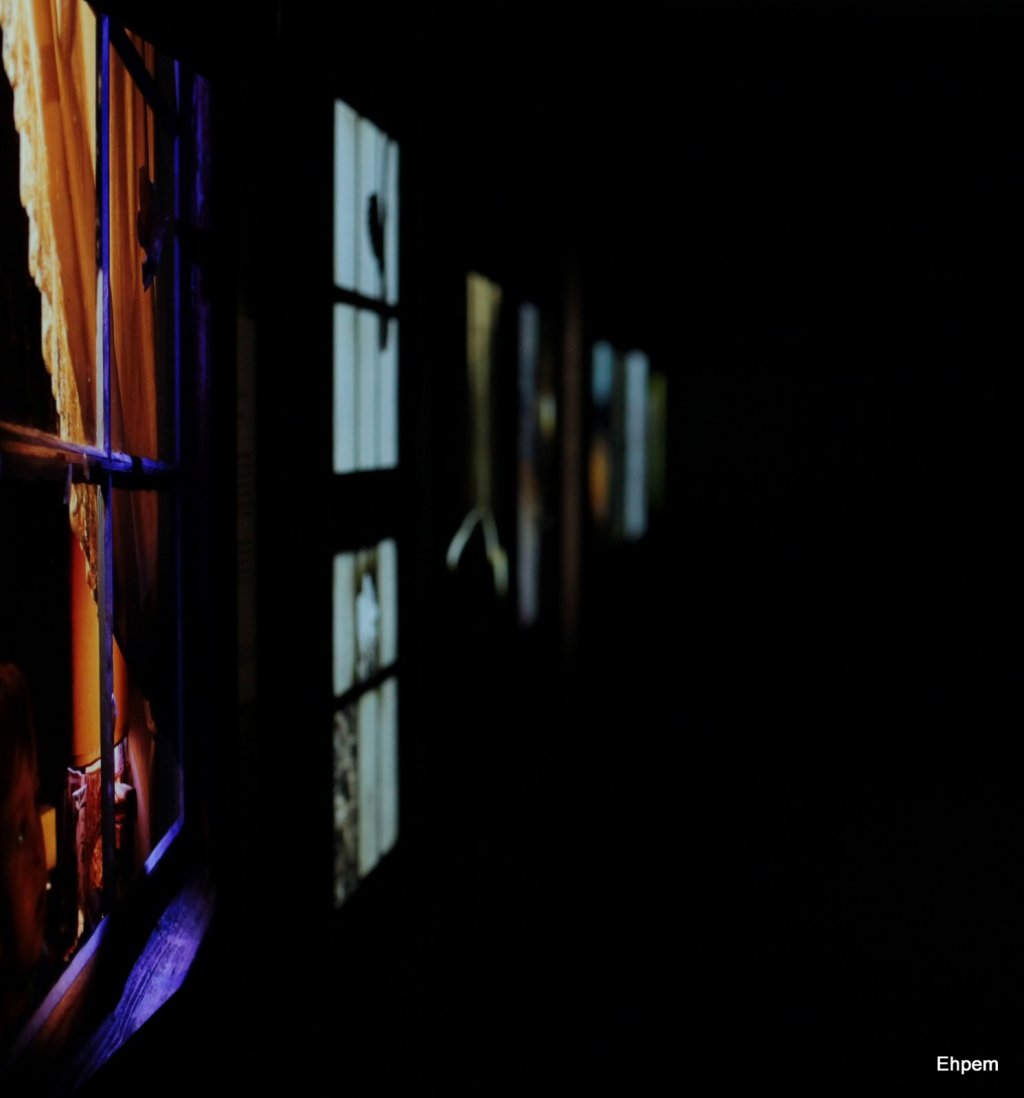
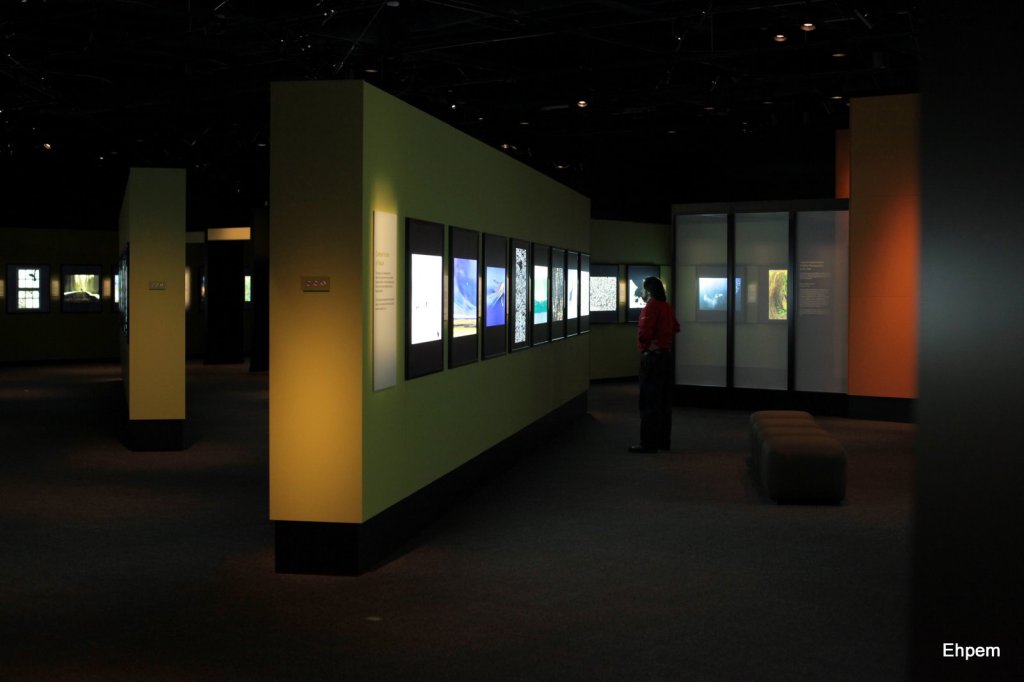
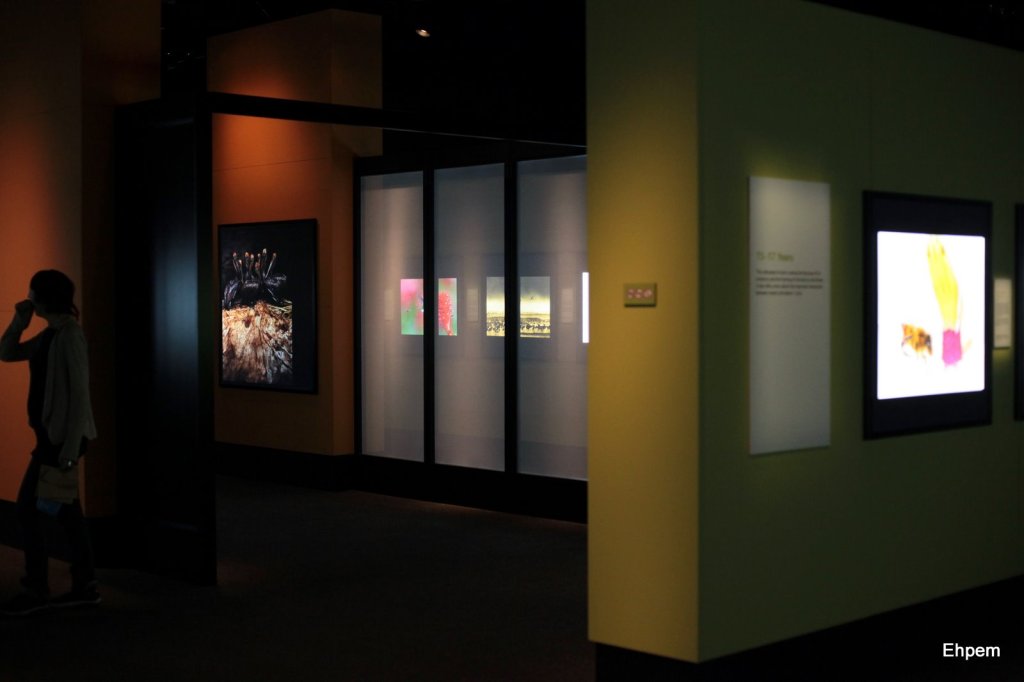
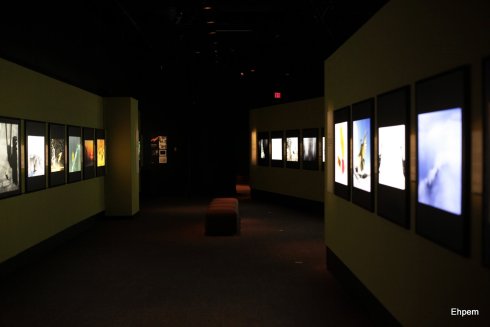
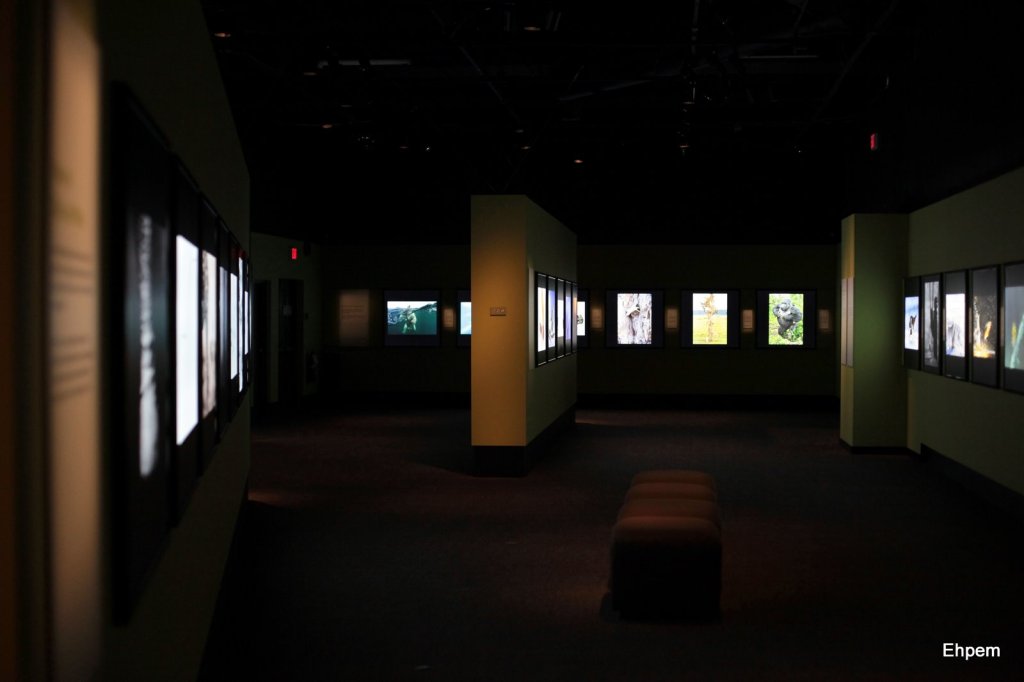
As usual, the RBCM gives us high quality design – you will see what I mean in the following pictures, especially if you compare them to this more typical example from the Bristol Museum and Art Gallery, which is so much lighter (pun intended) than the RBCM’s dark but colourful space. The exhibit space is roomy with the images quite well separated so that several people can view one picture at a time. It is going to take a lot of people for a viewer to feel crowded or hurried. The photographs are large and hung low enough that they are not too far away for kids. A touch lower would have been nice for the youngest kids and perhaps people in wheelchairs, though this is always a compromise as viewers come in many heights-above-ground. The labels are lit with low light, but are fairly readable and don’t get in the way of enjoying the photograph. The gallery is hard to photograph but who really cares since you are not allowed to anyway. You can see what I mean below where I have put two exposures of one corridor side by side. I am guessing that this the ideal situation for HDR, if tripods, not to mention cameras, were allowed.
I am not totally sure of the technology used to display the images – they are either transparencies back-lit with LED panels, or they are some form of static LED panel displaying the image like a frozen computer screen. In either case, they are very well displayed with terrific colour and good resolution. This kind of lighting is a great example of using technology in museums to keep pace with change in our everyday lives. All these photographs are created or manipulated, submitted and judged on computer screens; they are a product of illuminated surfaces held in rectangular frames so they should be displayed that way. The need for paper prints no longer exists in this day of digital photography, if one can afford to display them like this.
And ‘how are the photographs?’ you will be asking by now, impatiently. They are terrific. Every single photograph is beautiful, engaging, technically excellent. There is every kind of nature shot, from landscape to macro, whales to tiny bugs, aerial to underwater and even underwater taken from the air. Many shots are by professionals who make preparations to take a picture over many days based on a lifetime of learning the natural history of a species and finding the best ways to shoot them (gear, lenses, hides, photographer behaviour, exposure length, focal length, aperture, and so on). Some shots are by talented amateurs (kids included), most of whom have determination and knowledge to get a photograph equal to a professional; a few seem to have got lucky (which might apply to the professionals as well). But, none are casual shots, and it shows on every frame.
If you plan on going to see these photographs, wherever you can find them, I recommend you plan for a break in the middle. There are 108 photographs here. They each have relevant technical information about exposure, equipment and so on. There is a short story about each photo from the person that took it, and a bit of information about the subject of the photo which enhances learning about natural history and provides context for the photo. It took me two hours to get through, and the last 15 or 20 images I could no longer concentrate on. That is partly because I often wanted to read the technical detail as well as look at the image. There were so many times that I wondered how did they do that? And, usually the answer is on the label, or at least enough information was to find out more about a technique. I wish I could have taken a picture of some of the labels as a form of note taking; next time I will probably take a notebook so I can look up more about them afterwards.
This leads me to the question, is there a catalogue for the exhibit with all this information in it? There is mention of a book published as part of the contest and which likely serves the purpose of a catalogue. I avoid gift shops in museums but a phone call tells me that they do carry the book (Cdn$37.75 incl tax). Christmas shoppers take note! According to one part of the display, you can order prints of your favourites, probably through this website. And, the technical information for each photograph is available at the NHM web gallery, accompanied by unsatisfying low resolution versions of all the images, so in fact I don’t need to take a notebook when I go back (though navigating the on-line gallery is tedious). Another good reason to go in person, or to buy the book. In fact, from the looks of the URL’s on these links I have provided, I expect that they are short-term internet postings – the text is for 2010, but the URL makes no such distinction and likely will be replaced with the 2011 content when it is ready. Which would be yet another reason to get the book.
One of the more interesting parts of the accompanying text were comments from the judges. These only appear for the winners in the different categories. I would have liked to see more of this to help me learn what the professional photographers and naturalists think are important and successful aspects of each photograph. There are some comments in the on-line gallery, so they can eventually be found. Maybe they are in the book too.
One of the more interesting reads that I had researching this post is to do with the contest rules and submission guidelines, including rules for young (under 18) submitters. No HDR images, no removing or adding things to an image, though stitched panoramas are acceptable. One of the most beautiful pictures that really caught my attention was an in-camera double exposure of a flower that had me all excited until I discovered that my DSLR won’t do them (except in the old way, with low light and putting the lens cap on and off, or similar methods). Anyway, in many ways the rules around this contest probably contain some very good guidance for all photographers – such as keeping an unedited original and setting up the shot before hand such that you don’t have to go crazy in Photoshop.
I highly recommend this exhibit to all ‘viewers’ (that’s what WordPress calls you, so that is what you are, but you deserve better for having read this far). There is a great deal for every kind of visitor here, whether you photograph for a living, for other serious purpose, just for the heck of it or not at all; if you love nature, you will love this show. On my second visit there were quite a few children, and they too were enjoying the pictures and clearly learning a lot judging from the kind of questions they were asking. So, take the children in your lives to this show, they will leave with lasting impressions.

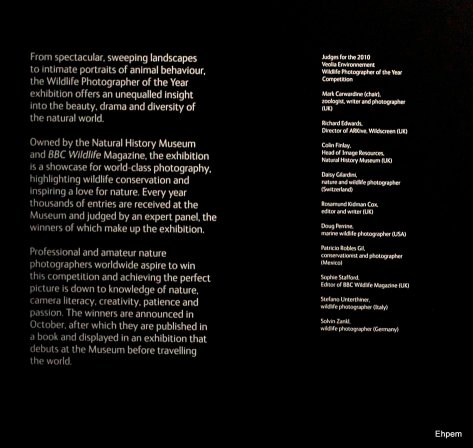
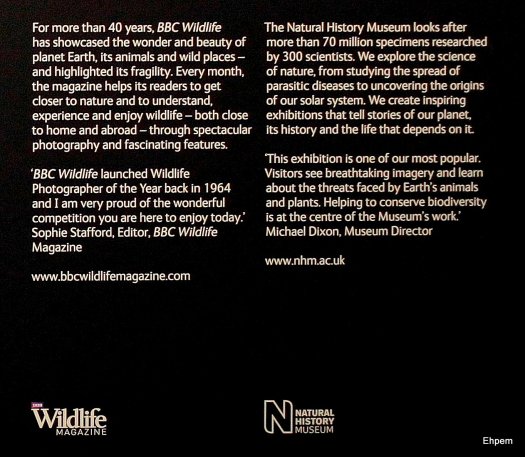






.
.
All shots taken with Canon EOS 5D MarkII, 50mm/f1.4 Canon lens, ISO 2000, f-stop ranged between 1.4 and 3.5 (mostly 2.5), AV priority and manual settings, with a variety of shutter speeds from 1/25th to 1/1000th depending on whether exposing for the architecture or the display panels or somewhere between.


 burnt embers
Pingback: Anniversary Links | burnt embers
Hey great post! I really like the way you captured the exhibit!
LikeLike
Thanks so much! I am glad you like it. Sounds like you got in to see it just in time as it is now closed. I have the catalogue, but really it pales by comparison to the display technology which was terrific.
LikeLike
Pingback: Six Months – Awards « burnt embers
I’m glad you enjoyed the exhibition – thanks for the glowing recommendation. One of the best perks of my job is being able to watch people experience this exhibition for the first time and it has certainly been popular.
David Alexander – Communications Manager – Royal BC Museum
LikeLike
Hi David – thanks so much for coming by and commenting. I am glad it is a popular exhibit – the more that people appreciate nature and good photography the better a place we will all live in (my biases showing through loud and clear!).
I have been meaning to add a comment about the book which goes with this exhibit since I mentioned it above, and have been given a copy for Christmas. This is as good a moment as any to do so.
The book that goes with the exhibit is “Wildlife Photographer of the Year, Portfolio 21” published by the Natural History Museum, London. It is a nicely designed and laid out medium format volume with quite large photos in most instances. It has pretty much identical content to the exhibit – all the same photographs (and no others), what appear to be identical captions to those in the exhibit and other similar or identical content. Therefore, it is a useful reminder of the exhibit, and if you intend to buy it then you need take no notes during the exhibit. If you can’t get to this exhibit, or one of its clones near to wherever you live, then the book would be a good substitute. However, I find the production quality of the images to be middle of the road and after seeing the wonderful glowing photos on display at the museum, the photographs in the book are a bit of a let down. So, my recommendation remains, go see the exhibit, and if you want a guide to what you have seen, get the book too but don’t expect it to have the same visual impact as the LED displayed images.
There, two birds with one stone. Thanks again David and congratulations to the exhibit design staff – they have added to these great photographs through a well conceived and sensitive display environment.
LikeLike
I really like your writing style, wonderful information, thankyou for putting up : D.
LikeLike
Hi Reed, welcome to my blog. Your comment was in the spam folder and I have brought it back to life, but have removed your website just in case. Thank you for your comment.
LikeLike
Happy 100th!!! It’s a pity I will never get a chance to see this, it looks amazing. When I worked for the George Eastman House, I had the pleasure of seeing quite a few traveling photo exhibits (in addition to the permanent exhibits) and it was always a thrill. Anyone who enjoys photography (much less those that have a passion for it) would love the chance to see displays like these.
Occasionally I have to photograph displays at the Museum (where I work now) and lighting is always a problem. I have very little control of the overhead lights but sometimes the maintenance people will try to accommodate me, but it’s never easy, especially if the subject is behind glass and can’t be removed. We do the best e can with what we got.
LikeLike
Hi oneowner (do I call you that now with your new comment name?) Thanks – 100 seemed to go by awfully fast. Does the second hundred go just as quickly? I see you celebrated number 200 recently with an awesome photograph.
Interesting that you have trouble with these kinds of shots too in your museum. I wonder if you could deal with the glass by using a polarizing light source and filter? Not sure how that works, have only seen it done for aboriginal rock paintings that had a thin layer of silica deposited over them – night photos that worked extremely well in that situation.
The RBCM travelling exhibition space is pretty versatile space as it is just a big empty hall with a load of tracking for lights and so on on up high with lots of connections in the floor too, as needed. They have put on some very diverse exhibits in this space so they may have more to work with than you do when it comes to illuminating an exhibit space for the purpose of photographing the exhibit. I am sure there are a lot of lights that could be added to the scene for taking a picture of the exhibit. It would be interesting to know how they go about it, especially with these LEDs. Maybe it is a multiple exposure / HDR kind of situation for this exhibit. I could see taking a good exposure of the exhibit and then one of the images and photoshoping the good images into the good exhibit picture. Pain in the behind, but probably not too technically challenging.
LikeLike
Happy 100! 🙂
It looks and sounds like an amazing exhibit. I’ll keep an eye out for it. Thanks!
LikeLike
Hi Robin – thank you :). When I last looked at that website, there were no exhibits listed for the USA. I wonder if there are copyright reasons of some kind, some alternate equivalent exhibit such as from National Geographic that is doing the rounds, or maybe the museums are just a bit slow off the mark.
LikeLike
Happy 100th post : )
LikeLike
Thanks Valentine – welcome to my blog. And come back anytime, you follow requests so beautifully 🙂
LikeLike
Hi ehpem. I love this post, you are amazing. Congratulations on your 100th post, and all of the accolades that you have received along the way. I have been following your posts, and have enjoyed each and every one of them. I do wonder, though, how you find the time — you ARE still working, right?
LikeLike
Hi there vf – thanks for coming by so often, and for commenting – I love comments. I AM still working, and balancing some other pseudowork (ie: not paid) things at the same time. I am sleeping less. Surfing the web a lot less, sweeping the floor at even wider intervals. And, I am enjoying it 🙂
LikeLike
Congratulations on your 100th post! Not sure how you manage to keep up the pace! Thanks for the heads-up on this exhibit, it sounds/looks fabulous and I hope to make a trip to Victoria to see it.
LikeLike
Thank you Laurie! I am not sure either. I don’t have a big bank of images, almost none since I started blogging right after I got the camera. Sometimes I feel like I have run out of pictures, but so far have not had to skip a day. It keeps me going out several times a week with the camera, which is one of the best parts. Other things give though – I don’t read nearly as much news on the internet anymore (what an unexpected bonus, it really feels good to be free of some of that blood and gore and suffering).
I hope you get over to see the exhibit – I maintain that its good for you small island dwellers to get onto a proper sized island from time to time 😉 and what better excuse?
LikeLike
All I want for Christmas is to go to this exhibit! GREAT post, my friend, well done! LOVE your framing and compositions on your shots, you really showcased the exhibit and the photographs so very well. Great write-up on it; you’ve done the museum proud there!
LikeLike
And Toad – you can! An hour’s drive and you will be there 🙂 Make lots of time, I really think you will want a break in the middle, or at the end, and to then go back in to see the rest, or revisit some highlights. Maybe have a coffee or lunch and then go back for more.
It can be hard to find things to praise the museum for these days – not because they don’t have great staff doing great work because they do, but the staff are working under very trying circumstances and the place has become diluted and less and less in focus over the past couple of decades. It pleases me to find something there that is so much my kind of thing, that can be squeezed into the BC context and their mandate too. There are several images from BC, one by a local photographer, but the subject matter is universal, and most people from BC take pictures and are surrounded by wildlife.
I hope you get your Christmas wish, and that you enjoy the exhibit as much as I did.
LikeLike
Thanks for this! It’s a fascinating insight into the structure of an exhibit. Interesting that it’s all backlit imagery. As you say, with photography now being digital, it makes sense to go this way, and there are technical reasons why the colour in digital images is stronger than that in prints—the colours are more saturated, for one thing—supporting this choice. (I wonder if some images would work better in print than onscreen? Ansel Adams comes to mind.)
As for catalogues, I’ve noticed that a lot of exhibitions produce books now, rather than the more traditional catalogues.
LikeLike
Hi skadhu – I really thought the museum was going to say no to my use of the images from inside the gallery so I am glad that I could show how it is set up and what it looks like. It would be really nice to have a couple of those panels in the house to display images, so long as they could be changed from time to time. Given how expensive the really small digital frames are, a big one won’t be coming into this household in the foreseeable future.
LikeLike
Lucky you–the exhibition looks inspirational to say the least. Thanks for sharing, Sally
LikeLike
Hi sally – there is a lot to be learned from these photographers and their pictures.
LikeLike