
Guudiingaay – Sea Urchin

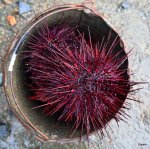
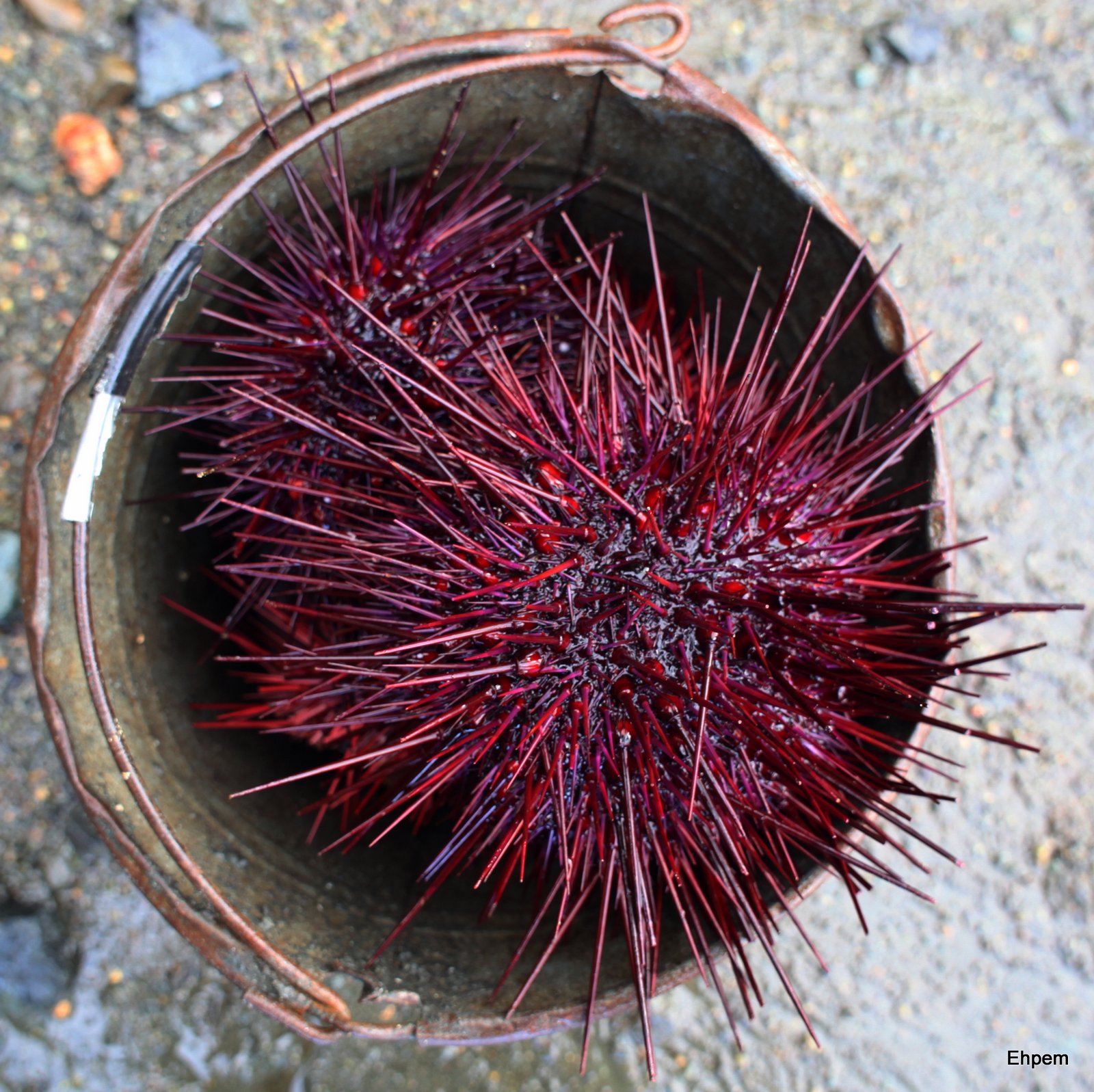
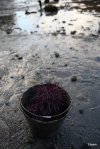
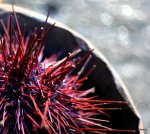
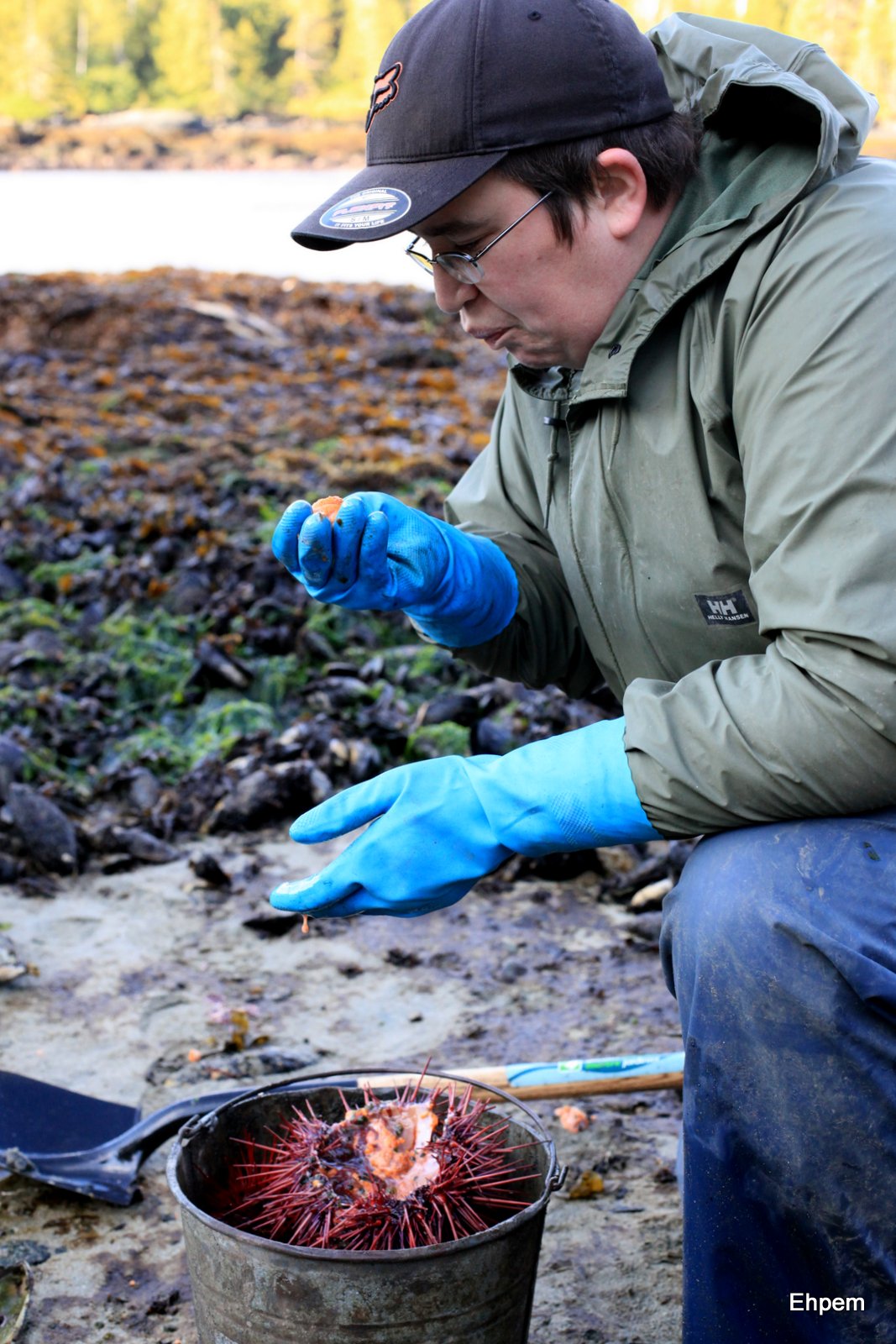
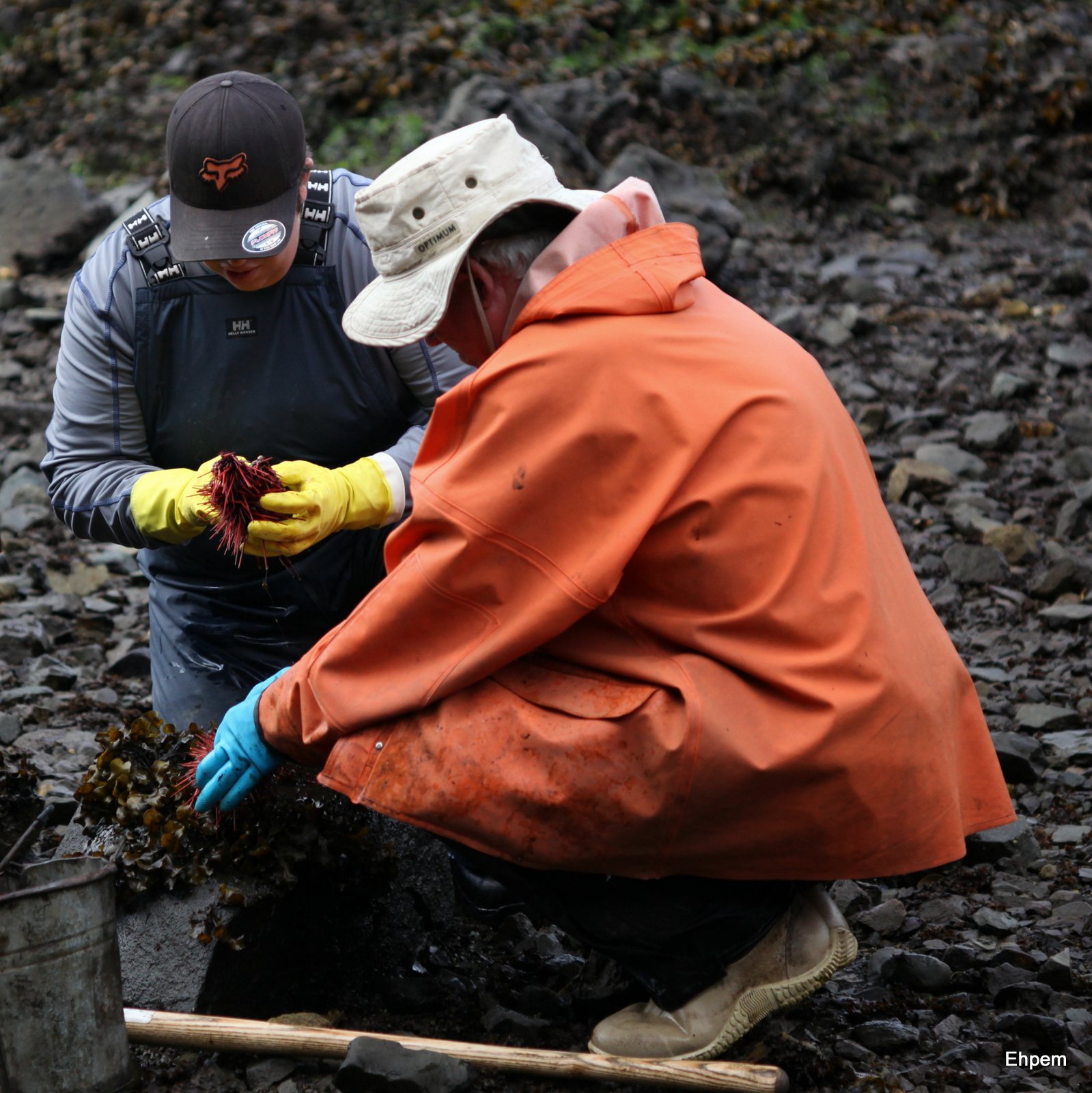
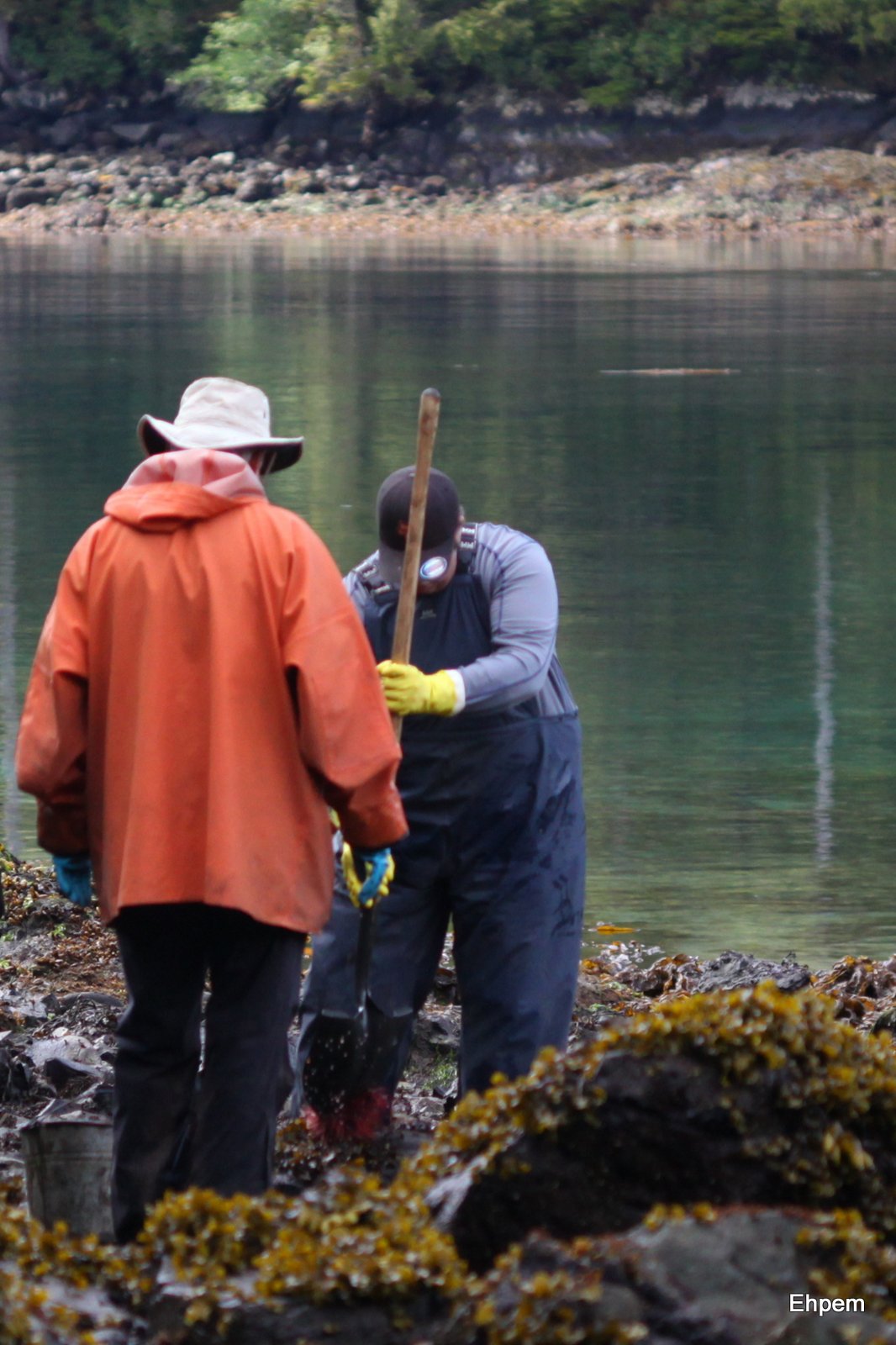
There is fishing, and there is fishing. Yesterday’s post was about fishing with a jig in deep water. Today’s is about fishing with a shovel by scooping Guudiingaay off the bottom just beyond boot height at lowest tide levels. Guudiingaay is the Haida word for sea urchin, and that is the term used on the project this year. For Goox and Dale especially these were a nice light morning snack, freshly caught and opened by Goox; shared with all that were willing. Some were eaten by the shore, others stored in a bucket by the screens, for higher tidal levels.
If you are going to try this, handle with great care. The barbs on sea urchin spines are perfectly designed to drive them ever deeper into your flesh, if one breaks off in your skin, which they are inclined to do. They fester and often require the application of a knife to remove them. We just kept our screening gloves on for the handling parts.
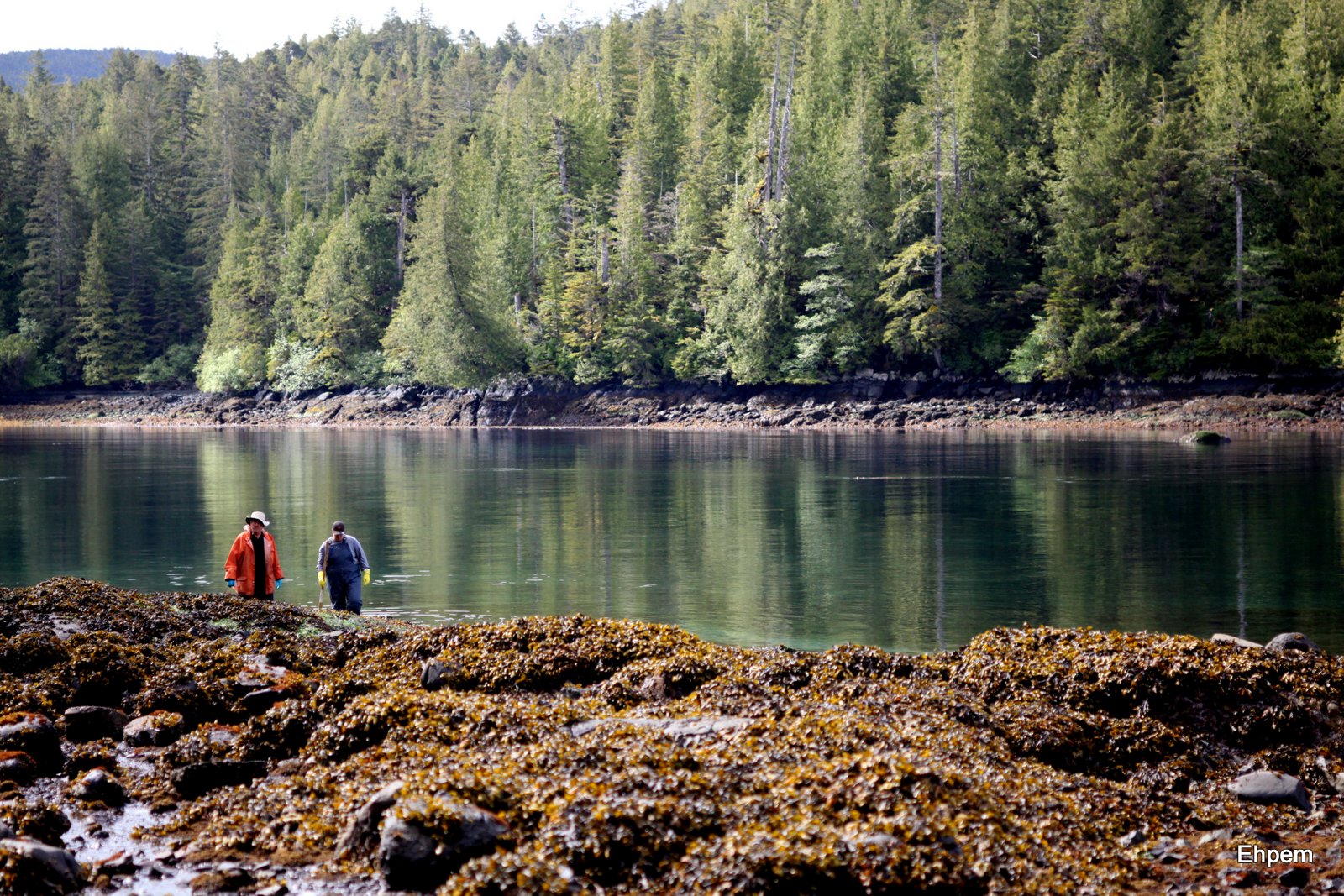
The gathering grounds
.
From Goox we learned that her elders teach the proper way to eat Guudiingaay is to slurp them into the mouth. Dale and I and others tried it his way, but of course for the camera it is sometimes better to just drop it in. Take Goox’s advice – it tastes different when slurped.
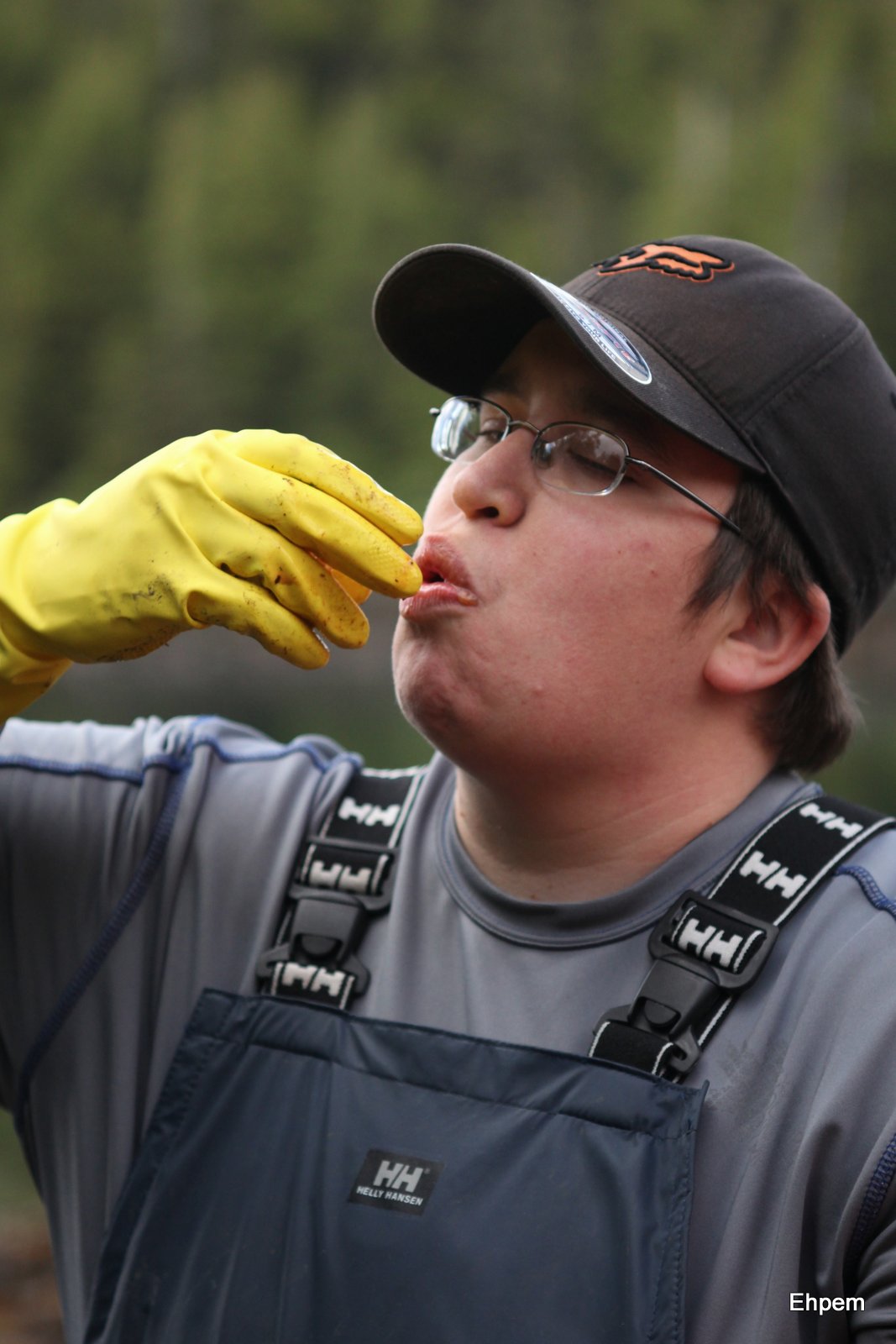
Goox demonstrating how to slurp Guudiingaay
.
I seriously doubt you will ever see another archaeological screening shot with a half dozen cold ones waiting in a bucket to be cracked open – cold Guudiingaay that is.
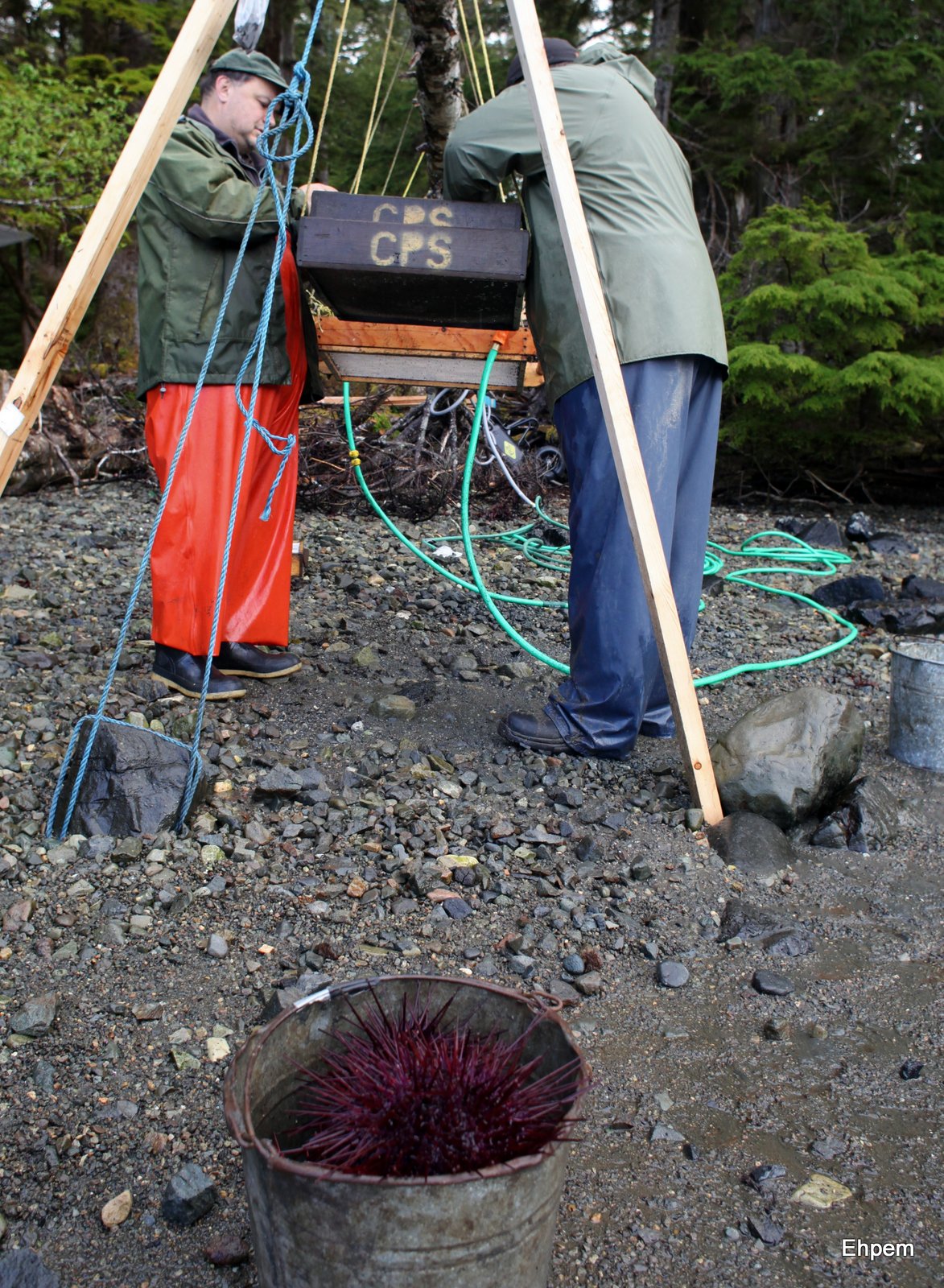
Snack all ready for a break at the screens
.
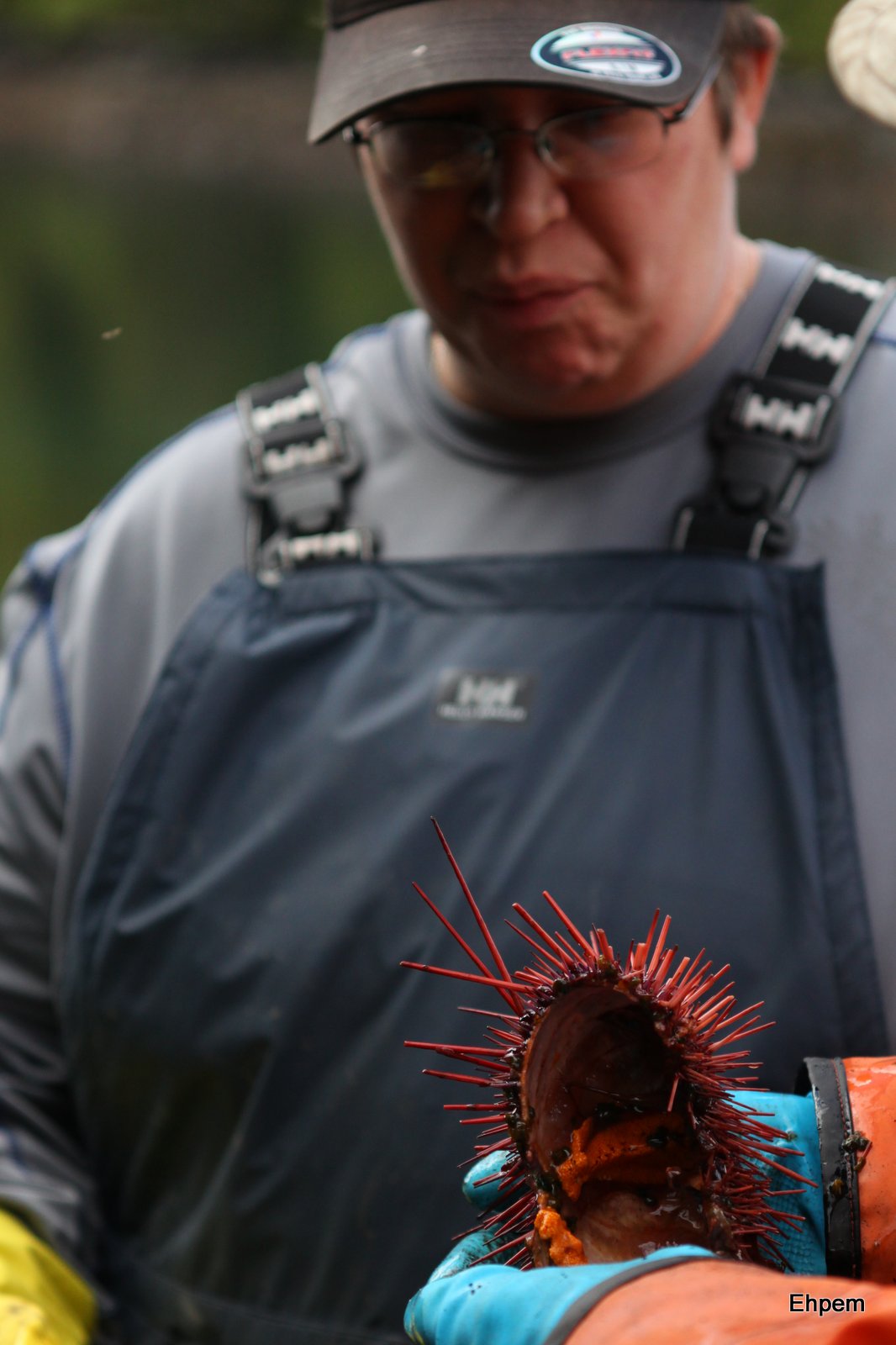
The edible part is not really roe, it’s the gonads which produce the milt or roe. I tried to put that factoid out of mind as I slurped them up.

Dale, not slurping
.
Urchins are a very serious problem in Haida Gwaii and other parts of this coast too. In quantity they are an indicator of ecological imbalance triggered by the extirpation of sea otters, which feed heavily on them and used to keep their numbers in check. The urchins feed on algae and create havoc with kelp beds which are like forests in the ocean, supporting huge numbers of organisms and animals that feed on them. Large kelp beds also serve to dampen wave action and reduce coastal erosion – they also result in different beach sediment types in their lee than when the kelp is gone. Without sea otters there are many places that are termed “kelp barrens” where the sea floor is covered with Guudiingaay, so close together they are nearly touching, and no kelp. Since urchins are an important fishery (for the Asian market almost exclusively – termed Uni in Japanese they are very highly valued) there are commercial pressures against the reintroduction of sea otter. Probably pointless since as their numbers grow on the Alaska panhandle and north west Vancouver Island they are very likely to move over to Haida Gwaii without human assistance.
To open the gallery below click on any image, use the arrows to navigate between images and escape to return to this page.
-
- 15 – Snack all ready for a break at the screens
-
- 14 – Don’t brush up against the bucket in shorts
-
- 13 – Bucket of Guudiingaay next to the screen

-

- 12 – Waiting at the screen
-
- 11 – In the bucket next to the screen

-
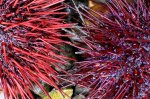
- 10 – Colour variants

-

- 9 – Oh so good

-

- 8 – Breakfast
-

- 7 – Getting the breakfast out

-
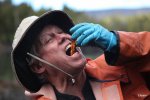
- 6 – Dale, not slurping
-

- 5 – Goox demonstrating how to slurp Guudiingaay
-

- 4 – Extracting the edible parts
-

- 3 – Breaking open the shell
-
- 2 – Slicing open the shell with the shovel
-
- 1 – The gathering grounds
.
This link catalogues my posts about Kilgii Gwaay.
I was accompanied on this trip by one of the Quimper Hittys, Tansy, who has been blogging about the trip from a doll’s view and you can find those posts here. Pertinent to this post, she has already blogged about her experiences of Guudiingaay here.
Canon 5Dii, Canon 50mm/f1.4 lens, Nikkor-N (pre ai) 24mm/f2.8 lens, SMC Takumar 100mm/f4 macro lens. The EXIF data in the gallery is not accurate as the f-stop cannot be registered for the adapted old 24mm and 100mm lenses.
.


 burnt embers
Sea Urchin is by far my favorite meat on the planet. I love the oceany flavor that blossoms in your mouth as you eat it. Your photos are lovely, especially the first one. I love the capture and color.
LikeLike
Ryan – what a discerning and cosmopolitan palate you have! You would have loved it here, all the wonderful seafood.
LikeLike
Mmmmm! I bet. Between the food and the experience, I’m sure I would have loved it.
LikeLike
The Guudiingaay are huge compared to the sea urchins here in Melbourne. Did you enjoy eating them?
LikeLike
We have several species around here and these are by far the largest. I did enjoy them, but I prefer them later in the day. I think a croissant and home made jam is better at 8am, or 6 or when ever this was.
LikeLike
A fascinating blog post & wonderful pictures to tell the story. Not sure I’d try it though, especially raw. I can never get my self to try Sushi either. Maybe one day.
LikeLike
Sometime it is necessary to turn off the imagination when eating fresh seafood like this.
Many times I have been set up by First Nation’s colleagues to eat something that they think I am going to cringe at. Fortunately, I was raised by a marine biologist and every summer when I was pretty young we went to a fantastic barbecue near the marine station where all kinds of unusual seafood was eaten as if it were perfectly normal to do so. So, I was well primed and probably a pretty disappointing target for my crew. And, very occasionally I was able to turn the tables by eating something that grossed out crew members – “oh no, we don’t eat that”. That was fun 🙂
LikeLike
Interesting. Those are very large sea urchins.
Your bucket of “cold ones” look rather unfriendly! 🙂 I think I would try it, though…
LikeLike
Unfriendly indeed. But it is worth trying them. They are good for you, and a pretty unique taste. These ones in particular were good.
LikeLike
How intersting but I’m not at all sure I fancy trying it 😉
LikeLike
It is really quite good, though I much prefer it around supper time. Much better than raw oyster, for instance.
LikeLike
I don’t like that either 😉
LikeLike
Well, how about limpets, scooped out of the shell with the back of your thumb nail, and popped straight in the mouth?
One of my friends when I was a kid used to do it, probably to gross me out. And it did, but have tried it since and they are not so bad. Small, which is in the limpet’s favour. But not as good as Guudiingaay.
LikeLike