Iris Bug
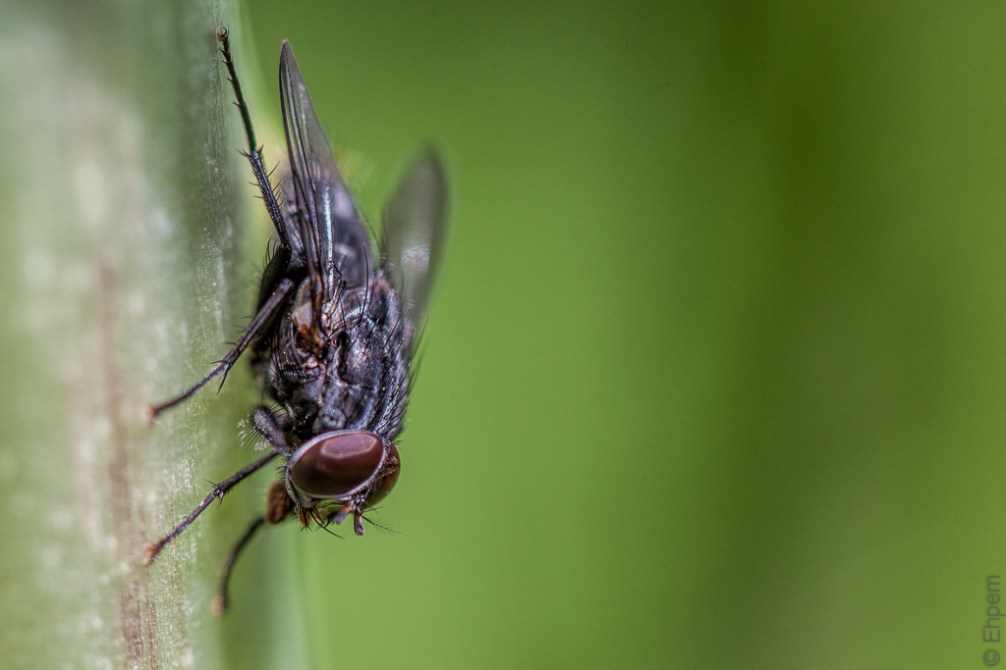
A different kind of iris shot from the garden – this is the start of a series showing the invertebrate users of the irises. There are many but it’s bloody difficult to get good pictures of them. Thus it will be a short series.
And since it is father’s day, and because my father is an invertebrate biologist this post is for him (good thing I added biologist right there, eh?). I know, I know, giving one’s dad a hairy fly for father’s day is not suggested in any etiquette manual, but I don’t think he will mind too much. He can complain below if he feels like it. Since I hold the password-protected power of deletion he had better keep it clean!
Happy Father’s Day to all you dads out there.
.
.
Canon EOS 5D MkII, Canon EF 100mm/f2.8 macro lens, ISO400, f-3.5, 1/500th second, hand-held. Original shot at 5616 x 3744 pixels, cropped to 4185 x 2790. Processed with Lightroom 4 and Topaz Clarity.
.
.


 burnt embers
Great image – and wow, I’m impressed with your steady hand! Loved the text too. I appreciate the discussion re: handheld shots, focusing for macros, eyeglasses etc. – like you, I wear glasses that are different at each level of the lens and focus can be a challenge. Autofocus is awful on handheld closeups (I can hear my battery draining by the second it seems), and tripod is very awkward in many situations (and useless for moving things like bees etc). The idea of using continuous burst for these kinds of images hadn’t occurred to me – it makes sense as it’s so hard to maintain a steady focal distance. I will definitely try this.
LikeLike
Hi Laurie. Thanks for the compliment!
The continuous burst method only recently occurred to me, and arose from a conversation on the bus with a guy that works in the vintage camera equipment store in town. It really does result in a lot of discarded images and no guarantees for results among any of the shots. Fast shutter speeds help too, when they can be arranged, as quite a lot of the fuzziness seems to come from camera shake, not just from swaying in and out of focus. I would like to also try a monopod with a head on it, but mine is just a stick with a bolt in the top. I suspect that would help a lot, though it too would be slow. Fortunately a lot of the insects seem to have a pattern, and they come back, so with a bit of set up and waiting it is possible to get a shot.
LikeLike
I had been thinking of buying a monopod, as it seems less bulky than a tripod – but I’ve changed my mind. Reason being, I’m using live view now for my tripod shots (and for closeups) – easier to see when focus is achieved. The monopod wouldn’t work for me when I’m using live view (not enough hands to work monopod, camera & remote shutter release!).
LikeLike
A monopod is more a replacement for hand holding than for a tripod in my mind. It does not do what a tripod does – more like a convenient solid object to brace a hand held shot against. Thus no remote release (I find if I have a 2 second delay set, for slow or stationary subjects mind you, that I can steady the camera very effectively after pressing the shutter release), and no focussing in a magnified live view either – too tricky. I think they are of limited utility for macro, less utility than image stabilisation in the lenses, if only I could afford that.
LikeLike
Thanks for this, i’ts helpful. I have IS in my lens now, and it’s helpful for sure – though a faster lens would be even better! But don’t think that’s in the cards at this point.
LikeLike
Excellent macro. My son sent me a card of a pair of frumpy old women for Father’s Day. I wasn’t quite sure what to make of that!
LikeLike
Were it my son, I would be hoping he just liked the picture and was not thinking messages:)
LikeLike
This is an amazing macro photo Ehpem!
LikeLike
Thanks David! The fly was at exactly the right angle so I could line up a lot of it in a the plane of focus without scaring it away
LikeLike
I can’t imagine any invertebrate biologist who wouldn’t be happy with this. It’s a fantastic macro.
LikeLike
Thanks for tbe greeting Ehpem and its a fine photo- every hair in place and all set to buzz madly about the room driving us nuts
LikeLike
Well, that seems to be a suitable gift from father to son, the driving dads nuts part. Have a great day!
LikeLike
Thanks a lot Ken!
I am finding that the solution to hand held macros is turning on the motor drive and taking multiples when it looks in focus. At least that is the case for a slightly decrepit middle aged guy like me that has insufficient core and arm strength to be still for very long, if at all, and 3-prescription glasses interfering with fine focussing.
Most of the shots I have been taking in the Irises are not compatible with tripods – most things are on the move or hidden at awkward angles. And setting the lens to highest magnification, turning off autofocus and moving the camera is the best solution to getting the detail I am looking for. This morning I was trying my old Canon FD lens that I normally use on the bellows unit – it is set up with extension rings and the lens is reversed too. It gives me greater than 1:1 magnification, so I will probably use that combination a bit more. Though I need to get closer with it and among the iris blossoms that is often too close and I start bumping other parts of the flowers, and scaring the bugs!
LikeLike
I usually turn off autofocus for macro shots. The Nikon just keeps hunting for best focus and it’s easier and faster to do it myself. I also have set the diopter adjustment on the Nikon to my prescription so I never wear eyeglasses when shooting. I’ve done the same for the studio camera at the Museum but since I’m the only one that uses it, no one seems to mind.
LikeLike
Hi Ken. I have an astigmatism so have to wear glasses regardless of what I am doing. However, I have set the diopter to adjust for my glasses, the problem is that the close up prescription is a think sliver at the bottom of the lens, then another thinnish for computer distance, then a fatter one at the top for long distance. Looking through the wrong part of my glasses, especially when the camera is set up on a tripod near the ground or similar is a pain. And focussing on screen, for video in particular, is next to impossible.
LikeLike