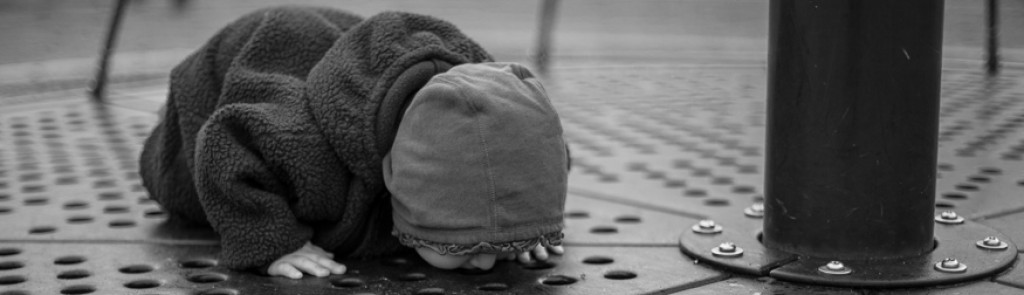
Green Album

More products from a recently acquired photo scanner – this time I scanned a childhood photo album. The album dates to a year-long trip we made to Europe; to England and Scotland when I was seven and then to the south of France where I turned eight. The album has photos from that trip, is not in the greatest of shape with some of the photos gone, probably forever, some of them were loose, and so on. I put new corners (the black ones) on some photos, using the package of corners that was in the other other album. Now that was a nostalgic event, the taste of that glue bringing back lots of memories of photo corners, stamps and envelopes of old. Probably it was an animal based glue, ground up horse hooves or something similar.
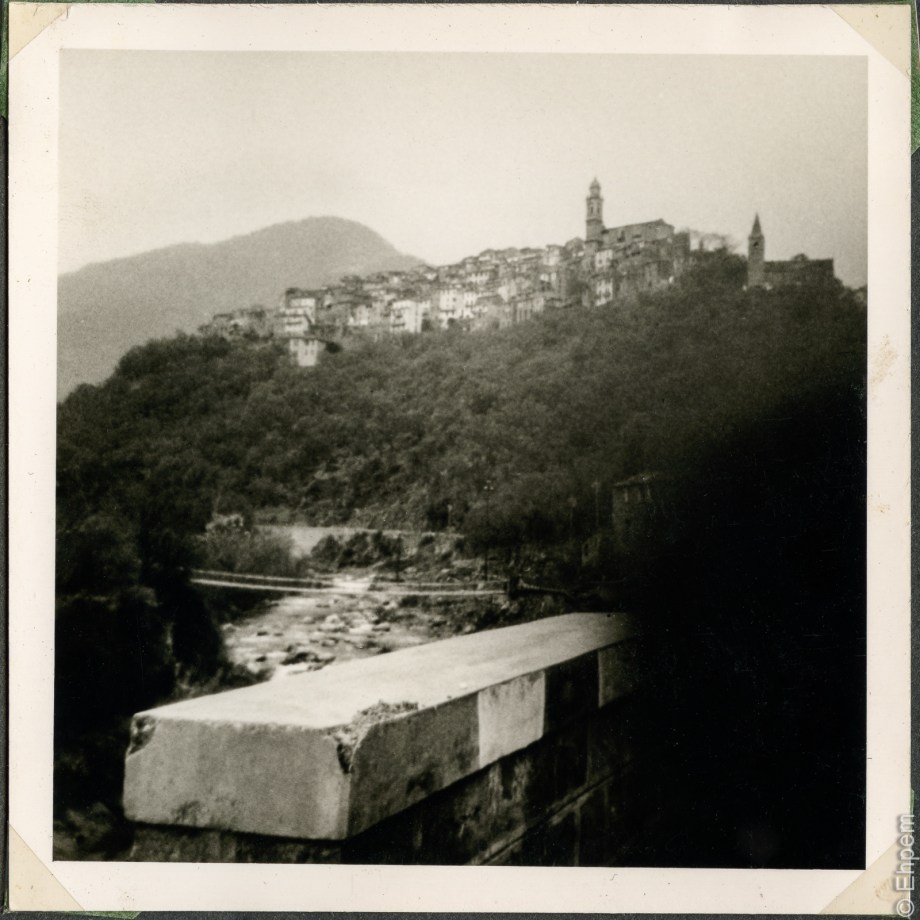
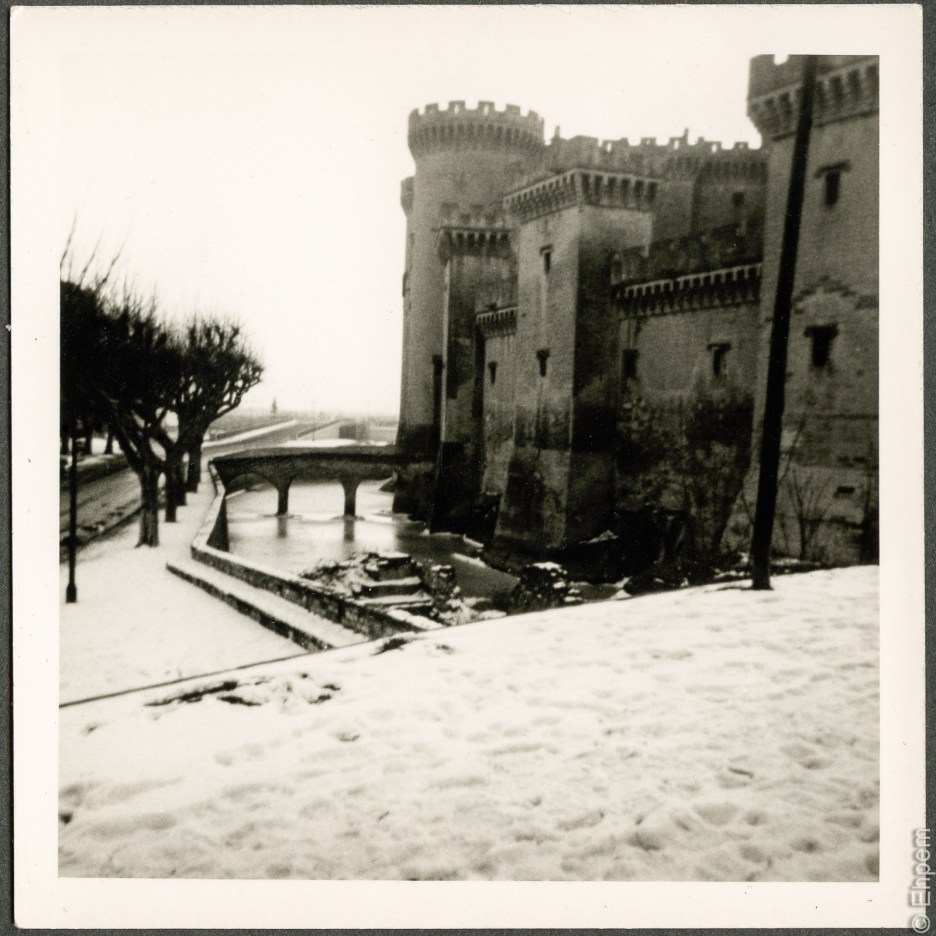
I remember that I took some of those photographs like the ones of the Pont du Gard Roman aqueduct in Southern France. But I find it hard to believe that my little Brownie camera, and my 7-year-old eye, could have captured the photo above, or the one second from the bottom. My mother took the terrific photo that is attached inside the back cover of me and my siblings, also on this trip, but the format is different – she had a fold out camera with a wonderful lens, I think from the 30s. So, I am inclined to say these shots are taken with my Brownie, and I am supposing that I took them. My parents don’t remember otherwise, so now that it is written it can become fact. The last photos “in” the album (the ones without corners) were taken by me, but were loose in the album, and as you can see, they were not cut. I think they are part of the same batch as the one above, or processed at the same time. I believe the processing was done in Britain and maybe also France. The photo album was purchased at Boots and I don’t think there were Boots stores in Edmonton, where we lived at that time.
To see the entire album in a book form, click on this link. You will find tools at that site for enlarging the view and I urge you to look as there are lots of photos. Even though most of them are lousy as a group the album becomes an interesting object. These can be classified as my first photographs since the camera was a present that I got for this trip. Whether I shot a roll at home before departure, I don’t know and can find no trace of it. I rather suspect I got the camera once we got off the ship in England.
There are three sets of photos in the album, and a lot of blank pages. The first two sets of photos look like they were processed at the same time – pale grey, low contrast images with scarcely a black to be seen and are at the front of the album. They are distinguished from each other by two shapes – one square, one not quite, which I wonder whether it might be the result of cropping the negative to make it fit a paper size, or if they are the product of two cameras, or types of film. I don’t have any of the negatives, so these questions are unlikely to be answered.
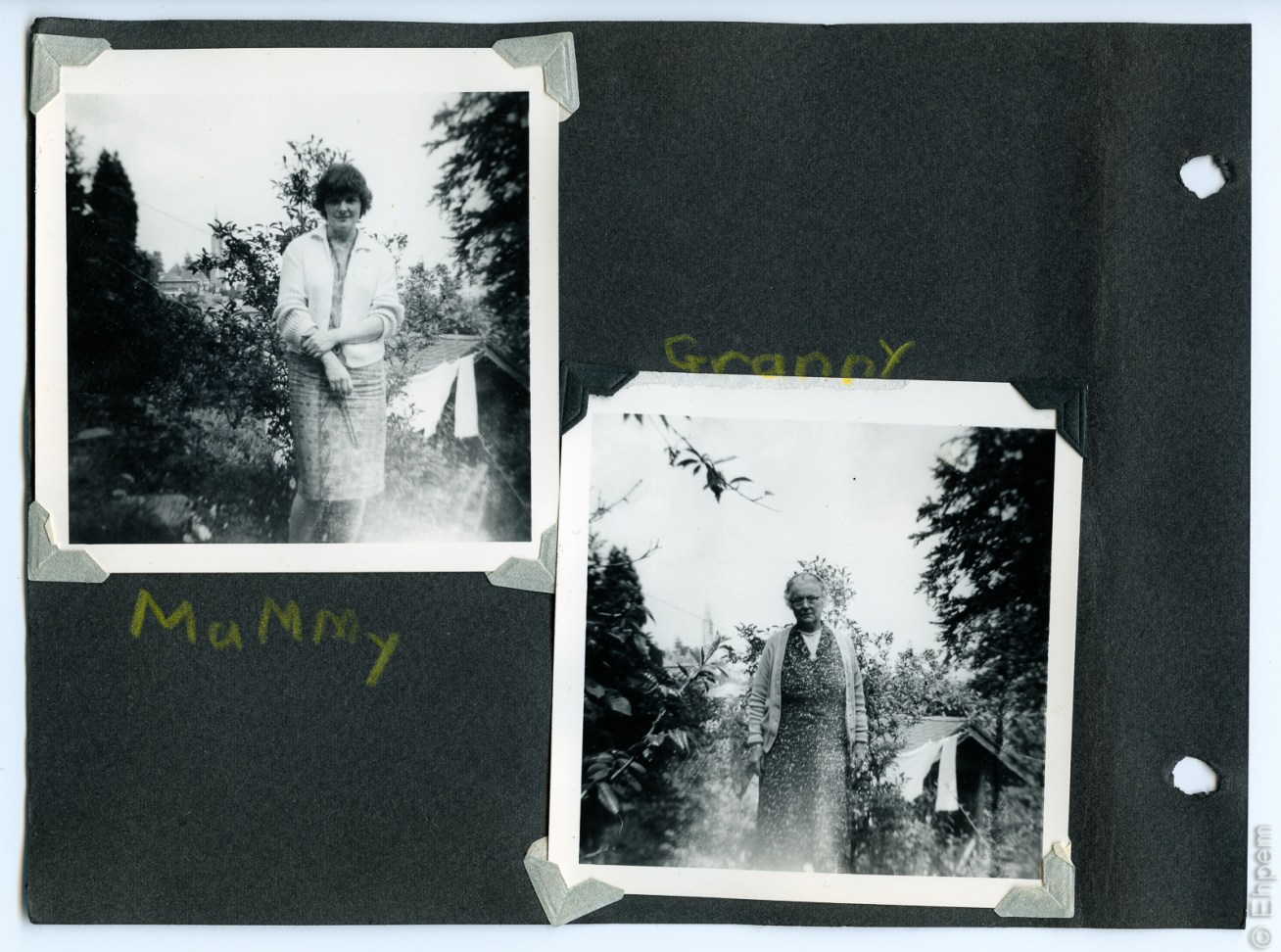
The album page below is an example of a square one from that series. Mostly this group is of my grandmother and family in England. I know for a fact I took those photos (except a few posed shots of me, sometimes in pairs with a posed shot of someone else taken by me in same location). The second set of images are a different kind of paper and processing, higher in contrast, richer in feel, with serious blacks and a yellow tone, like the shot above.

.
.
.
In the album, which I give a link for above, the images are scanned and not altered, though I adjusted the white balance a touch for the yellower prints which did not scan as they look to my eye. The single images presented here are crops from the scans in the album – on these versions I cleaned up the dust and hairs. Much of the dirt on them is on the original print from which I conclude the commercial photo labs for snaps shots must have been pretty casual and dusty places in those days. The top picture is a good example: look in the album (page 27) and you will see a huge black hair in the middle of the field of view which was quite the pain to clean up. In the album link, click on an image to get a larger view. Even more so if you select the icon for single page viewing and then click on the image.
.
Scans made on Epson V700 with Silverfast SE software: 48->24bit colour, 600dpi. Album put together in Lightroom 4 using the Book module to produce a pdf which was uploaded to the ISSUU website.
.


 burnt embers
Its really cool to see these, Ehpem! (Somewhere I have a set of my first photographs taken at around the same age but I can’t seem to find them.)
Some very beautiful work here. : )
LikeLike
The link is great – I like the format!
LikeLike
Thanks Karen. It was a bit of a revelation to work on this album, and have very close look at some of these shots. It also resulted in some amusing conversations with my parents.
LikeLike
I was very pleased with how easily it all came together – the LR4 Book module is very good. Any edits in photos shows up in the book, even after you have inserted an image into the draft. So you don’t have to take one version out and put the new one in, that kind of thing. And it produces a pdf with a lot of control too. ISSUU converted the pdf into this format of book without any hassle at all.
LikeLike
Lovely. Sometimes “old” technology produces the most stunning results. (One of these days when I have time I’m going to experiment with pinhole cameras, I swear…)
LikeLike
Good plan. I think the brownie is only barely one step up from a pinhole camera in sophistication.
LikeLike
Oh wow, I just love these old photographs Ehpem!
LikeLike
Thanks Toad – it was a lot of fun to do this little project. It had two unexpected bonuses – one was that I looked much more closely at those photos than I have ever done before and the other was that I have had some nice long chats with my parents about the trip, learning a bunch of stuff I had forgotten about the times we had.
LikeLike
Love at first sight on this image!
LikeLike
That is kind of how I felt when I discovered it lurking in the album, waiting for me to finally appreciate it, 50 years later.
LikeLike
Wonderful!
LikeLike
Wow. They’re great!
LikeLike
Hi Nandini – thanks so much! It was fun to get this little project together, and surprising to find some nice pictures to work with.
LikeLike
This is certainly a treasure that should be preserved and passed on. It’s the reason why photography was invented in the first place.
We have a similar Epson scanner at the Museum and I used one also at the George Eastman House on a project for them. They’re a great tool for this sort of thing.
LikeLike
Hi Ken. I think some of its value comes from it being a child’s view, which is less common, or at least which we don’t recognise many years later. And the scanner works really well for this kind of thing. It is a bit more of a pain for negatives and slides, though it does a great job on them, it is a bit fiddly.
I have one other album from that age, and some loose photos and a bunch of very badly treated 120 sized negatives which I plan to use as scanning experiments to learn how to do things better. I expect more images will appear on these pages.
LikeLike
Utterly fascinating. Our parents were quite good at documenting images, but I wonder how good we will be at doing the same with our digital images for the benefit of future generations. The unknown Viaduct/Aqueduct looks remarkably like one at Chaumont in central France but I suspect there are a lot that look rather similar.
LikeLike
Hi Andy. My digital images will be a mystery to my kids, at least the ones that are not around here. And too many of them for them to really care about them. Probably they will be toasted, or left to languish until the storage media is obsolete. Which so far has not happened with paper photo albums!
The Chaumont Viaduct does look extremely similar, but at its lower end has a second level http://bit.ly/13GCNFR. What looks identical is the shape of the arches, and the little platforms that stick out from the railings along the upper edge which suggest to me that these must be train bridges, confirmed by a search for the Chaumont one.
LikeLike
I was trying to remember if there were two levels to the Chaumont one. I think you are right. It must be about 10 years since we actually visited it. We used to stop in the town at a hotel on our drives down to Switzerland.
LikeLike
These are great! I haven’t had time to look closely, but the first pass was interesting. You had a keen photographic eye even as a child, didn’t you?
LikeLike
I am not going to claim that. I think I lucked out on a few shots, but mostly they are exactly what one would expect from a kid.
LikeLike
I recognize St. Rule’s Tower at St Andrews, second to last page in the album; St. Andrews Cathedral is the ruined cathedral. I wonder if the last photo was taken at Aberdeen? It doesn’t look like St. Andrews.
LikeLike
Hi Richard. It looks like it has a guard box at a gate, I expect it is the entrance to a palace or something.
LikeLike