Fliptych
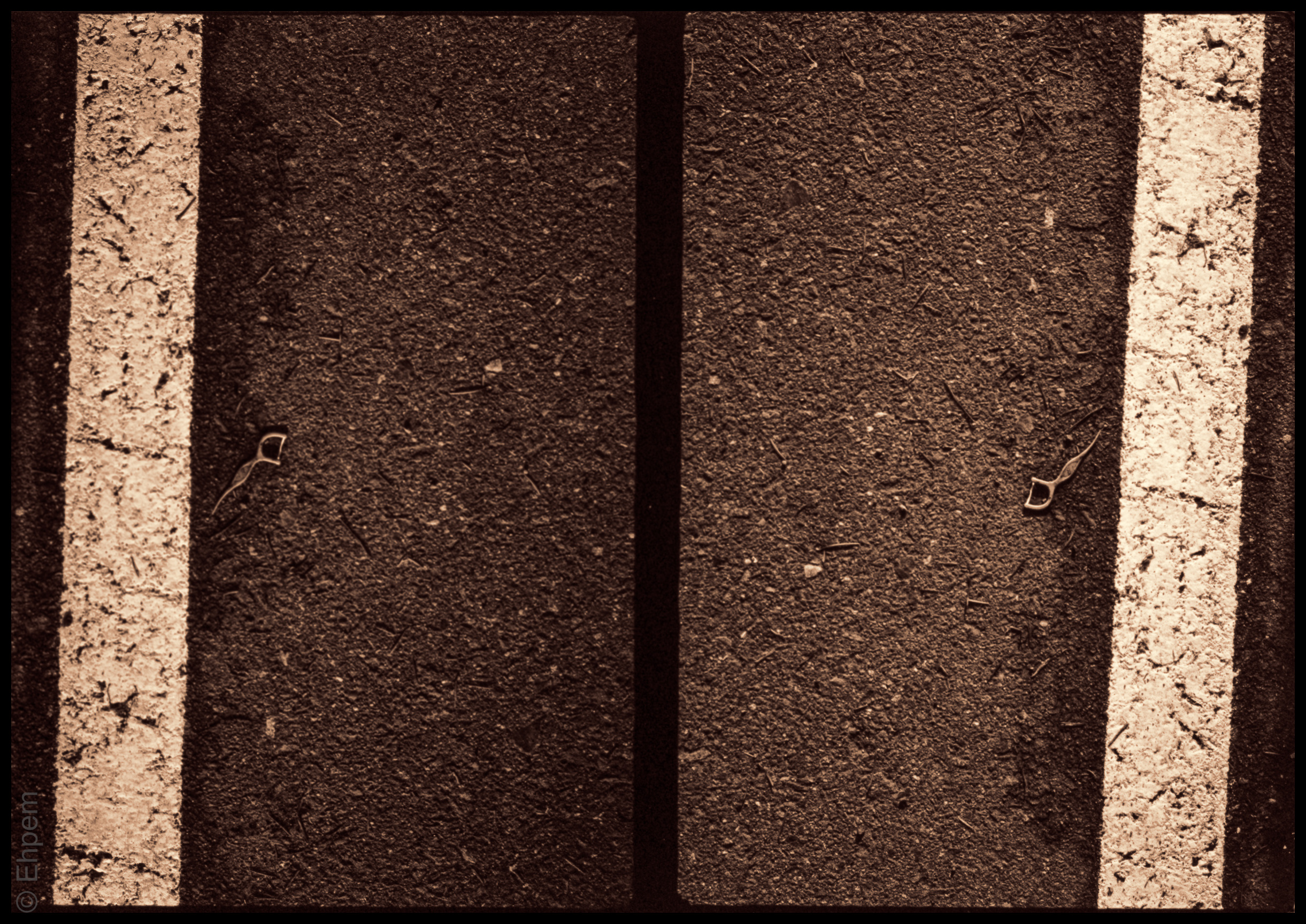
I have received back my third roll of film from the Olympus Pen, and it leads me to the new term ‘fliptych’. I just made this word up, though I see it exists with another meaning. My use is for the half-frame images that proliferate on this roll of film. The ones where I have taken a picture with the camera pointing in one direction, and then flipped the camera 180 degrees for the next picture, and then back again sometimes.
So, this is another in my series of half-frame photos, and indeed it is also a diptych. But I prefer the term fliptych since it is more descriptive of my process, and can include triptych and other formats too. Get used to the word as I plan on using it, and I have lots to share, and continue to experiment with the form.
This is one of my favourites for its simplicity. I like the toning too. Click on the picture for a bigger version.
This shot was taken while getting into the car after the walk in Thetis Lake park, so is really part of that series too. Once again this is single digital image scanned from adjacent frames on the negative.
.
Olympus Pen, half-frame camera, Efke KB50, ISO50, 1/50th, ~f3.5.
.


 burnt embers
Pingback: Floss Fliptych | burnt embers
Pingback: Horizon(tal) in Negative | burnt embers
Pingback: Easy Fliptych | burnt embers
Pingback: Horizon(tal) Fliptych II | burnt embers
Pingback: Horizon(tal) Fliptych | burnt embers
This is a very nice idea and really a natural for 35mm half frame. I wonder if anyone else has used this technique?
My first visit to your site and will return to see what you are up to!
LikeLike
Hi John – welcome to these pages and thanks for commenting. I can’t believe I have two people checking in from Webster, WLIWL!
This idea of flipping the camera must have been done before; it is as you say, a natural extension of the diptych idea. I have not looked too hard for other examples, but the looking I have done at half-frame images on-line have not shown any. There seem to be quite a few panoramas and diptyches, though most of the diptyches don’t really show much imagination (they seem like accidents noticed while scanning).
LikeLike
I like it! Nice work with the Pen. I look forward to seeing more from this roll.
LikeLike
Hi Gary. Thanks for dropping by and commenting. I am so pleased to have found your blog with so many familiar scenes from Victoria, viewed with an excellent eye and caught on film. Also, your reviews of favourite old film cameras are very well written and interesting.
LikeLike
Fantastic texture!
LikeLike
Thanks Lisa. That, and the dental flossing thingy, were what caught my eye. I have a dentist appointment today – I wonder if there was a subconscious choice of subject matter today.
LikeLike
This is a really neat and creative technique. Could be a project!
LikeLike
Thanks Ken. It could be indeed!
I am trying to keep it ‘natural’ without a lot of processing of the scanned negatives and so on, but am finding that some of my LR plugins really work well with some of these images, so that resolve may be going out the window faster than it came in.
LikeLike
The old (film) adage of “getting in right in the camera” is out the window. Nobody teaches that any more. To do so is to deny the full potential of digital imaging. Cameras and software work together to help (you) produce the best image possible. I believe this to be true and I try to take advantage of it. I should write a post about it!
LikeLike
Hi Ken. I am of the same mind. But the idea of these in-camera “multityches” is about getting the framing and associations right in camera to make a single image, so it would be nice to get other aspects right in camera too. However, I have been finding that some of the Topaz treatments on black and white scans to be quite luscious and some of those are bound to find their way onto these pages. I just hope they don’t make the regular films scans seem a bit pale by comparison.
LikeLike