
Barrier Fliptych
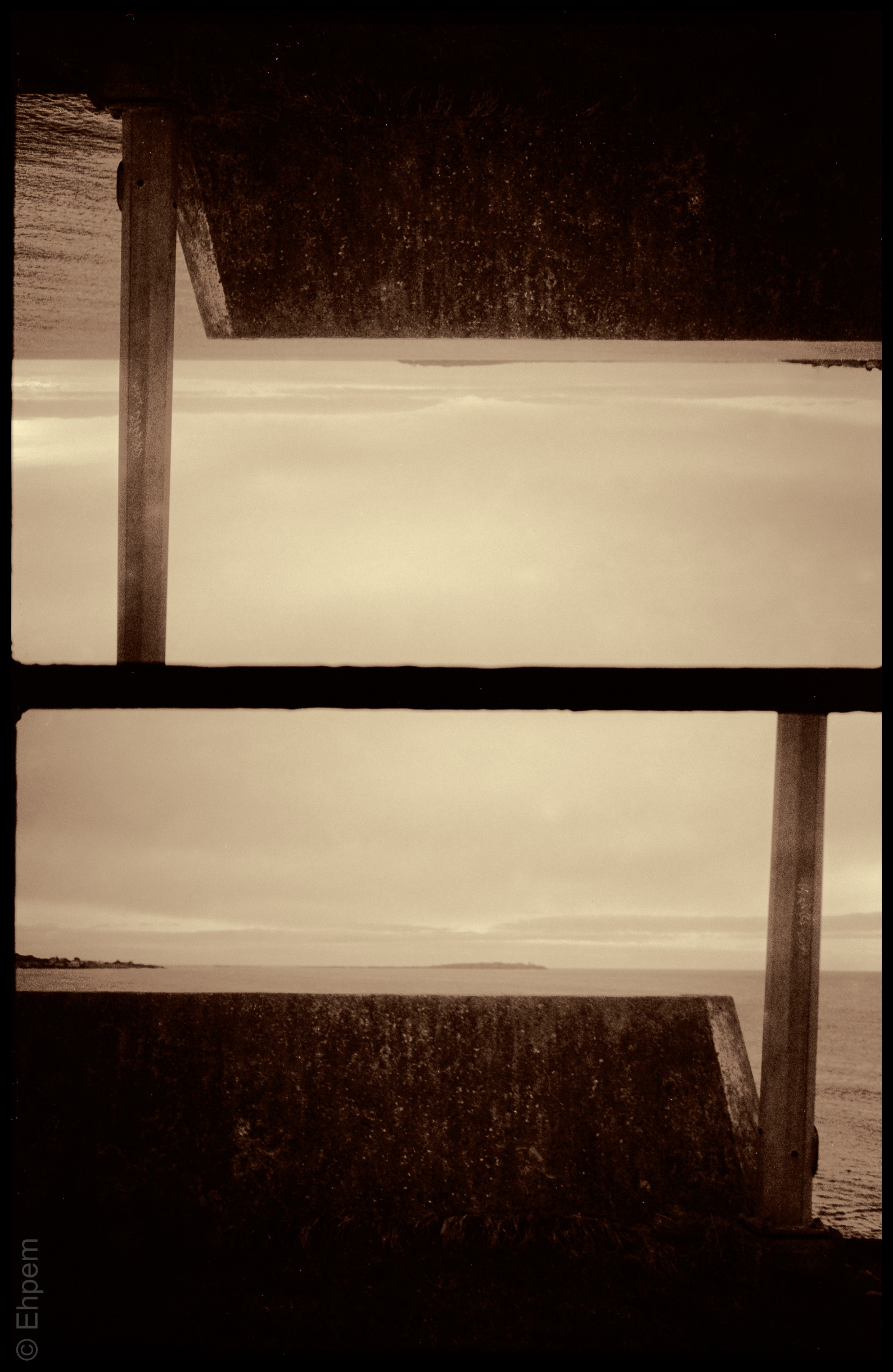
Another fliptych, as I have come to call them, this one of a barrier on Clover Point, with lamp standard and Trial Island in the distance. None of these details are immediately obvious, which is the way I like it. I also like the interplay between the light standard verticals and the medial horizontal line. It is almost like an architectural detail – windows or something.
These are made by taking a picture with the camera pointing in one direction, and then flipping the camera 180 degrees for the next picture, and then back again sometimes. In this case the half-frame camera takes portrait shots when held horizontal in the usual camera orientation, so these shots are taken by first rotating the camera 90 degrees in one direction and then back 180 degrees in the other. On the landscape shots I sometimes start upside down other times right side up which influences what ends up in the middle of the shot (imagine putting the bottom section of this shot on top of the upper section to see what I mean – it would be a very different shot). What I have taken to doing sometimes is to take a third flipped shot, because that can make two interesting pairs of photos with only 3 shots in total. And it can save my bacon if my vision is not good, or I get it backwards when from what I thought I was doing!
Obviously this is another in my series of half-frame photos, and a multitych (thanks to Ken Bello for the term, so much more suitable than polyptych). It is also in a series of DSLR shots taken at Clover Point, such as this one of the same view.
.
Olympus Pen, half-frame camera, Efke KB50, ISO50, 1/50th, ~f5.6, yellow (K3) filter.
.


 burnt embers
Oh well, it’s better than “twerk”.
LikeLike
Indeed it is. Even ‘selfie’ is better than ‘twerk’. Besides which, one can’t twerk and take (good) pictures at the same time so the word is of little use to me. Multitych on the other hand is an extremely useful word – if you click on the tag of that name, it will show you all of versions of -(p)tych on this blog. What could be more useful than a classificatory term that allows sorting things of interest? Which brings me back to twerk – it really more about sordid than sorted.
LikeLike
I like the new terms you and Ken have come up with. Are you working on the Wikipedia entries for them yet?
LikeLike
Hi Melinda. The grammarians and other purists should be quite unhappy with this word, which is one of the reasons I like it. Foremost, multi is from Latin, and tych is from Greek. And some (many?) purists would shudder that it is not the more correct ptych.
Since this is a bit of a dog’s breakfast of a method of photography, it is perfect that the label is itself a cobbled together feast of misused archaic languages. Don’t get me wrong, this is not a criticism of this invented word, or its inventor, this is an expression of joy at its perfection for the task.
Your comment made me look it up, spurred by a similar critique of a word used in my professional life.
Thank goodness Ken and I don’t have to run our new words past the nomenclature standards committee. Nomenclature, btw, is a Latin word. But those sloppy Romans made that word up from a combination of Latin and ancient Greek. I wonder if the nomenclature police try to suppress that information.
LikeLike