Pandora Street Neglect
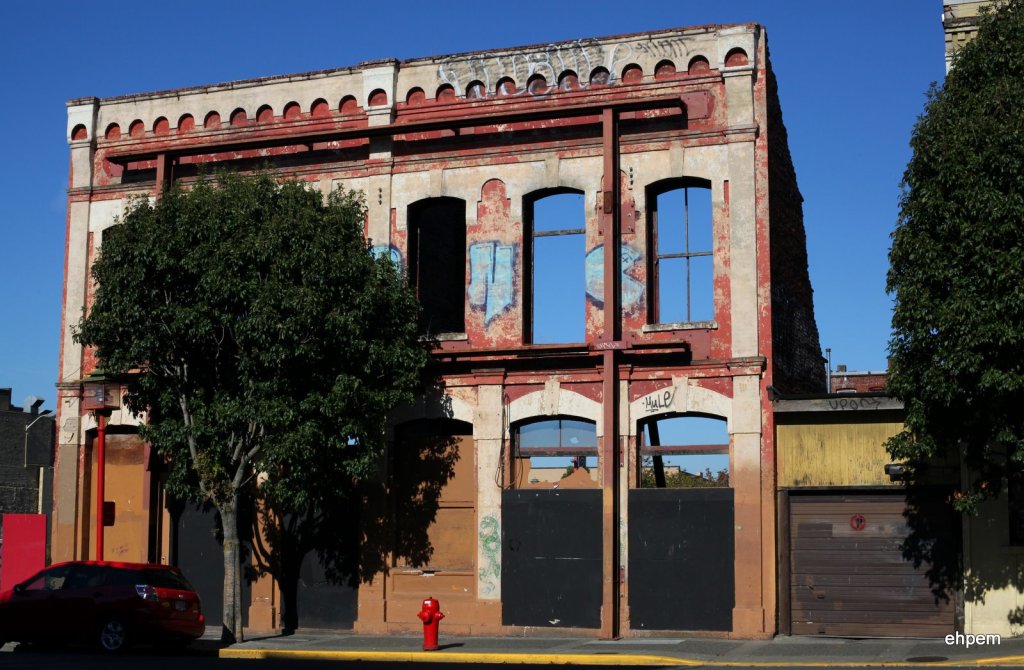
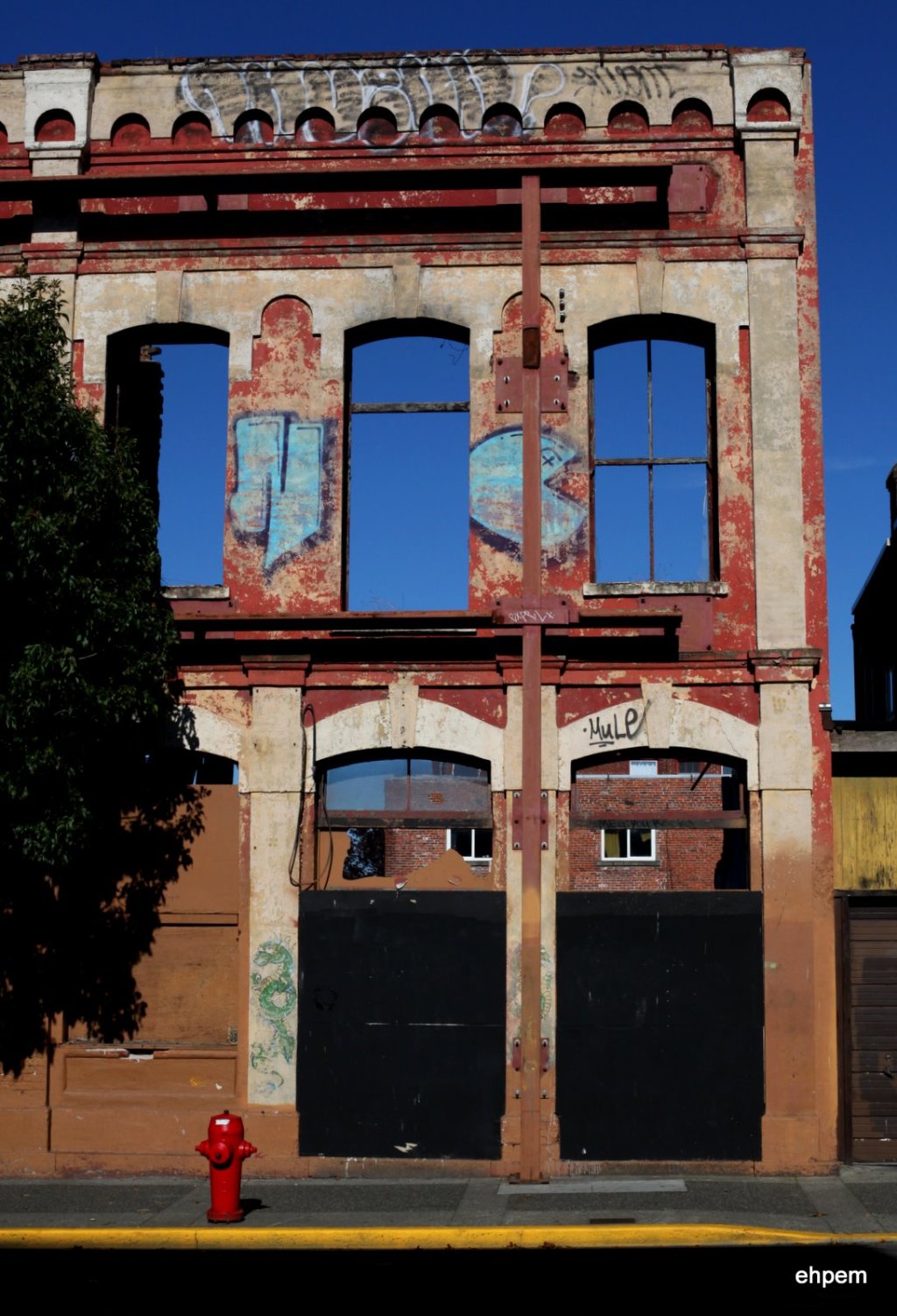
This building has been in ruins, or nearly so, for many years. It is located in the 500 block of Pandora Avenue (first block up from the harbour) at the edge of Chinatown in the heart of Victoria’s old town. A few years ago all but the shell was lost in a fire. The façade has been retained and stabilised, probably on instructions from the City of Victoria. Before that it appeared to have been empty and in very poor condition for a long time. This is another example of the neglect of Victoria’s built heritage. The building would have been very expensive to restore, including bringing it to modern earthquake standards and ultimately it might have been difficult to generate enough revenue to make the kind of profit a banker would want to see.
When I lived in London, England 20 years ago there were “listed” buildings that developers were emptying of occupants and then surreptitiously knocking holes in the roof. A few years later the building would be condemned and the property developed more profitably than otherwise possible. It seemed at the time like a negative effect of heritage legislation and associated government processes. I don’t know whether this is what is happening in Victoria, or at this location, but it is a shame that the oldest buildings can stand empty for years and then catch fire or fall down. That it happens at all calls into question the approach to heritage planning and protection.
I am not the only person to find this façade interesting enough to photograph. I took these pictures a few weeks ago, the same day I took the picture of the skirt and pumpkin just up the street. I started a post on the building about that same time, but never completed it. Last week I was surprised and pleased to find a similar image on Toadhollow Photography posted last February – I had only just discovered the Toad’s blog and photographs which shows how new I am to all of this. As most of my readers already know, Toad’s posts have an interesting story to go with great pictures. Toad’s thoughts on the ruin of this building are along very similar lines to my own and in many ways there is no reason for me to do this blog (Toad, we seem to be of one mind on this topic). I find it instructive to compare Toad’s photo to mine because he processed his as an HDR image, which gives me just enough of an excuse to publish this post. And, I accidentally published what was going to be today’s post yesterday and am looking to fill the gap without starting another post from scratch.
As one would expect Toad’s HDR picture shows a lot more detail in the areas that are in shadow on my photos as well as more sense of depth to all the surfaces. The greater clarity and sharpness is partly attributable to his superior image, but it highlights for me how much I am losing from some of my photos when I convert them to a smaller file for uploading here. My originals of these pictures are much better than they look in this post. Another thing I will have to work on – probably I need better software for the conversion. If anyone has suggestions about something that is simple, reliable and free or at least cheap, I would welcome them.
If you are in this area, check out the Solstice Cafe right across the street. It has great coffee, tea and food to go with a nice atmosphere.
BTW, if you got a confusing email yesterday about publication of my sock or sleeping back post, my apologies, that was me learning yet another way to publish a blog incorrectly. You can find that post by clicking here, or by selecting the Older Post button near the bottom of this page.
.
.


 burnt embers
Pingback: Lower Pandora | burnt embers
Pingback: 78 Fantastic Photography Links You May Have Missed « Photography « Rezalutions
While I love shooting old abandoned buildings, it saddens me when they are removed for progress. I really like Kevin’s idea about how the developer should try to incorporate the facade into the new building somehow (even if they do it on the inside).
About the compression, I have noticed what I believe to be a loss from the WP upload. Perhaps it’s the compression to fit the “allowed” image size on my theme? Not sure which it is however, what I’ve started to do is include a link to my Flickr’s Lightbox version. While not everyone clicks it, it’s always there, waiting… 😀
LikeLike
Thanks for the idea. I think that WP uploads might be a bit uneven, some of my photos seem to come across a lot better than others. Or maybe their algorithms for compression works better on some kinds of images than others. I should try exporting my images to the largest dimension that my theme will accept and no bigger and see if they upload more cleanly.
LikeLike
What a fabulous post! This building is near-and-dear to my heart as for some reason it seems to personify the loss of our history and heritage. Changes are afoot as well in Chinatown, I’m told, and I am not particularly thrilled about those either. I think it’s of utmost importance, myself, to document and share these images and to have a record for the future. The landscape we live in is in a constant state of flux and can and does change overnight. Great post, my friend, and thank you sincerely for the mention. It really means a lot to us.
LikeLike
Toad, I am so glad you approve of this post – I feel like I am walking in your shadow on this post and it would be easy to appear to be plagiarizing your excellence. I have been enjoying your documentation of old buildings in the Victoria area. And even of the hoarding that was all you found when you came back to photograph one of the buildings in this part of town (that was an interesting building and its a shame that it is gone).
LikeLike
No matter what software you use, reducing the size of the original image to fit within a blog post will drastically reduce the detail. It’s just a matter of the number of pixels. If you start with 4000, but the blog is only 900 wide, you’re going to lose more than 3/4 of them in the conversion. One thing you might do from time to time is crop out a significant detail in the image so you can display it at the camera’s original resolution. That will show your visitors more detail and they can imagine the details in the whole shot. The other solution is to shoot more close ups. That’s very limiting but the larger the objects in the image, the more detail you will preserve when they are reduced in size. I tend to do that on my blog.
LikeLike
Hi Doug, thanks for the advice. I was under the impression that some software did a better job of choosing which pixels to eliminate, or some such “decision” in order to better retain some of the detail, or appearance of detail if that is the right way of putting it. Perhaps I may just have to load bigger files if this size does not do the trick – I just don’t want to use up my WP free allocation too quickly! The idea of preserving bits of detail with crops or close ups is an intriguing one as well.
LikeLike
this is an interesting topic and one of those where i am kind of torn between two different motives – as a photographer these buildings make a very interesting subject (not that a well maintained building cant be a subject, it just wouldnt be boring in a way) whereas as a concerned citizen probably concerned about the apathy and want it to be better taken care of. These motives are kind of opposites. Perhaps a middle ground could be where the building isnt destroyed but maintained and cared for and kept in its state of ‘arrested decay’
LikeLike
abu, that is an interesting thought. In some more enlightened (read big cities I think) places, that might be possible. I would find it hard to imagine Victoria agreeing to arrested decay as a heritage principle, or an aesthetic to be aimed for. Many of these old buildings, even when well maintained, are interesting subjects as they have a lot of detail of the kind that is interesting to photograph, and often missing from recent buildings with details that are neither small or intricate.
LikeLike
I really like your second image–the close up that highlights the character and wear of the architectural features. What a stunning sight and it’s astonishing that it was allowed to deteriorate. The image seems to say, “I am standing despite neglect.” Thanks, Sally
LikeLike
Sally – thanks for coming by again. It will be interesting to see what it looks like redeveloped. The character of this part of town is changing slowly but surely. The “blue bridge” less than a block from here is slated to be replaced soon and that will make this area feel very different too.
LikeLike
I’ve seen the same in Manchester England as you saw in London. Let buildings go derelict before replacing them with concrete and glass and something of this is definitely going on in Victoria. The plans for the replacement of the blue bridge appear to be going back a very long way (developers’ conspiracy.. ha ha). I have photos of this facade taken with my phone. Very stark the way it juts into the sky. Also I love the amount of detail that shows in your photos.
LikeLike
Hi Joseph – yeah, its partly the developers fault for sure, they are not satisfied with a million dollars if they can find a way to squeeze two million out of a project, and to hell with the built environment. Which makes it partly the city planner’s fault for not using their iron fist in these kinds of situations and requiring replacement with something that looks just the same, or as if it were built in the period, regardless of cost. The harder the planners make it for a developer to profit by pulling these stunts, the less likely they are to try it on.
Thanks for your compliment on my photo – I like all the detail too, but if you had a look at Toad’s image (it seems to load pretty slowly), you will have seen how much more there is that can be realized from a photo of this type. I also need to work on getting some software that will let me downsize my images without softening them so much, which you can’t see from my post, but I can when I look a the original. I am sure that some software does a better job of it than what I use.
LikeLike
Retaining the façade is just part of the task, and often not enough. The interiors of many of these buildings are an important part of the heritage and if they are not kept, then an era of architecture will be lost. Also, keeping the façade , but surrounding it beside and above with something else seems to be a preferred option that often does not work well. For instance, the new building proposed for this location will bolt this façade onto something that is completely different. The new building does not make any real attempt to be compatible, and includes a Fisgard Street frontage on the north side of this lot where it will not fit in very well. Pictures of the proposed structure are here.
Kevin, btw, you wordpress site that you linked does not work. If you typed an error and want it fixed, let me know by email. ehpemm_at_gmail.com
LikeLike
Oh, how I wish developers would save the facades — or incorprate them into the new structure. It’s very sad when a building with character is demolished and replaced with something that is bland.
LikeLike