
Beach Wood
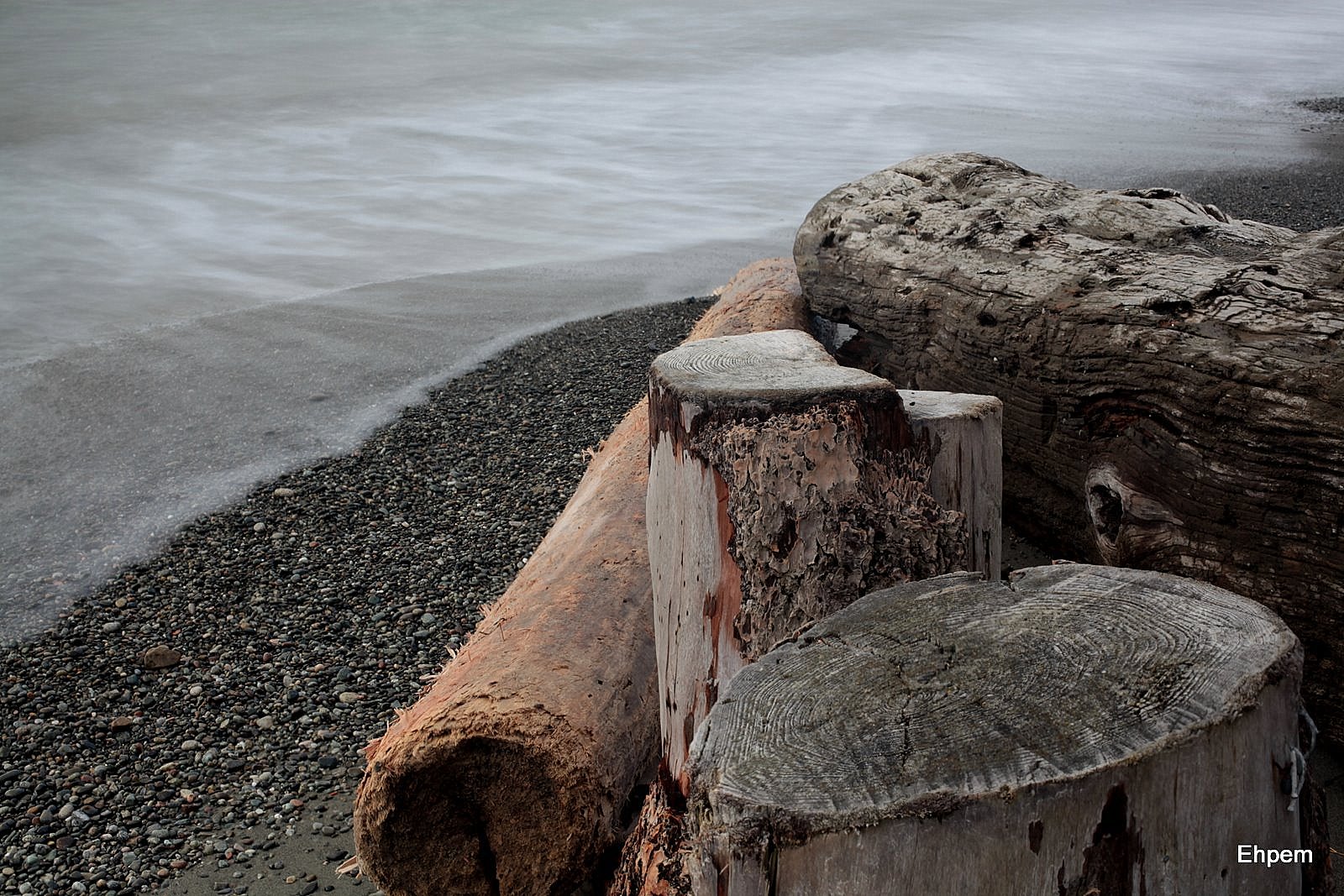
More of the waves on the beach in front of Beacon Hill Park, taken just east of a staircase that leads down to the beach from which I previously featured Beach Curtain and Beach Cloud, taken on the same day. These are long exposures to smooth out the waves.
I liked the arrangement of these logs – this is a natural arrangement – the two stumps in the foreground are joined at the base and thus settle this way without human encouragement. I also like the growth rings in the top of the stumps, and in the top picture the curve of the edge of the wave and in the lower picture the transparent and luminous cover of water from a passing wave at its upper-beach limit.

.
Map link here (sometimes is a bit slow to load).
Canon EOS 5Dmkii, Canon 50/1.4 lens, ISO100, Cameron ND Fader filter, at about 4-5 f-stops of density. Top: f16, 5 seconds. Bottom f16, 10 seconds.
.
.


 burnt embers
I like the subtle colours in the first shot. Nice work.
LikeLike
Hi Andy – thanks so much. Beaches are often pretty subtle places in terms of colour and texture. I think that must be partly why so many of my shots are taken along the water’s edge.
LikeLike
I’m drawn to the rings on the log. I just keep staring at them.
Like the passing waves,
Time flows, etched memorials
Remain in wood stumps.
LikeLike
Oh Ryan – you honour me with one of your lovely Haiku. You leave me at a loss for words (which I expect I will overcome, momentarily).
I also think about time when I see tree rings exposed like this. And dendrochronology – the use of tree rings for dating archaeological finds, and heritage buildings and so on – which involves discerning the patterns of growth (wide rings vs narrow ones) left by changes in climate through time and then comparing the patterns on an old house beam or stake from a fish trap or part of a Roman waterfront warehouse and seeing where they fit. And when a fit is found, you know when that piece of wood was growing and have some idea of when something using the wood was built.
So those “etched memorials” remain also in drowned logs, wooden beams high up in the ceilings of ancient cathedrals, or in a wooden house beam from a First Nations big-house in the forest of BC or Alaska. Dripping with time and memories and history.
These two stumps, joined like Siamese twins, must have an intimately shared history, and yet must also have some experience separate from each other. The kind of bird that sat on their branches, or nests built, or which trunk was the best rubbing place for a bear’s backside, or perhaps the roots of one cradled a small glacial erratic while the other rested on bedrock. I wonder how much of that information can be recovered from the tree rings. Did you know that there are studies being done to ascertain how much nutrients bears contribute to forests by way of hauling salmon inland from spawning streams? Apparently it affects the nitrogen levels in growth rings and their fluctuations can be meaningfully studied through time.
Phew – I was not tongue-tied for too long 🙂
LikeLike
And, I should have said. Everybody go and download Ryan’s first book of Haiku which can be had electronically for 99cents on line – a steal at 10 times the price.
LikeLike
Oooo, I LOOOOVE that second one, in B&W, my friend! Talk about drama here! GREAT composition, great textures and details… everything I love in a great photograph!!
LikeLike
High Toad – glad you like it so much.
LikeLike
very nice…there is so much to look at with these two images!
LikeLike
Thanks David. That is a great thing to hear for what is really a pretty simple subject.
LikeLike
I like the color photo. There is fine composition and exposure, clean light, and it makes a powerful image. However when enlarged the black and white really comes into its own showing beautiful textures and nuances. It takes a good eye and sturdy tripod 😉
LikeLike
Hi Joseph. I am glad you like them both. As I said to Ken, I have it in my mind to convert the colour to b&w sometime to see how that would work out. However, the colours are just so northwest coast beach that they speak to me at an emotional level that is a bit lacking in the b&w.
I have a decent tripod for my purposes, purchased in new condition for $50 in a thrift store along with some small devices for clamping and strapping small cameras to railings and small trees. The tripod is a heavy Slik, with a ball head. It has some issues, is not much good for video and if not used just right the head can shift a touch when you clamp the position tightly (aargh). But, the price was right, and its so much better than my 30 year old lighter weight Velbon which I used in the field for years (which is an excellent tripod for that purpose and extremely versatile in many ways).
LikeLike
This looks exceptionally well in the B&W version, in my opinion. But I grew up on black and white and I’ve always believed that it was a powerful (but personal) interpretation.
LikeLike
Hi Ken. I considered converting the colour to b&w, and may still do so. I prefer the composition in it – the curving lines of foam seems to pull the image together somehow. But I am with you, I really like the b&w too. The growth rings on the stumps, the worn douglas fir bark.
LikeLike
Yes they are lovely and beautifully composed images.
LikeLike
Hi Terrill – thanks for coming by, and for commenting. I am glad you like them. There is something especially SE Vancouver Island about these ones.
LikeLike