Sky Jellies
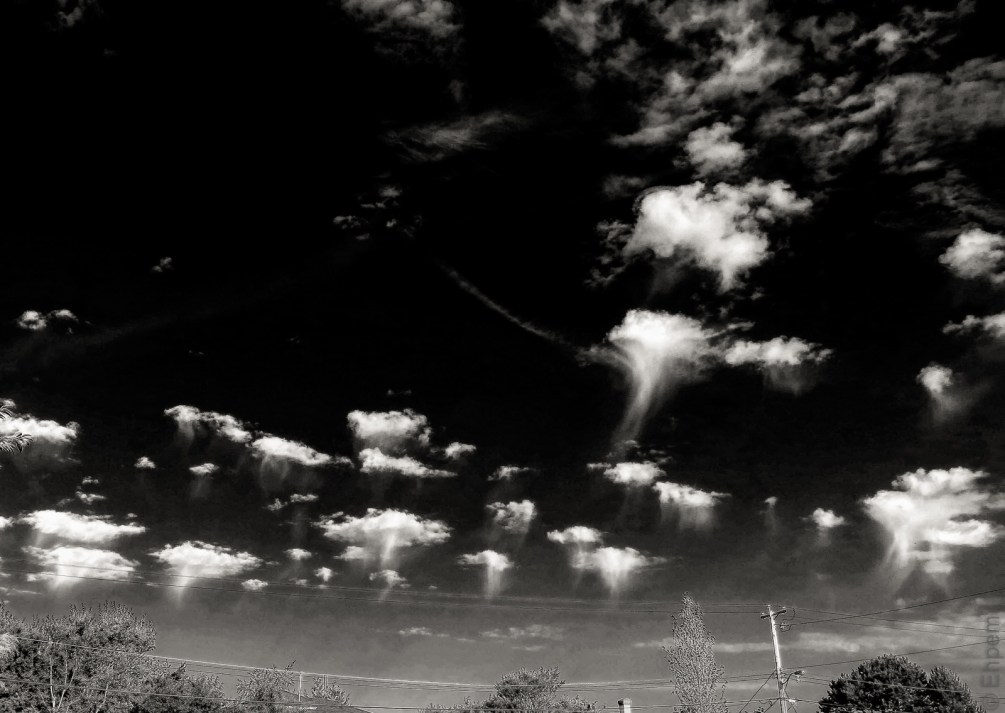
I have never seen a sky filled with jelly fish until one morning on the way to work last summer. I did not have my camera, but my wife had hers. The bus was waiting and so I could not spend the time figuring out how to set her camera to raw and other preferred settings. Above is the image that resulted from my rather hasty fumbling. Better than nothing anyway!
I thought I would show how I processed this image with a series of steps as I progressed to the final version above.

The image below is the unedited version out of the camera, except it has some light edits that apply to all my images on import – in this case a touch of sharpening.

.
The first step in processing was to run the jpeg image through Topaz DeJPeg software. As it turned out, it made little difference as this jpeg was very high quality. I then took that version of the image and processed it through Topaz Clarity to get a bit more sharpness and detail out of the clouds. I used one of the presets, but can’t remember which now. The image below is the result. Next time I would skip both those steps.
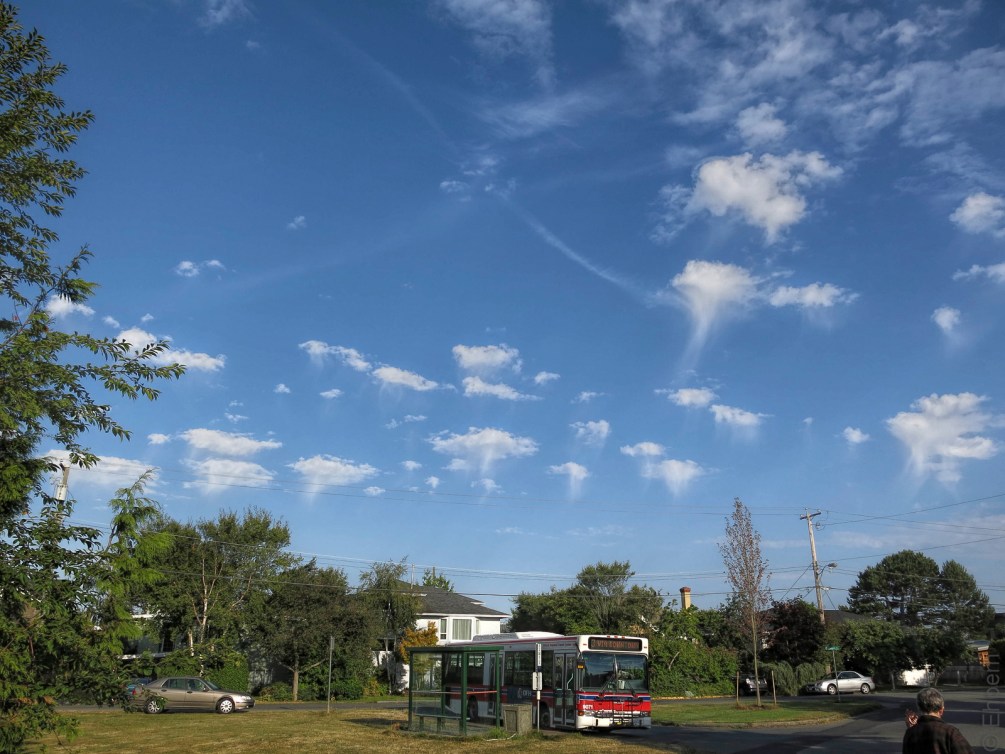
.
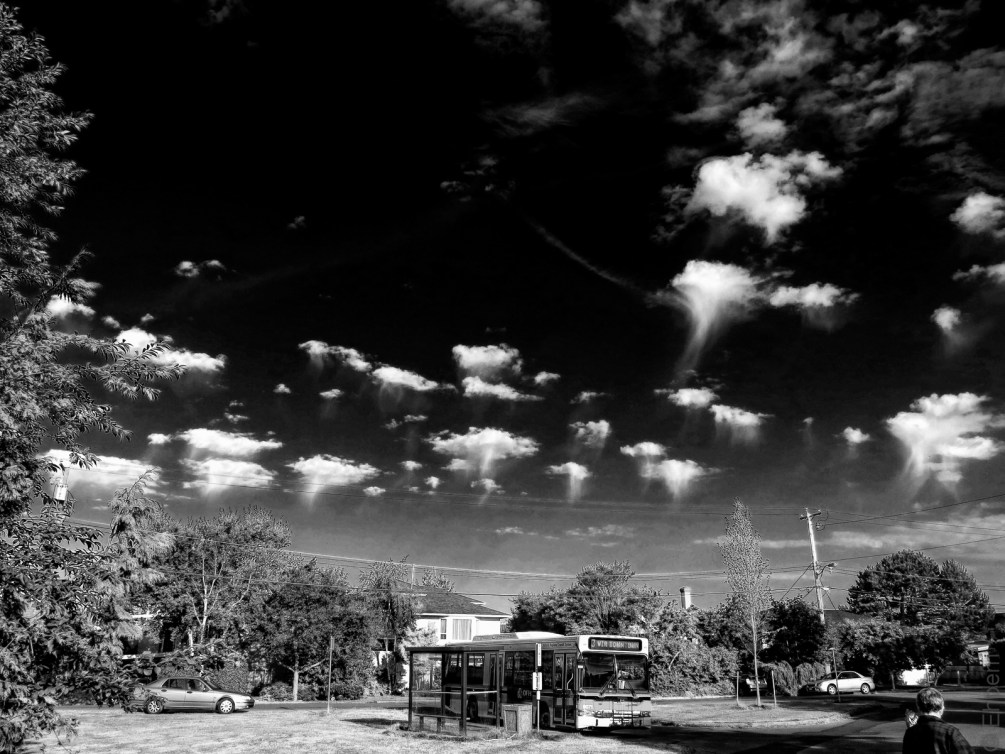
I then processed the image above through Topaz B&W Effects, using one of the Infrared presets, which I then tweaked a bit to get more detail in the clouds. That is the image below. Finally, I worked over the image in Lightroom 4, cropping to underline the clouds with the powerline, adjusting some levels just a bit and adding a slight yellowish tint to warm it up a touch. The top image is the result of these cumulative changes.
I expect some of you might think I should have stopped part way along the process, like before I lost the colour, or the bus. But my aim was to concentrate the eye upon the unusual cloud formation, and I think the top image does this better than the rest.
.
.
Canon G15, ISO80, 6.1 mm (=28mm full frame), f2.5, 1/2000th
.
.


 burnt embers
fascinating, I’ve never seen anything like that. Well done on the editing, perfect!
LikeLike
Thanks Chillbrook! And welcome to my blog, I appreciate you commenting. They are very strange, but if you do an image search for Jellyfish Clouds you will find quite a few pictures of them.
LikeLike
You must have known I would love the sky jellies! Big smiles from me, Ehpem! I like the crop and editing, it really does bring our their jelly-like form.
: ) Awesome.
LikeLike
Hi Karen – I am not surprised you like them at all! However, if you were handling the post production, something tells me they would have come out high-key(ish) and softer focus 🙂 And been good for the treatment too.
LikeLike
Extraordinary clouds – and I read that they really are called Jellyfish clouds. I learn something new every day! The processing used is very effective – it really adds emphasis to the clouds. I very often use the initial captured image as the starter for artistic manipulation. Painters manipulated what they saw to create canvases often far removed from reality. Our tools are different but we we are only manipulating reality to create an artistic impression.
LikeLike
Andy, thanks so much for your comment. I did not know they were called Jellyfish Clouds – but of course they would be. Using that term I was able to search out other pictures of these formations.
Thanks for your contribution to the discussion on manipulation of photographs as well. I have found it very liberating to be taking photos for more artistic purposes – it is very nice to get away from the documentary aspects of work photography. And by doing this, I have become much better at both the initial capture and the post-processing, which work photos will benefit from as well.
LikeLike
Very nice clouds – you should submit this to the Cloud Appreciation Society – http://cloudappreciationsociety.org/!
LikeLike
Hi Melinda, I just found two comments like this from in my spam folder. That is weird. Must be the URL is a problem for some reason.
LikeLike
I’ve never seen this type of cloud either, but I usually don’t notice things like that. I think the black and white is a bit more dramatic and I tend to like the cropped photo a little better, too.
LikeLike
Thanks Ken. I know it is a matter of degrees with these kinds of edits, and there were some decent stopping points along the way. Knowing when to stop is the tricky part I find, or not going to far. I stopped after the B&W treatment for a while, but decided a crop was warranted.
LikeLike
These clouds are just magnificent in black & white ! Great processing !!
The bus was fine for me … but not the man on the right side 😀
LikeLike
Hi Mathias! Thanks so much. I did not mind the bus too much either, but prefer it gone.
LikeLike
So, bye bye bus !! 😀
LikeLike
Wonderful processing here. It looks like a scene from a sci-fi movie. Nice work.
LikeLike
Hi Meanderer – thanks so much. It is a bit sci-fi, and that is what struck me about it. Can you imagine, a sky full of stinging jellyfish that feed on humans? It would change our behaviour, that is for sure.
LikeLike
Nope…I like what you did with it. It really brought out the cloud formations and the bus didn’t belong. Also, I like the “underlining” of the wires.
LikeLike
Hi Erin, thanks for you comment. I thought the wires added something too, and they could not really come out or I would have lost too many of the clouds.
LikeLike
Although I am not a fan of editing, I definitely think that the way you processed the picture makes it come alive, especially in b/w! Great capture, I’ve never seen those kinds of clouds before.
LikeLike
Hi Kiki, I am glad you like this treatment.
I am curious why you are not a fan of editing, and what you mean by “edit” – does that include cropping, white balance adjustments and similar minor corrections, or only major revisions like I have done here? It is a point of view I struggle to understand, except in journalists, and would like to know more.
LikeLike
By editing I don’t mean basic stuff like cropping, white balance, autocorrection or saturation adjustments. It’s running something through e.g. photoshop and getting a result that looks nothing like what I saw with my eyes/through the viewfinder. It’s a different matter to me if someone does it for “artistic” reasons, e.g. to make something look totally different from the original. That’s probably why I like your edited b/w version – it looks like art to me :-). But I guess that’s just personal preferences. With my own pictures I try to get the original right (emphasis on “try”) and do the basic adjustments mentioned above, with sometimes a filter on top.
LikeLike
Hi Kiki – thanks for your reply. I know what you mean about things not being what the eye saw and there is a lot of value in trying to get that part right, especially if one is documenting something. Which I have spent a lot of time doing at work over the years, though not in any sophisticated way, which is a setting where representative accuracy is paramount. Perhaps that is why I have been having so much fun trying other things where veracity is not an expectation.
In this instance when I took the picture I knew I wanted to process it in black and white with a darker sky to set off the weird clouds. This image is not what I ‘saw’ with my eyes, but it is pretty much what I envisioned. If I had had the time, I could have set the camera to mono, with an “infrared” preset, and maybe captured something like this. But I don’t see any real difference between getting the camera to rearrange electrons and doing it on the computer afterwards. For instance, double exposures – I would love to shoot those in camera. My camera won’t do that, and in fact until recently I did not have the software to do it either (and still don’t know how to use the software to do that).
I think it is really a continuum. Many of the things that people do in digital form could be done in the dark room, with a lot of effort and failures along the way. And there are many other things that are completely different and new and depend on having pixels to manipulate. I think photography should change with the times and exploit the possibilities, for art, for story telling and for documentation and journalistic purposes.
LikeLike