HVAC Wall
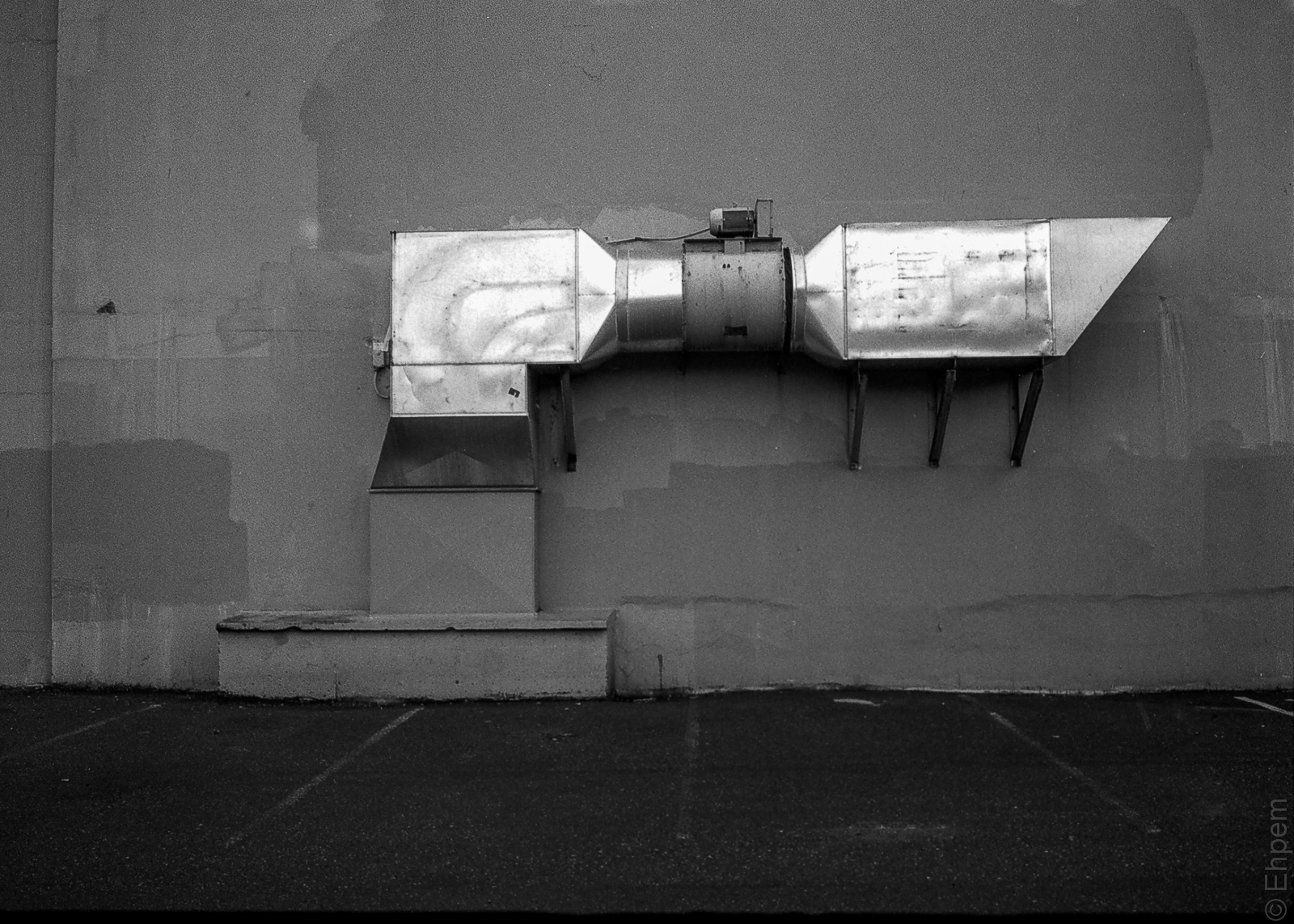
More from the half-frame Olympus Pen, but not paired with other images this time. The subject is, however, visible in an earlier triptych that some of you have seen here. The vent really is pretty big – it ventilates underground parking beneath the View Towers high rise that was shown in another set of images a few days ago. Those are full sized parking stalls marked on the pavement. Usually there are cars parked here so it was a nice surprise to find the parking lot totally empty one Sunday morning.
I am very impressed with the quality of this film, considering it is a half sized negative and a pretty low resolution scan. I think I scanned at 300 dpi with an output size of 8×10 – a higher resolution scan would be that much nicer. Click on the image for a larger version.
.
Olympus Pen, half-frame camera, ca 1961. Ilford Pan F Plus, ISO50, Probably shot at 1/50th and f8 or f11.


 burnt embers
How lucky you are to get the parking lot empty! And what do I say great shot, which is why I like using Olympus myself. But I guess some would say it is not just the camera, but of course it takes two to tango, as what they say. It takes a smart and creative photographer to know when , where and how to capture that perfect moment or image or place as what the case would be.
LikeLike
Thank you Stella. A good camera does not hurt, but is not necessary if you know what you are up to with it, and have a good eye. This little Olympus is very basic indeed, but is capable of good photos!
LikeLike
And I like how all the dividing lines between the parking spaces are pointing and saying, “Look at this gorgeous piece of sculpture!”.
LikeLike
Thank you Linda! It is very sculptural, which is what attracted my attention. It is really big too, so hard to miss – the wall is varying shades of pale green so it stands out from a nicely neutral background. I had never seen it without cars parked in front so had not appreciated it before. Glad to have a camera in the pocket at moments like this.
LikeLike
The camera/film combination does a nice job preserving the texture and detail. Higher res scan might give a better print but it would be hard to notice the difference on the web.
LikeLike
Hi Ken. I agree, not a lot of point in scanning it again for web. If I was going to print it I might scan again. There is almost no manipulation of these images other than “exposure” during scanning and then dust spotting afterwards, with a tiny bit of croppy to even out the edges. Unfortunately the negative holder on my scanner does not leave both long edges a bit visible, so always one side has a very narrow band, or no black at all. I suppose I could rescan with the negative lying on the flat bed if I want a ‘natural’ black border, but have not tried that yet.
LikeLike
We don’t use the neg holders at the Museum. They are more trouble than they are worth especially since we have interns doing the scanning. I do all the editing but the scanner and the interns do such a good job that little or no editing is required.
LikeLike
That is really good to know Ken. Do they line up multiple strips of negatives side by side and then set up the scan for each frame? Also, any tips for dealing with dust would be much appreciated. I have a very dusty house and pulling a negative out of its factory-clean sleeve, inserting into the mount and putting it on the (cleaned) scanner bed is enough to attract gobs of dust. I spend quite a bit of time cloning out dust, and always seem to miss some.
LikeLike
I sure do like all the different colors on that wall! And the wavy line where the wall and the parking lot intersect is nice, too.
LikeLike
Thanks Melinda. They do add something to this rather strange structure.
LikeLike