
Horizon(tal) X
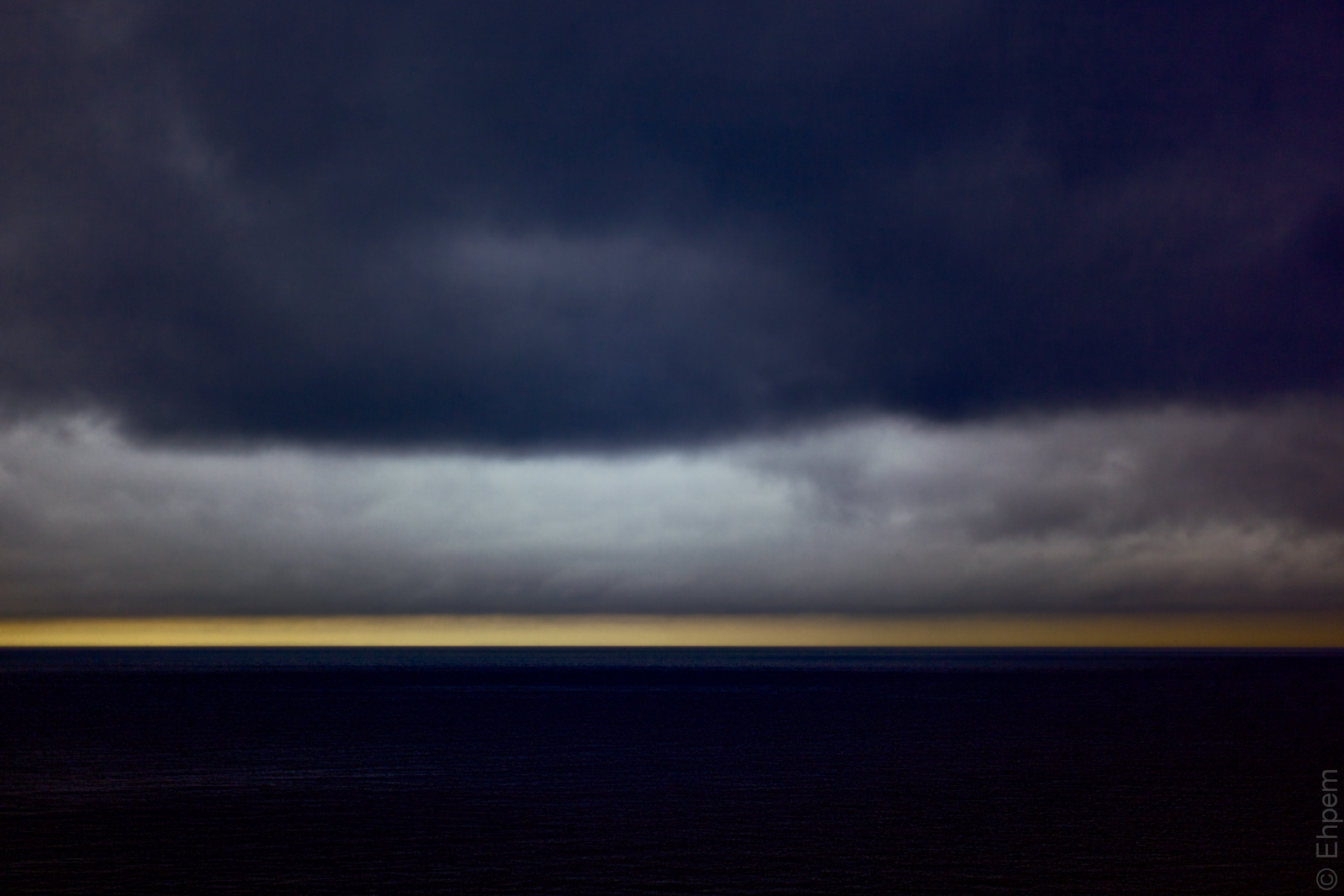
It has been rainy with low dense cloud for a couple of days now, but this strip of light over by the Olympic Peninsula is all that is needed to brighten up a gloomy scene (sort of).
This is part of a series of horizon shots.
Recently one of my readers, Angelina Hue, commented on the VII version of the series that it reminded her of Hiroshi Sugimoto’s work.
If you too don’t know his work, do an image search for his name and ‘seascapes’.
I had never heard of Sugimoto before, so that was a really great lead for me to see what a great photographer has done with minimal horizon shots.
Also a bit humbling to be reminded, yet again, that it at has all been done before and better.
.
Canon EOS 5D MkII, Canon 50mm/f1.4 lens, ISO100, f1.4, 1/320th Processed in Lightroom 4 and Topaz Restyle.
.
.


 burnt embers
Great layering here, my friend, very dramatic!
LikeLike
Thank you Toad, I am glad you like it. A few days on you will find another rendering of it, simplified a lot and made abstract.
LikeLike
Pingback: Horizon(tal) XI | burnt embers
Strong!
LikeLike
Thank you Joseph – tomorrow it is reinterpreted.
LikeLike
The processing is spot on – the image has moved on so far from the preliminary result you provide a link to in your reply to OneOwner. I think I have alluded to Rothko in a previous comment earlier in this series. Here’s an idea that might or might not appeal to you. Crop the image into a thin vertical slice maybe about a third from the left edge, then using Image/Resize, uncheck the Constraints box and alter the width setting to what it originally was before you cropped it. You will now have stretched a small vertical slice back to a typical horizontal image.Then use Filter/Blur/Motion Blur to blur the image even more horizontally, setting the degree of blur at a high level. You will now have simply solid bands of colour a la Rothko. Voila! A perfect abstract. These steps are taken from Photoshop Elements, I would think you could do the same in Lightroom but I have never used it myself. This is a technique I have used, or variations of it. It works really well if you want to then go on to manipulate an image further using some of the more Wacky filters that are in Photoshop.
LikeLike
Hi Andy – thank you very much for an interesting suggestion. I have taken you up on it, and the results will be seen tomorrow on these very pages! I had to open up Elements (for the first time) to do the things you suggest, though I could probably have done it with a combination of Lightroom and one of the Topaz plugins, it seemed easier to follow your instructions, and proved to be almost problem free to implement. Thanks for a great idea. I am not sure if I prefer the result or not, it does take the abstraction to a new level, and that is great. But I do like the residual ‘natural’ in this photo as well, the familiar in amongst the unfamiliar.
LikeLike
That’s the nub of it: do you like the natural view – and regard that as the only valid interpretation – or do you go off at a tangent and derive something from that starting point that creatively exploits those same pixels to create an abstract. We all have a different opinion on that topic.
I’m pleased you were tempted to try my idea out and I’m looking forward to what you have come up with.
LikeLike
this is really a beautiful photograph!
LikeLike
Hi Mark – thanks for your enthusiasm. I too am pleased with this shot, it is one of my favourites in the horizon(tal) series.
LikeLike
I may be wrong (I don’t think so) but this may be the best of the series.
LikeLike
Thanks so much Ken! I am beginning to figure out what conditions of lighting and cloud and so on will work for this kind of processing, and the appropriate exposures too. I actually set out to take a photo very much like this. This is the starting point (a bit of sharpening in LR, and straightening): http://wp.me/a1R4lY-5fN. It has some merit just as it is, but no drama, and to me does not communicate so well the feeling of these long wet dark winter days.
LikeLike
This is really, really beautiful…
LikeLike
Hi Merilee – thanks for coming by, commenting, and following! I am glad you like this – I sometimes find it hard to see the beauty on these very grey days, but that little strip of light was just enough to make something out of.
LikeLike
Hello again! I think we get inspiration from everywhere around us – be it works by other people (in our time / before) or just simply, nature itself. It’s what you create eventually and what it means to you that matters 🙂
LikeLike
Hi Angelina. I certainly find most of my inspiration in my surroundings, but it sure is nice to find it, or ways to interpret it, in the work of others. Especially those that have spent a lot of time and thought figuring out how they want to represent their vision.
LikeLike