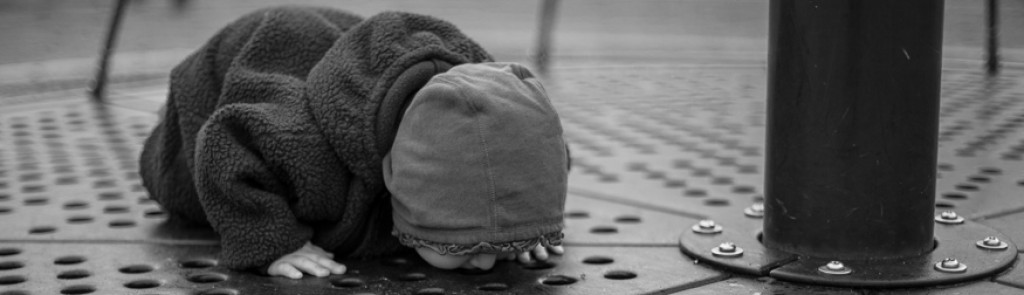
Thetis Lake V
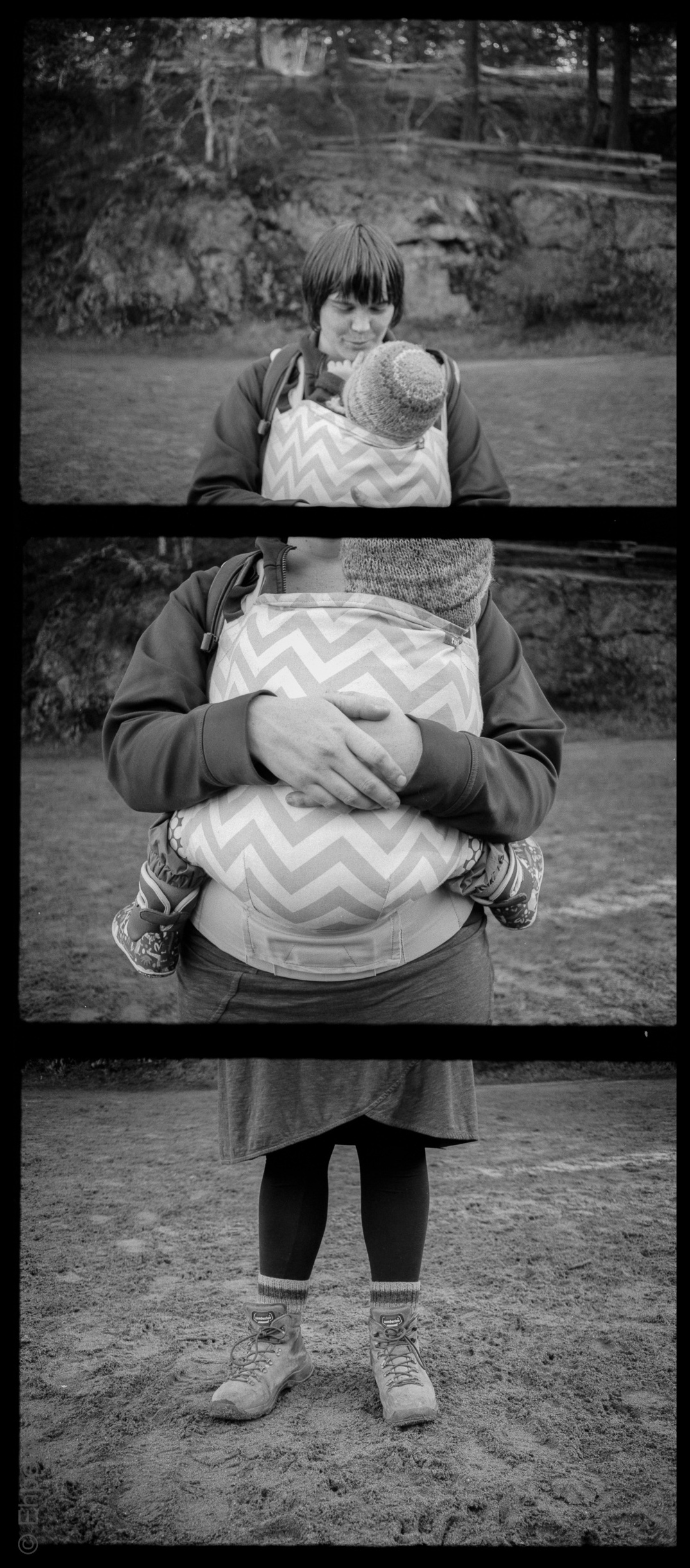
Some more photos from my walk around Thetis Lake a couple of weeks ago with my daughter and granddaughter. I only took a few pictures with the Olympus Pen as there was not enough light in the forest.
This idea for vertical triptychs of a person is adapted from some very interesting street photography by Adde Adesokan which I found summarised here. You can find more scattered on his flickr site, with stories about the person and photos. So, this is an unashamed ripoff adaptation of Adesokan’s great idea. As soon as I saw his photos I thought they could be made to work on film as sequential half-frames, scanned as a single image.
The top image is the second one I shot because I thought the bright lake in the background of the first would not work well. The bottom shot is the first one; little did I know that I had caused the filter to steam up by holding my hand over the front of the camera (a disadvantage of a rangefinder is that you don’t look through the lens). Still, I like the ghostly quality enough that you get to see another of my mistakes redefined, by me, as presentable.
Clearly I need to think more about getting in closer, estimating focal distance, and the alignment from one frame to the next. It feels awfully strange taking a portrait beginning with someone’s feet. Perhaps if I held the camera the other way up I could start at the head, though I would have to think calmly with my eyes closed to try to visualise if that is actually how it works.
Click on the image for better quality – the top one in particular is nice with baby touching mum’s face.

.
.
Olympus Pen, half-frame camera, Efke KB50, ISO50, 1/50th, ~f8.
.


 burnt embers
I really like them, though I have no idea how you achieve them in-camera? I love the way you have focussed in on the hands and to me that says much more than the photograph could if it were just a single shot. I think that some people forget, that there is a lot to learn from immersing yourself in a process (or doing it the hard way) even though it might not ‘look’ different from something similar produced in photoshop. It’s a bit like why I bother to use a medium format camera with 120 film. It’s the process I enjoy as much as the results – there is something meditative, enriching about it. I’m not aware of the photographer you mention I will have to check him out. (I’m also very jealous that you own an Olympus pen btw!)
LikeLike
Hi Emily. The in-camera part is that they are images on adjacent frames on the negative, shot with the intention of scanning them together as a single image. If something goes wrong, say on the third frame, then you have to shoot all three again to get the sequence in one place.
You have hit the nail on the head about the importance of the process. And, to make things look like this in photoshop seem like unnecessary fakery. In fact, if I had the photoshop skills, I would not make them look like this, with between frame bars and rough edges of the film and the vignetting on each shot, and so on. All of that could be corrected, or if shot on the DSLR, non-existent. I have to think much harder when taking these pictures than any other kind. There are suite of technical things that need to be attended to, but also, the composition and other esthetic aspects need to be more carefully considered. It contributes back to my digital photography and I think is helping me to become a better photographer. There are a lot of ‘basics’ that I skipped over in my self taught learning process, and have been slowly learning ever since.
LikeLike
Oh, and the Pen. It was a lucky find, but there are a lot of them out there. Particularly lucky in that it is one of the totally manual models of which most are not. I am glad not to be constrained by a camera set aperture which many Pens with light meters do. Though in some ways it is a moot point, with so little latitude in shutter speed (two working speeds on this camera, plus Bulb).
LikeLike
Pingback: Half-frame Buildings | burnt embers
Sorry, I just dont get it with these tryptychs. They dont say anything to me, I suppose I am too conventional.
LikeLike
Hi Val. You are a tough customer to reach through a (half-frame) lens! By “these” did you mean the two on this page, or all the ones I am doing, or Adesokan’s? You have made a comment a bit like this before, so I am assuming that the ones I am doing don’t resonated with you. I don’t have a lot more of an answer than what I said before, that I like them better than carefully stitched electronic panoramas because of the thought and technique involved in making them work in-camera. These two shots are just a test of an idea, which I think Adesokan has done much better and which I can do much better, with practice. His often put into detail some salient feature of the person in a way that a full length single-shot portrait would be really stretched to do. His triptychs don’t appear to be in-camera, but are carefully composed and provide a lot to look at, and raise lots of questions about the person so I think they work really well as portraits. Maybe I will get to a point as well where you are finding a lot to look at and ponder when you see the triptyches at burnt embers, but given I have only shot 3.5 rolls of film through this camera I have a lot more learning and exploring to do before I have mastered any of these ideas.
LikeLike
Thanks for taking the trouble to explain the thinking behind tryptychs.I like Adesokans single pictures better than his tryptychs too. It is as if he is preaching to the viewer saying look, these are the salient features about this person,which you may be too dense to spot unless i pick themout for you, enlarge or reduce bits and reassemble them to grab your attention. I think the viewer can swiftly spot the significant details in an undistorted conventional photo for herself.
As for doing it in-camera,arent you voluntarily setting yourself a super-difficult task,one which could be achieved so much more easily digitally. Its all because you happened upon this funny old camera which lends itself well to tryptych making, because of the shapes of the negatives it makes. It reminds me of a potter I know who digs his own clay, dries it, wets it down to sieve out the junk, dries it again, immense time and labour for the sake of a silly romantic idea about being close to nature and his pots look no different from those made with clay formulated to resemble earthenware bought quite cheaply from a pottery supplies store.
LikeLike
Hi Val,
I can see your point about preaching. But a general photo does not show the kind of detail a close up does and subtle information like the amount of wear on a pair of hands, or muck under the finger nails would be lost in a general portrait. And it allows the photographer to tell a particular story instead of a general one.
As to your potter friend, and not being a potter myself, I still can imagine many things that the potter learned and which contributed to making better pots with any materials. Things like how to mix clay, failed experiments for clay bodies and successes too, how to get a glaze to shrink the same rate as the clay and thus stay on the pot, what glaze combinations will give the desired colour, how to throw a really smooth or gritty clay, all those really basic things that probably the average potter has no idea about. Maybe it is romantic to think a craftsman can be better by totally understanding their materials and tools, but it is a notion with some substance. It applies to woodworkers understanding their wood, their tools, knowing how to sharpen them, knowing grain, species differences, glue properties, and all that. Maybe they take their tools in for sharpening and buy ready mixed glues, but the more they know, the more mastery they will have in the end. I think anyway.
As to the Pen. It does not produce the greatest images on their own – I can do better on the DSLR. But it can do some of these other things on its own that are not able to be done in the other cameras, and that potential is worthy of exploration. Doesn’t mean everyone will understand or like the outcomes, but if I do, that is all that ultimately I care about. Unless everyone hated it, then that might be different. Fortunately lots of people are interested and seem to like it too 🙂
LikeLike
Interesting concept. I noticed in Adde Adesokan photos he seems to change his vantage point for each of the three photo. It looks like he does not pivot the camera but moves up (or down) for each shot. Once you get past the absurdity of the portraits, they begin to make sense. I like this idea.
LikeLike
Thanks Ken. They are a bit absurd, but I think they make a lot of sense – often highlighting something important about the person. I too changed my vantage point and moved up and down, though I did not get on my belly in the wet sand for the feet shot which is what it would have taken to get his kind of shot. I also moved closer for the central frame. Overall I was too far away for a relatively wide angle lens, I can see this camera having some limitations for doing the same as Adesokan, but adapting to the camera and doing them in-camera is different enough that I hope it they can become more than mere copies of his idea.
LikeLike
super! I really like these.
LikeLike
Thanks dothob! I need to work on the idea quite a bit more, but I can see some possibilities.
LikeLike