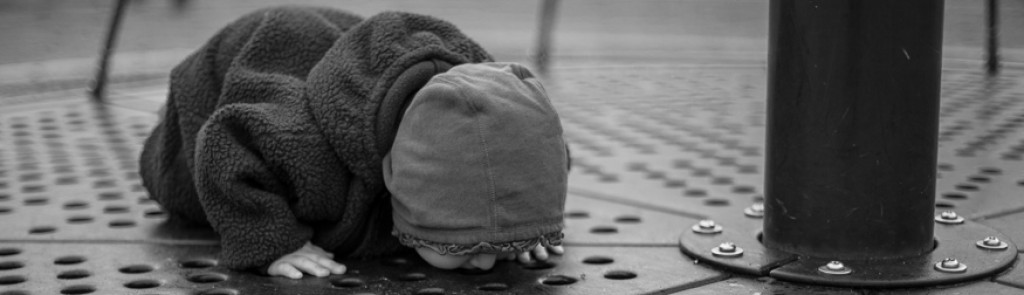
Land Quarters

According to the owner of these buildings who I talked to a few years ago when buying steel tubing here the wooden sheds have a fascinating history that dates to the late 1800s. They were built as bunkhouses for the crews from the sealing schooner fleet to stay when they were ashore. If only these walls could repeat some of the stories they heard but failing that there are historical sources to fill some gaps.
The sealing schooners hunted northern fur seals in their breeding grounds along the Alaska coast, taking with them crews not only from Victoria but from the First Nations up the coast, especially Nuu-chah-nulth and often Haida. The Nuu-chah-nulth brought their own canoes and harpoons for hunting.
There are many photos of the sealing fleet in Victoria harbour, as can be seen on this link. There are lots of great shots in the archives; this is one of my favourites.
A few years ago I posted photos of SGang Gwaay Llnagaay the Haida village that is a World Heritage Site at the south end of Haida Gwaii. In this blog post (one of my all time favourite posts), the second photo shows a deeply eroded pole – most likely a mortuary pole or a house frontal pole that has been burned. It is said that part of the village was set afire by Nuu-chah-nulth sealers who came ashore from a schooner on their way south. They had an old grievance with the Haida and were exacting retribution. Also, during work I have done in Nuu-chah-nulth territories I have been shown sealing harpoons in people’s houses in small coastal communities on Vancouver Island from their grandfathers or great grandfathers who went on these schooners.
A truly fascinating contemporaneous book (Condition of Seal Life on the Rookeries of the Pribilof Islands by Charles Haskins Townsend) has observations made on a sealing schooner and is on-line here. It has to be one of the more complete accounts of the daily working life of First Nations hunters in the early industrial economy. It includes photos of the schooners in the Bering Sea, with details of the Nuu-chah-nulth canoes and gear, various appendices regarding catches, biological information about the seals and so on (some interesting bits reproduced below). The descriptions are sometimes marred by the nearly ubiquitous racism of the time but there is a lot to learn from this document.
CRUISE OF THE DORA SIEWERD IN BERING SEA (from an appendix by A.B. Alexander)
Pursuant to instructions from the Hon, Marshall McDonald, United States Commissioner of Fish and Fisheries, to secure passage on a pelagic sealing vessel for the purpose of making a cruise in Bering Sea, with the object of gathering information concerning the pelagic habits of fur seals, the methods employed for their capture at sea, their food, the proportion of each sex represented in the catch, etc., I left the Albatross at Unalaska, the middle of July 1895, to await the arrival of the sealing fleet. Subsequently accommodations were obtained, through the kindness of Capt H.F. Siewerd, on his vessel, the Dora Siewerd, a schooner of 100 tons register, and one of the largest in the fleet. She carried 18 canoes and 2 boats, and a crew of 36 Indians and 9 white men. As two Indians go in a canoe, the spearsmen and boat steerers were equally divided. (page 123).
Peel

This is my first roll of Agfa film, at least packaged as Agfa.
I really like what it does with the greens.
And my first roll through this camera which it turns out vignettes pretty heavily at 28mm and I am guessing wide open.
I can live with and even like it.
I think this must be one of the older buildings in Victoria. Probably an old warehouse.
Abrupt
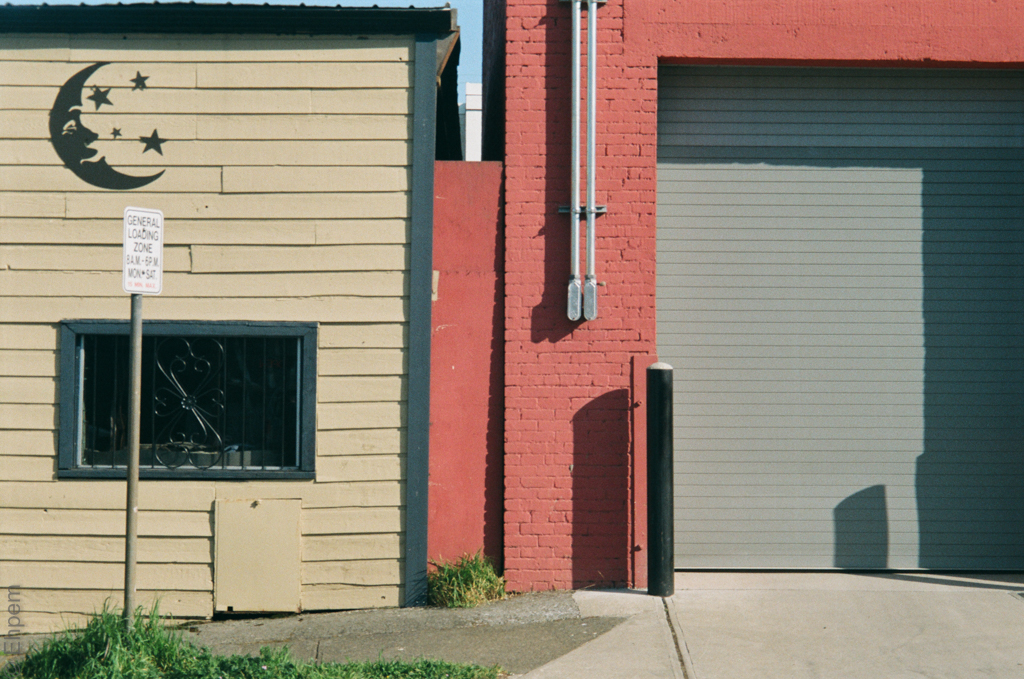
Even though there appears to be a skinny passage between these into two buildings, they do present a very abrupt boundary to the viewing public.
I wonder what is in that passage. Come to that, what is in the compartment under the window?
Probably general things, worthy of stopping for in a general loading zone.
Setting Up

There was great light when I was testing this camera early one morning.
I turned around and came back for this shot of the elderly shop keeper setting up for the day. (more…)
Binned

One thing about these small point and shoots with telescoping lenses is that the extended lens fits through a chain link fence.
Like it did when I took this picture.
Olympus Trip First Roll
My roll 12 of the 2016 52 Rolls project. This has the rest of the test roll from an Olympus Trip which I have been showing on Burnt Embers for a few weeks now.


I have been testing a lot of new-to-me cameras this year – I seem to have come across quite a few on my list of cameras to try. Today’s example is an Olympus Trip 35 (there are a lot of Olympus cameras on that list). This is a bit of a cult camera but I have always felt it deserves its reputation, even before I knew of its popular status. My wife had one before we got married and the pictures she took when working overseas are excellent. Enough so that I wondered how she was taking sharper better exposed photos than I was with my Pentax Spotmatic (the answer to that is that I did not know what I was doing, and she did not need to know with the Trip). Her Trip is around the house somewhere – in a box of stuff that we obviously don’t need if it…
View original post 224 more words
A Breath of Fresh Air
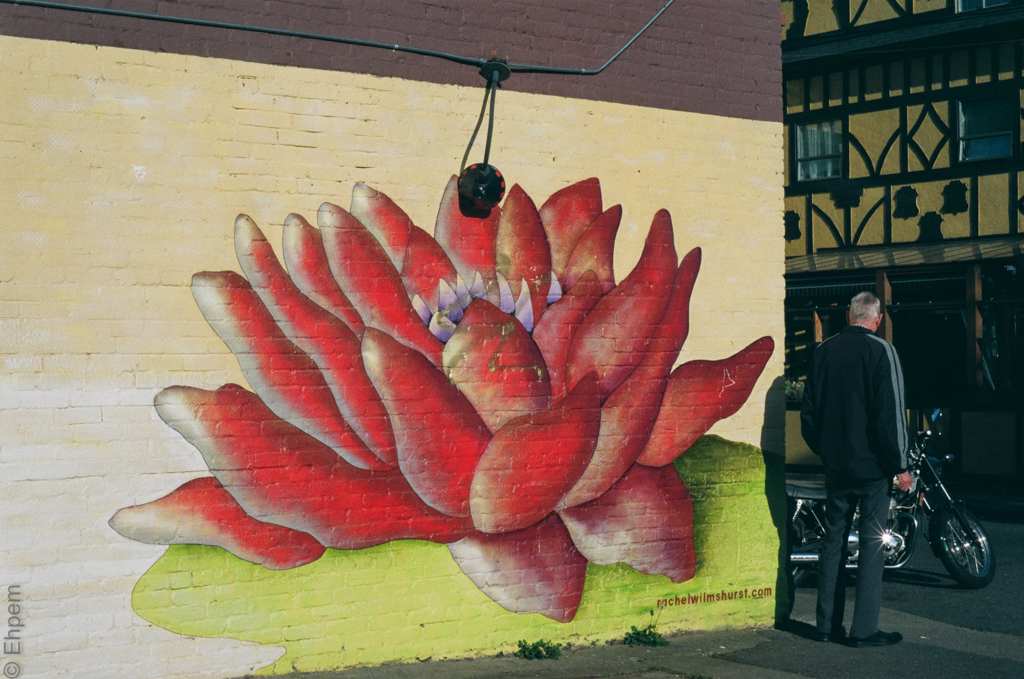
Out back on the main drag in the Fernwood neighbourhood of Victoria.
Looks like this guy stepped out for a “breath of fresh air”, not to mention a bit of sun.
I can’t help thinking that the light fixture has shocking potential.
Top Posts & Pages – Click Thumbnail To View


Recent Comments
♦ FUJITA (藤田光学工業) H.… on Fujitar P.C 35mm F2.5 Asahifle… ehpem on Child’s Grave Kyle Hoyt on Child’s Grave ehpem on Charles Elliott Pole, Universi… Lisa Kadonaga on Charles Elliott Pole, Universi…


 burnt embers