200mm Teaser

These photographs are stills from an upcoming timelapse video taken two nights ago near sunset. The images are edited in LR4, and translated to all the images in the series via LRTimelapse. I am really appreciative of that software, it makes the processing of timelapse sequences so much easier.
Arriving home from work I had noticed that the Olympic Mountains were out in all their glory across the Strait of Juan de Fuca, with a bit of cloud around the peaks. I know that this is a great telephoto subject, so after dinner I set off to Trafalgar Park with my longest lens (200mm) and the idea of taking some telephoto timelapse. This is all part of my ongoing learning of timelapse methods. I wanted to capture this scene, thought the mountain cloud might be interesting speeded up, and was curious about the use of a telephoto for such purposes. Will a fairly heavy long lens magnify vibrations noticeably? My experience with the 200mm lens is that it needs some pretty heavy editing to get the best from the image, so I thought this was a good opportunity to try heavier edits in this software combination. It seems to work really well, the images are taking about 10 seconds each to render, even though I have converted to black and white with individual adjustments, done some spot removal, sharpening, clarity and various exposure and similar changes.
I don’t know the answer yet as the video is processing as I write (or try to write, the computer is working very hard). I took several sequences with the telephoto, including of the sunset. The lens I used is an old SMC Takumar screw mount (m42) 200mm/f4 that I bought for my Pentax Spotmatic in about 1974. It is completely manual which is an advantage for the timelapse in preventing aperture flicker. Besides, my next longest lenses are 100mm so this was the choice.
.
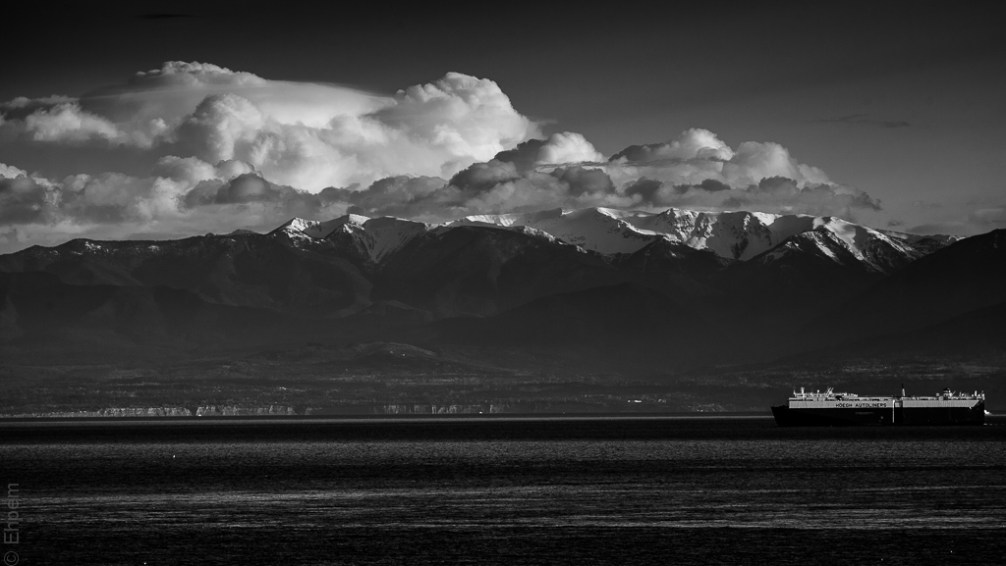
Fortuitously a ship came into view at the right time. The ship is in the fleet of Höegh Autoliners, though I do not know which of many ships they run. It slowed off Victoria to pick up a pilot while I was setting up my tripod, so I am guessing it was heading to Vancouver to offload cars from somewhere in Asia. Also visible is a mirage along the distant Washington State shoreline – the appearance of cliffs is greatly exaggerated by some common atmospheric effect. Some times it is even more pronounced than it was on Monday.
.
.
Canon EOS 5Dmkii, SMC Takumar 200mm/f4 macro lens, ISO100, 3-stop graduated ND filter, f-4, 1/250th
.
.


 burnt embers
Magnificent!! I love that first image (the ship distracts me a tad too much in the still (but sure it rocks in the TL)! Really interesting seeing the Cliffs of Washington…I’ll have to visit that mirage one of these days. 😉
LikeLike
Thanks David. I really like that I can make an image like this as a still (I could end the sentence here) and then roll those edits into a timelapse. I really need to do more of those distant clouds, with a longer lens perhaps. They are great clouds. The mountains and Cliffs of WA are all so close to you. Check them out! Though truth be told, unless you get up into the mountains, the more distant views of them are much better from over hear than on your side.
LikeLike
Pingback: Autoliner Time Lapse | burnt embers
These are a couple of gorgeous shots, Ehpem! I am excited to see your time lapse.
I was interested in what you said about the mirage that make the cliffs appear more substantial than they are. Is this a fairly regular occurrence? About four or five times a year I can see a mirage in the western horizon that looks like a low mountain range (if you forget that you are on the Plains). If the light is just right, you can see things – mostly oil drilling equipment – that is actually past the horizon. It’s (so far) impossible to photograph, but those mornings when I se it are my favorite mornings of the year. My friend Darryl calls it “fata morgana,” a lovely term if if there was one!
LikeLike
Thanks Melinda. The new timelapse will featured tomorrow morning (Thursday). The mirage is really quite common across the Straits. It photographs OK with a telephoto lens. If you have one, then maybe that would work for your fata morgana (it is a lovely term).
LikeLike
I do have a 200 mm, but even that won’t capture the mirage the way I see it. But I guess that makes those few days when I DO see it just that much more miraculous.
LikeLike
It’s extremely virtuous of you to not be using this an excuse to get more glass!
LikeLike
I didn’t mean to be virtuous. Please don’t tell anyone.
LikeLike
At the far end of a long lens lies a different world that takes time to penetrate. These photographs are very good lookers, ehpem and I am impatient to see the result of your time lapse project.
LikeLike
Hi Joseph. Long lens and macro lens have many things in common and “a different world that takes time to penetrate” is certainly one of them. Which, btw, reminds me that I must do some macro timelapse at some point soon.
I am glad you like these images. I first learned of the power of the long lens for this scene in the 1970’s – in those days I was crewing on sailboats during races in this very water. Some shore based photographer gave me a shot of our boat, with dominant mountains behind. I think that is one of the reasons I bought this lens. The other was that I also bought a set of extension tubes so I could use it for close ups of insects, without being too intrusive. Which gets back to your different world observation.
LikeLike
Yes, those extension tubes, basic and good They did tend to make the photographic process a bit more labor intensive.
LikeLike
A bit more labour I agree. I have used them a few times with the Canon. For instance when filming hummingbirds at the feeder http://wp.me/p1R4lY-2Mk. They still work just fine.
LikeLike
Two first class classic B&W shots. The clouds are magnificent and really add so much to the image.Nice processing too.
LikeLike
Thank you Andy. These shots are taken 20 minutes apart which gives some idea that there might be a lot of motion in the clouds during the timelapse. I find very interesting the idea that all the photographic editing tools available to me can be incorporated into the timelapse move. I think it should be possible to make some very striking timelapse sequences, if one can find the time….
LikeLike
The stills are fantastic so I’m anticipating a a very nice TL. The subject is perfect for black and white with a good amount of contrast and, with the clouds the way they are, movement. I doubt if my computer could do a TL any faster than yours as it’s old and weak, but functional.
LikeLike
Thanks Ken. The telephoto shots were quite hazy and and thin, so they needed a contrasty treatment to really bring out the details. This software combination is a lot easier on the computer when it comes to rendering the video. What really crept up on me without adequate monitoring is the amount of space that TL consumes. Even though I am using smaller image sizes, in two sessions this week I managed to take 32gb of photos. My hard drive is suddenly full.
LikeLike
Great photos of “our mountains,” as the Olympics are sometimes called in Victoria. Apparently the Olympics, while American mountains, are not visible in their gory from anywhere in the United States.
LikeLike
Thanks Richard. I think we must have the best view. They don’t look like much of anything from anywhere on the Olympic Peninsula, and I think from the east they are not as dramatic. They do look terrific from within though, at altitude. Very much worth a visit.
LikeLike