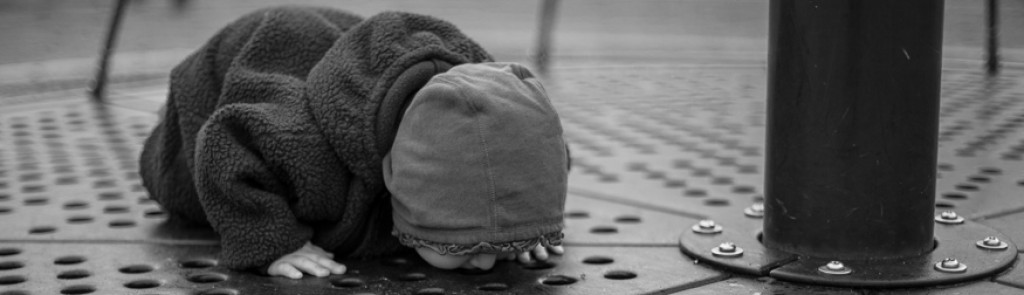
Phi Theta
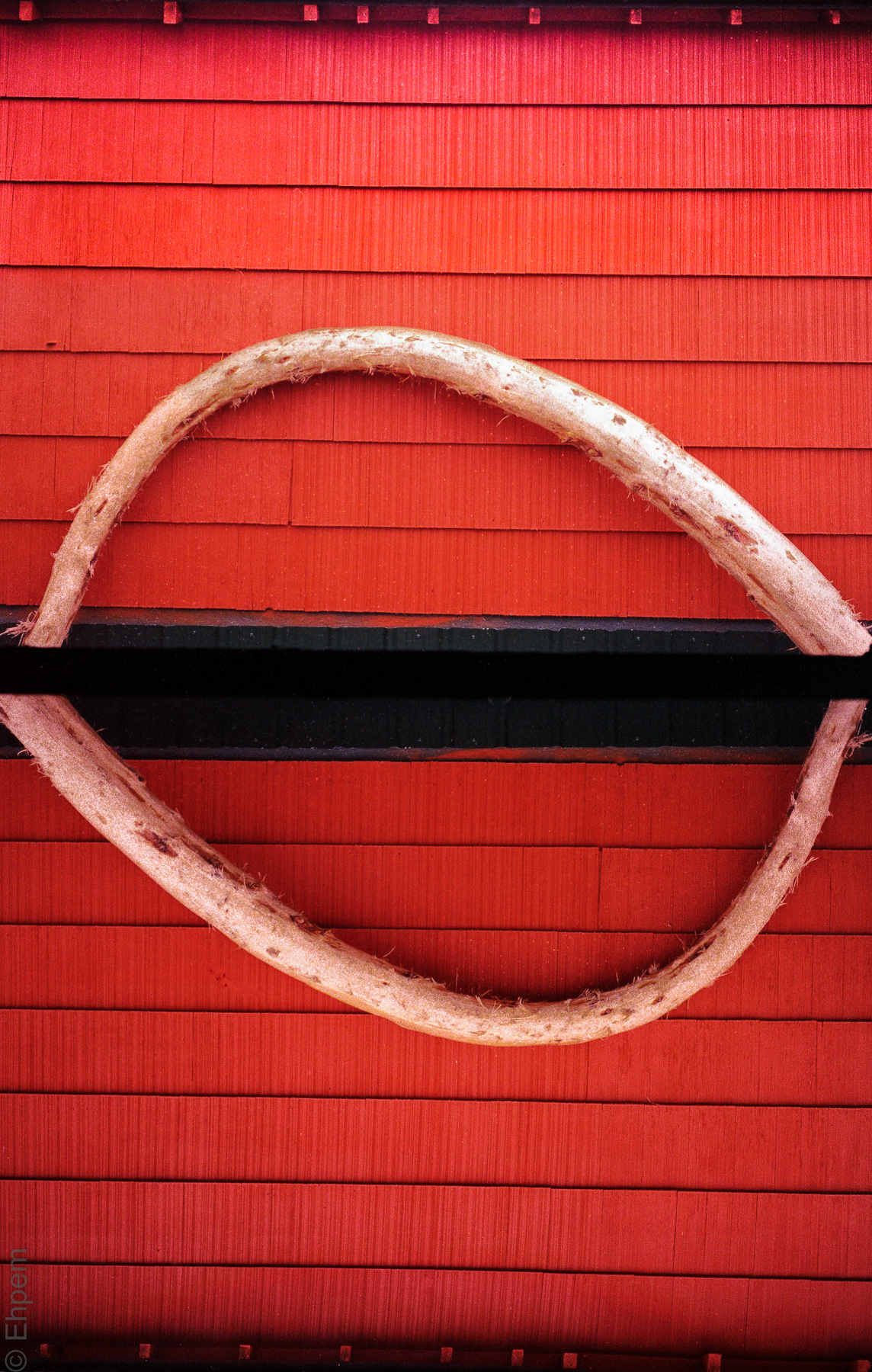
I can’t easily decide between the Phi and Theta versions of this fliptych, but right at this moment I prefer Theta (above). This is the side of the cabin I stayed in at Port Renfrew a couple of weeks ago. It really is this colour, or very nearly anyway. The driftwood was perfectly placed for a fliptych.
This photo was made with the (well one of the) aim(s) of obscuring the black bar between the frames by placing that edge next to a dark area in the photo. As usual, it is two adjacent frames scanned together as one image, and the camera was rotated 180 degrees between shots.
The roll of film was from my parents, given to me with cameras they no longer needed. It is the first roll of colour I have run through the Olympus Pen. It expired in July 2009 so I was not sure if I would be getting any useable shots. Many turned out quite well, so I am hopeful the remaining two rolls will also be good. I hear they have some more in the freezer, though of what type I am not sure. I have held off shooting this film until I got a neutral density filter that would allow me to expose it in bright light since the camera has a pretty narrow EV band of exposures, and 200 ISO is too fast for bright daylight without cutting a couple of f-stops worth of light. Finding 22.5mm filters is not all that easy, but it has been done.

.
I should also mention that a few weeks ago one of my more regular readers and commenters took pity on me when I mentioned my light meter had gone walking and sent to me a surplus and very nice Gossen Lun-Pro, very similar to my missing LunaSix-F. I am using it for a variety of things – confirming my Sunny 16 exposure estimates, making accurate readings in lower light where I am still terrible at estimating guessing, and testing a number of filters I bought (mostly for black and white film) for their correction factor. I don’t know if this generous person wants me to mention their name, so I won’t, but if you want to own up in the comments, please do. The light meter is working very well and helping me a lot with the trickier situations. It is especially nice that it has a dial that can be used to compensate for filter factors and thus I don’t need to do any mental math in the midst of trying to take a picture. Mental math dries up my creative well very quickly.
This gift is an example of the wonderful community that we are part of here, and a form of generosity, support and encouragement that I find amazing. So thank you very much!
.
Olympus Pen, Half Frame, 28mm lens, Fujicolor Superia 200, ISO200, NDX4 filter.
.


 burnt embers
Pingback: Red and Green | burnt embers
Beautiful colours Ephem. I have to go with No 1. It looks like image plus reflection at first glance until you realize the ‘reflection’ is flipped horizontally. This was the ideal object to try this technique out on. Very cleverly thought through.
LikeLike
I’m glad you like this one Andy. It is another of those shots calling out to the photographer. How much a part I have in making these I sometimes wonder.
LikeLike
I had a hunch colour would work well for you and your fliptychs I really like #2 especially. By the way, I think that Fuji Superia 200 is a terribly underrated film. Although many deride such “consumer-grade” films, there’s no denying this one works — as your example shows. It has good colour, fine grain, and is economical as can be. You can get it for $2/roll in the states (B&H), but even buying it at London Drugs locally, it’s only $21 for a 5-pack.
Gary
LikeLike
Hi Gary, you were right with your hunch. I put that roll in the camera more to test that the film was advancing properly and to test that the film was still good even though expired. It is very satisfying to get a shot or two like this – makes the whole roll worth it I think. Though there are some others that I will be sharing that worked pretty well too, though very different from this simple graphic.
The Superia 200 seems pretty good to me, even 5 years past expiry. I did have to tweak the scan settings a fair bit so I am not sure if that is a result of aging of the film, or generally what the film is like. The price is very good compared to some of the money I have laid out for black and white recently (8-10$/roll usually for the types of film I have been shooting), and the processing seems cheaper than black and white as well, which all seems weird to me.
LikeLike
The colours in this are wonderful! Your driftwood makes me think of tusks in the way you have displayed it.
Lucky you with the new light metre, the blogging community really is great! : )
LikeLike
The blogging community IS really great!
I took quite a few pictures of this colour since I had colour film in the camera. But, I would have even with black and white film. Most of the other shots, not of this building, are far less colourful and not as simple. I expect more will show up around here as I get them processed.
LikeLike
If I were you, I’d be headed over to your parents’ house RIGHT NOW to raid the freezer for the remaining film. These shots turned out very well.
It is amazing the way we’ve created our community here – it is something that I certainly never even imagined was a possibility when I started blogging.
LikeLike
Thanks Melinda!
I had no clue about an internet community when I started either.
LikeLike