Fujitar P.C 35mm F2.5 Asahiflex Lens Test

In this post I present tests of a Fujitar P.C 35mm f/2.5 lens that came with my Asahiflex IIa (more about that kit here: link). This preset lens was made by Fujita Kogaku Kikai (according to this source). It is considered one of the earliest Japanese retro-focus lenses. The 35/2.5 came with the Asahiflex in a leather case with both end caps. The end caps are plain, but the leather case is embossed with Fujita Kogaku (see image in gallery below). There was no lens hood.
Of the three lenses in the kit this is the one that looks like it was used the most. I am not sure if that is because the metal surfaces are different from the Asahi-Kogaku Takumar lenses and more inclined to show dirt and wear (quite a few of the other examples with photos on line have a similar grubby look to them), or if it was the lens chosen the most often. I suspect the latter as I certainly gravitated to it of the three lenses. I really like 35 mm focal length, and because 58 mm seems a touch long. Though when I see the tests below, I think I will be more often using my S-M-C Takumar 35 (as I have done since the 1970’s).
The tests are made by adapting the lens to a DSLR. I compare it with a Super-Multi-Coated (shortened in this review to S-M-C) Takumar 35 mm f/3.5 lens and a Nikon Series E 35 mm f/2.5 lens. The Fujitar lens has a m37 mount, the S-M-C Takumar has a m42 mount and the Nikon has a Nikon mount. The S-M-C Takumar and Nikon lenses are the only other lenses that I own with the same focal length as the Fujitar lens. The S-M-C Takumar is well-known among the vintage lens fraternity so provides a useful baseline for comparison. The Nikon is known and oft derided as one of their poorest lenses. The tests included approximations of f/3.5 on the Fujitar and Nikon which are not marked for this value in order to match the S-M-C Takumar when wide open. These two lenses open up to f/2.5 so I include tests at that setting too.
E is for Edgewater
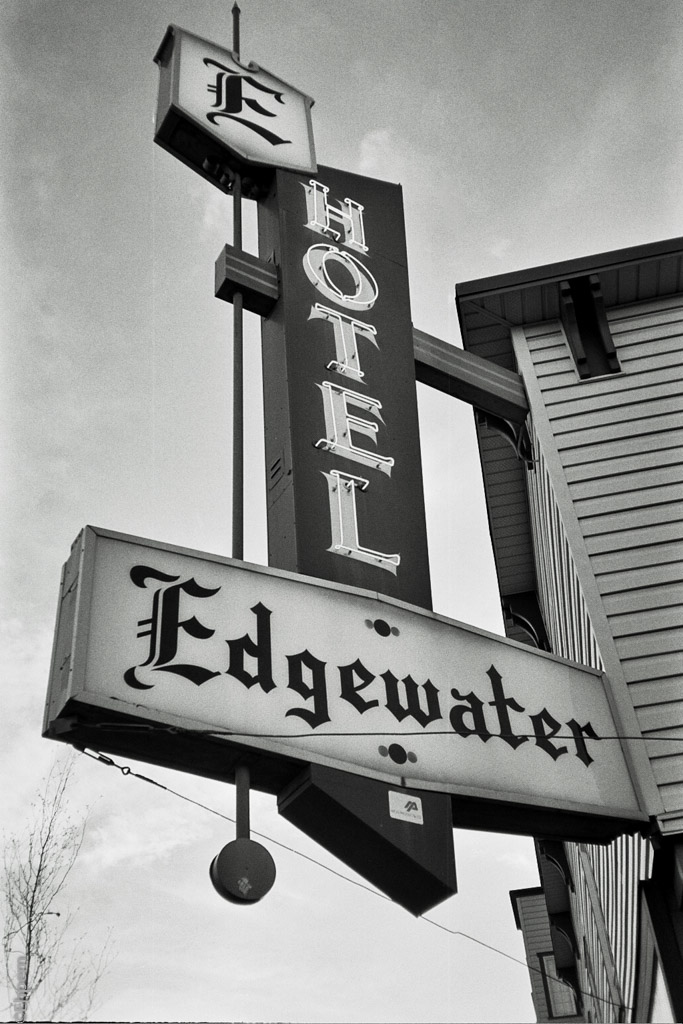
Downtown Whitehorse, Yukon Territory.
I took some colour shots of this sign too, but this is the one that comes to you first.

Asahi-Kogaku Tele-Takumar 135mm F3.5 Lens Test

I made a series of tests using a DSLR to judge the performance of the Asahi-Kogaku Takumar 135 mm f/3.5 lens that came with my Asahiflex IIa (more about that kit here: link). I compare it with a Super Multi Coated Takumar 135 mm f/3.5 lens and an Opticam Auto 135 mm f/2.8 lens. The Asahiflex lens has an m37 mount, the others have m42 mounts. The Super Multi Coated Takumar and Opticam lenses are the only other m42 lenses that I own with the same focal length as the Asahiflex lens. The Super Multi Coated Takumar is well known among the vintage lens fraternity so provides a useful baseline for comparison. The Opticam is poorly known, is not the preset model and the Korean manufacturer is a mystery. So, you can consider this a test of the Opticam too, if you like.
Whitehorse Raven
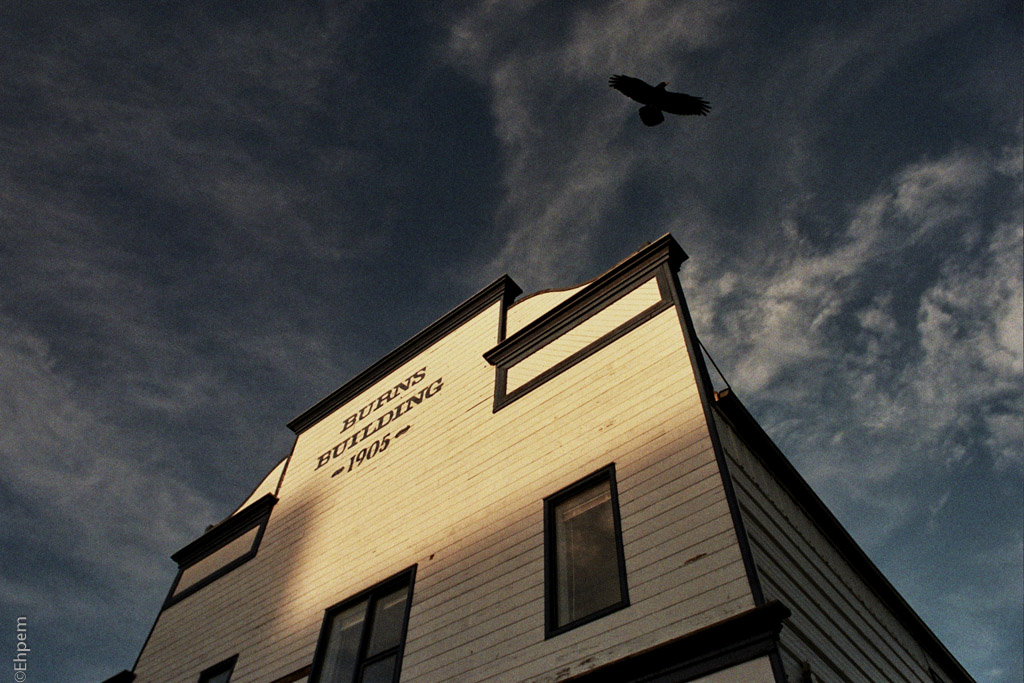
Downtown Whitehorse, Yukon Territory.
I think this is my favourite shot from the short trip north last weekend.
Yukon River

Yukon River in Whitehorse, Yukon Territory.
This shot was made at sunrise (10 am) but the sun did not get much higher than this before setting mid-afternoon (4 pm).
We spent last weekend in the Yukon, attending and speaking at a book launch for a book I co-edited.
I also authored a few chapters as did my wife and many others so we were invited to the Yukon launch of the book in Haines Junction.
It was great to catch up with nearly 20 year friends that arose from this the Kwädąy Dän Ts’ìnchį project.
Top Posts & Pages – Click Thumbnail To View


Recent Comments
♦ FUJITA (藤田光学工業) H.… on Fujitar P.C 35mm F2.5 Asahifle… ehpem on Child’s Grave Kyle Hoyt on Child’s Grave ehpem on Charles Elliott Pole, Universi… Lisa Kadonaga on Charles Elliott Pole, Universi…


 burnt embers