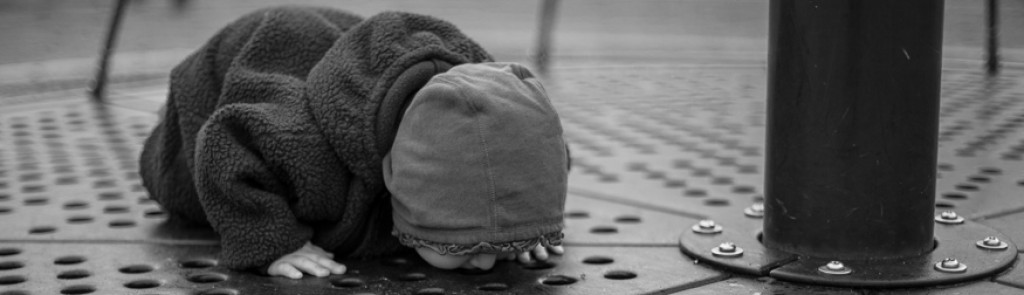
Comings and Goings

These photos are on the waterfront path at the Beacon Hill Park waterfront. It was interesting to take a shot with people (and animals) approaching a ‘milestone’ and then from the other side as they left it behind. Very tricky framing though, in such a rush. However, if you look at the bottom combined photo, you will see evidence that I did take some care in setting these shots up, even though I have yet to use a tripod with this camera. Considering that I moved locations twice between the first and third, and second and fourth shots, the similarity in framing is quite remarkable. I just should have tried to also get the level of the marker a bit more similar within the pairs.
I also think that the two sets go well together in one image, as in the last shot. It also shows the difference in pattern depending on which one order one shoots. The middle two frames in the combined image have a strong V in them, which I have exploited in subsequent shots.
A Wall of Rock
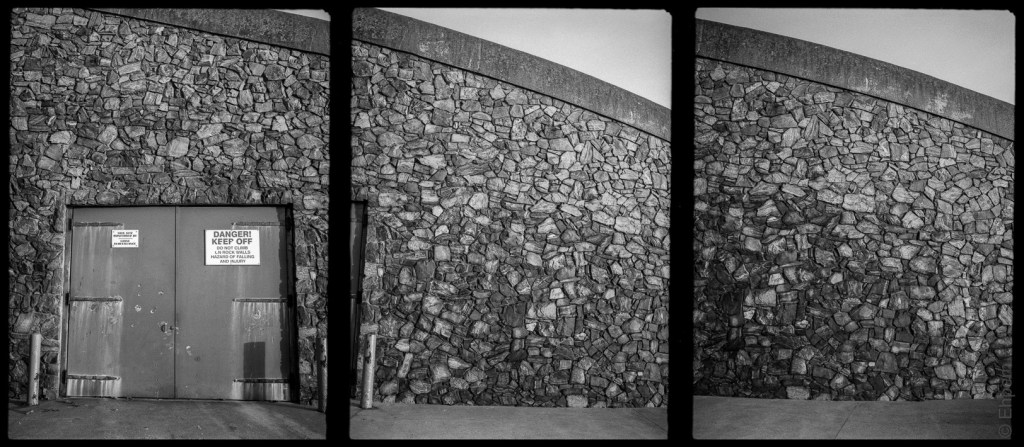
Last week I featured views of the Clover Point pumping station, made with my digital camera. Today’s photos are of the same place and time, but with the half-frame film camera. What I find interesting about these panoramas is that each shot is from a slightly different viewpoint.
This wall curves around a >90 degree corner and to take the pictures I walked around the wall trying at first to keep a similar amount of the frame covered by wall (that meant getting closer as the wall got shorter) and then when my shadow started to predominate just keeping a similar distance from the wall. I also tried to slightly overlap the photos, but that was tricky as there are no highly visible landmarks on most parts of the wall. There is an implicit motion in these pictures, especially in the way the metal rail over the vent structure slowly comes into view turning its face to the camera. This motion is not otherwise visible in the wall as it is curved and each shot is from a similar angle to the curve.
I also like how the pictures look stacked together as a series. I can’t scan more than 6 or 7 frames at a time, so chose to break this sequence into smaller parts. Now, I just needed a dog, or person in a frame or two. Sadly, they all walked behind me as I was obviously taking a picture – so polite!
Horizon(tal) Fliptych II

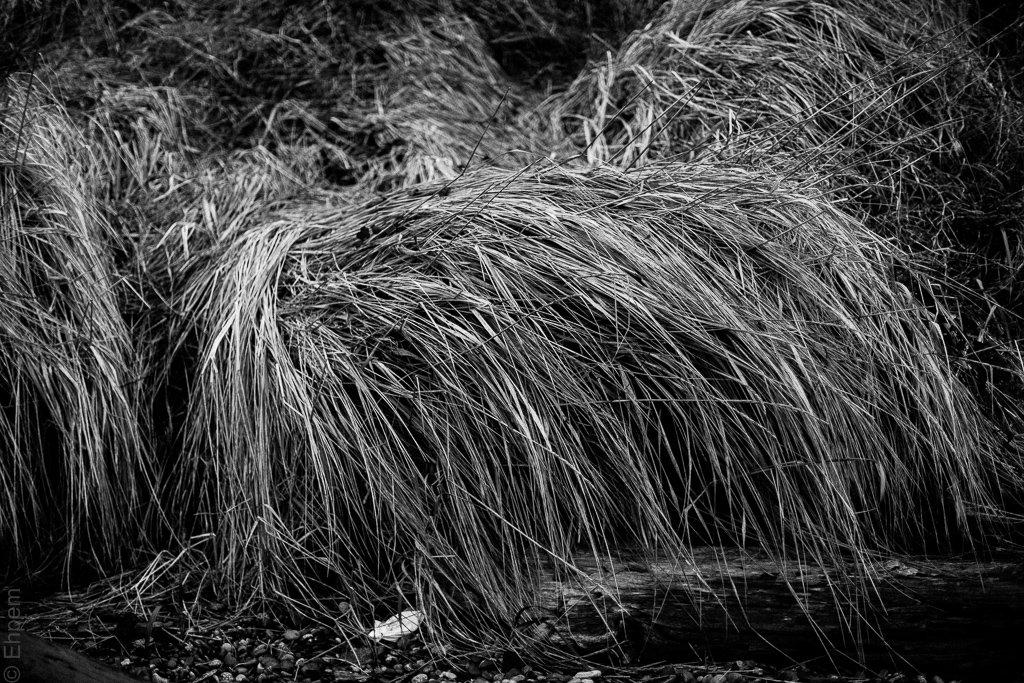
The other day I posted some diptychs that explore the ideas I have looked at with single frames from the DSLR. The two versions I presented there are from three images that were taken as a triptych, which is what I show you today. These are made by flipping the camera 180 degrees between shots, and on the half-frame Olympus Pen, they have nice proportions that go well together, especially as triptychs.
View Towers Montage
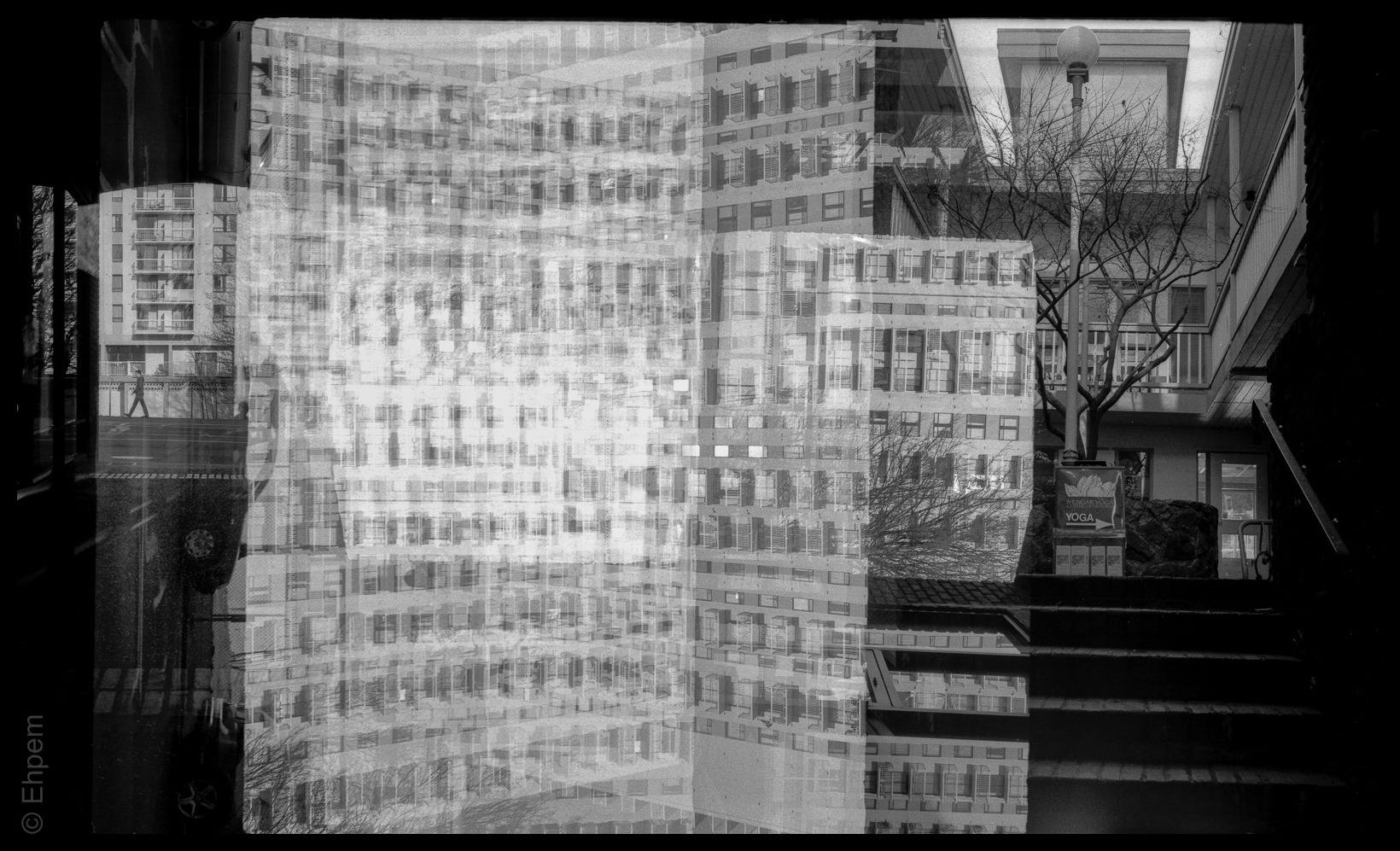
My latest roll of film from the Olympus Pen half frame camera could be considered a disaster but I prefer a wonderful accident. Such as the shot above, which is an in-camera montage of View Towers seen from Fort Street, from within a passage way that leads to Meares Street, and a shot or two within the passage without View Towers at all. Both portrait and landscape formats are involved, and a fliptych or two in landscape mode as well. Below is one of the diptychs I was shooting (with a sliver of the above image on one side as well).
I had meant to try a shot of this side of the building for some time – you will see from the link in the previous paragraph that I have stuck with the ends of this building, or closeup views. I have been a bit daunted by how much of a slab, a cliff face, this building is from the north and south, and it is hard to fit in the frame of all but the wider angle lenses, so I have never got a good shot from this side. You can see what it looks like from the north in this link, a local photography blog which I only just discovered and which is well worth a good look through.
Seeing Gary’s shot inspired me to try something from Fort Street where I used to stand for the bus most days staring at this edifice. I thought I would do it in a half-frame multitych format. However, I think the above shot is better than what I might have accomplished in that style. I think the jumbled overlays represents this large block of flats and the lives lived within quite well, and in a way that I would never have thought of. Which makes it food for thought, and a seed for experimentation. I like it that the view from across the street is embedded, and the relatively affluent existence of the lawyers offices, pricey restaurants and yoga studios stand out around the edges of this low rent and locally rather notorious accommodation.
While on the subject of windows, this morning I was reading an interesting post by one of my followers and occasional commenter on these pages Angelina Hue. Her post, Facing Windows: Voyeurism or Art, delves into the sometimes extremely fine line between voyeurism and art when photographing buildings and what people are doing as seen through the building windows. She provides some thought-provoking links on the subject and it is worthwhile spending some time browsing her listed sources. Those thoughts go well with this post, or at least with the photos I intended to take and post. One of the interesting things to do while waiting for a bus at this spot, at the end of the day, is to watch the lights come on as people arrive home from work. To see the things they do at their windows or on their balconies and how that changes when, for instance, there is a glorious sunrise to look at. From the vantage point of the bus stop it does not seem like voyeurism, but it does feel a bit nosy. Seeing this monolith come alive as people come home is interesting, and in many ways it is just a vertical part of the street scene with people going about their lives. Is it nosy or voyeuristic to stand at a bus stop and watch people walking or interacting on the sidewalk?
Land, Sea, Sky Triptych
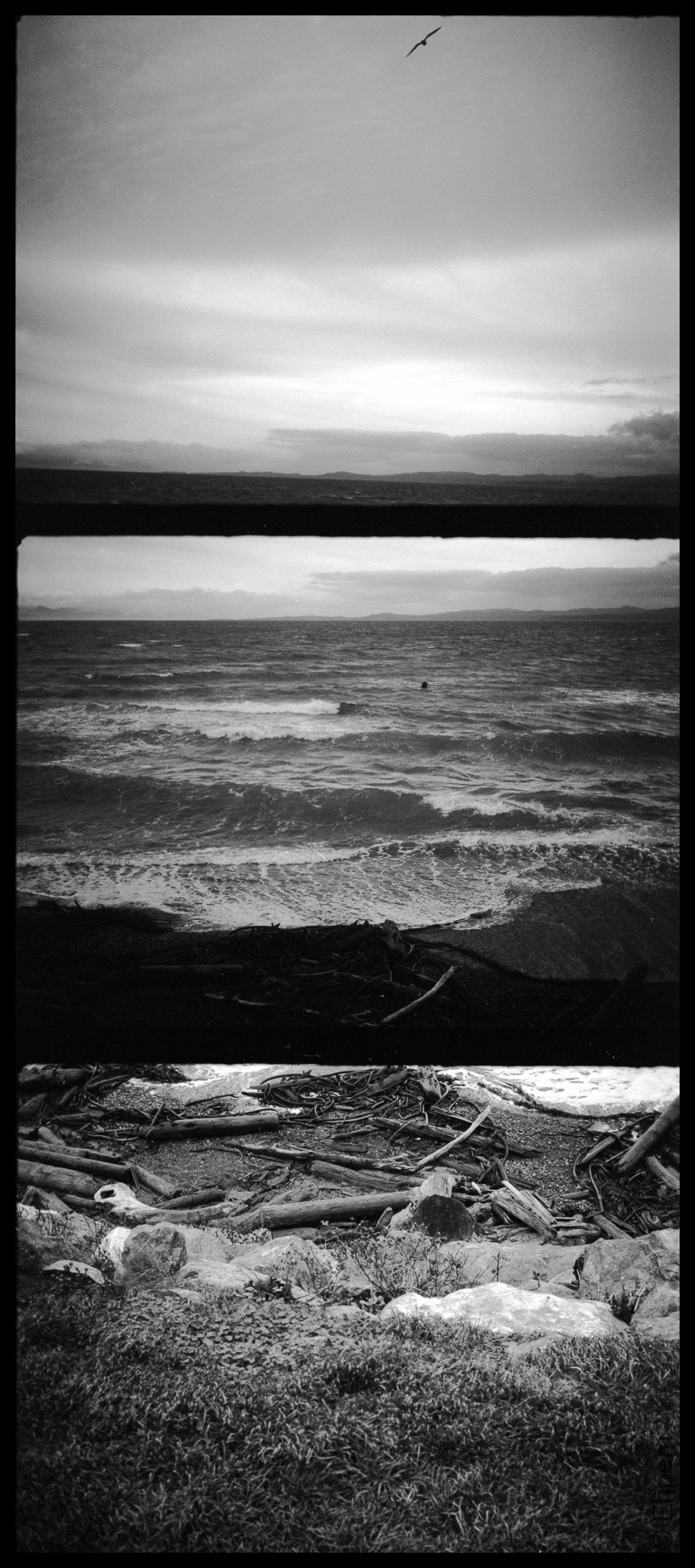
A blustery day on Clover Point looking towards the west. The seagull appeared at the perfect time – in fact I would argue that it makes this shot. I changed the exposures between each frame and think that I used a yellow (K3) filter on the upper two shots as well which might be why they are a bit less sharp – I am still working out what the issue is with that filter (probably how I am using it). I also need to work a bit more on the overlap between frames.
I have done a bit of experimenting with the overlaps. From some frames I took of my french doors, I find that when I shoot within the borders defined in the rangefinder I get another 11% of view on each side on the negative. I can see that extra, and then some, because the viewfinder projects lines onto a broader scene. So, I just have to frame from outside the lines. And to learn where those new invisible lines are for when I don’t want overlap between frames. However, I am considering attaching a grid to the viewfinder somehow that would give me more control over keeping things aligned in all directions.
Horizon(tal) Fliptych

Anyone that has been hanging around this blog for the past few months will be familiar with my Horizon(tal) series. These images combine my experiments with the Fliptych concept and the simplicity of our winter horizons.
All are scanned from two of three separate half-frames shot with the Olympus Pen (that is each pair shares at least one frame). The frames are adjacent and in a later post I will show the triptych versions. I am really pleased with these simple abstractions. The bottom versions are toned in a manner I have done elsewhere in the horizon(tal) series, and rotated to abstract them even further. I like how the brighter strip of clouds along the horizon is roughly the same width as the black band between frames.
Top Posts & Pages – Click Thumbnail To View


Recent Comments
♦ FUJITA (藤田光学工業) H.… on Fujitar P.C 35mm F2.5 Asahifle… ehpem on Child’s Grave Kyle Hoyt on Child’s Grave ehpem on Charles Elliott Pole, Universi… Lisa Kadonaga on Charles Elliott Pole, Universi…


 burnt embers