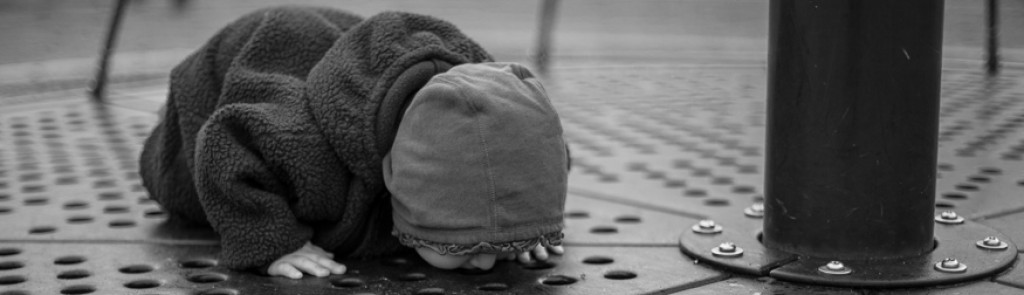
Dawn Light in B&W
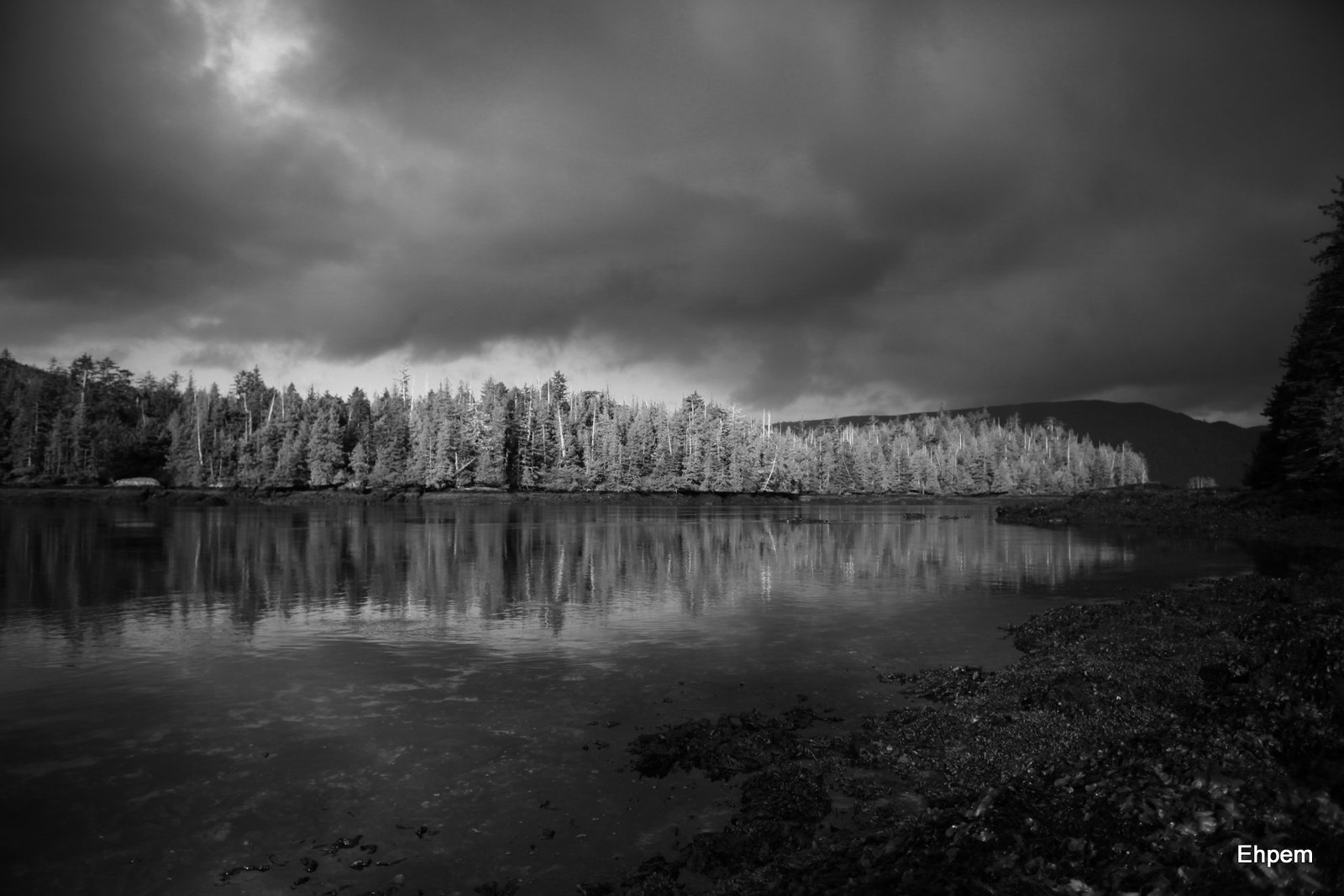
Dawn was typically viewed as we went to work at the Kilgii Gwaay site the first few days, and sunrise was viewed as it lit the shores opposite the site while we worked, as in the above picture.
(more…)
Water Screen

Water screening is absolutely essential on a wet site with its fragile artifacts coated in dark mud – without washing most things would go unrecognised and many would be ground to a pulp in the screen. When screening sediments were from these most delicate layers we would not even shake the screens, but would gently spread the contents of a bucket in the screen and wash the dirt away.
A water screen is the same screen that an archaeologist might use for any task. What distinguishes it is that water is used to wash the sediments placed in the screens. As is often the case in Northwest Coast archaeology, we used nested screens – the top one with a 6mm (1/4″) mesh, the lower one with 3mm (1/8th”) mesh. The top screen catches the larger stuff, and once picked through and completed, is lifted off and the lower screen is examined for very small things that might be missed when mixed with larger pieces like pebbles or whole shells. Sometimes there is concern that things of interest might be smaller than 3mm and in those instances we would sample the layers in the ground for fine screening in the lab.
(more…)
Kelp and Mussels

I am preparing this post on Friday night and am feeling lazy. So just two images today, and scanty text. I have lots more to present about the Kilgii Gwaay site and our activities there, but that will be on other days.
(more…)
Bucket!
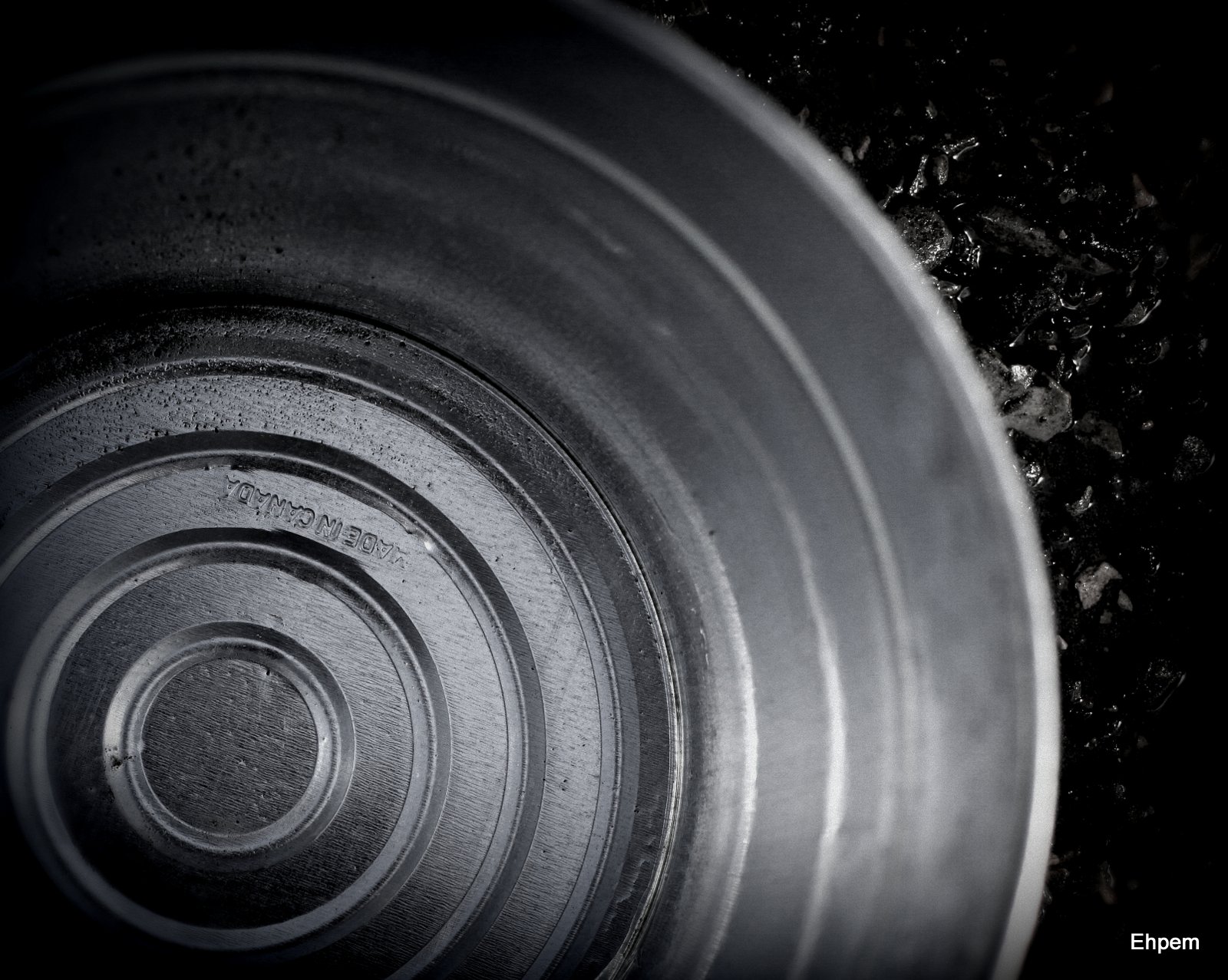
Bucket! It’s a common cry on an archaeological site, usually from the excavation unit, impatient to keep on digging.
Buckets are essential to an excavation. They have to be well made, tough, and preferably quite light. These metal buckets fit that bill – so much superior to the typical domestic plastic bucket that is only good for a day or two before it comes apart. And better than surplus commercial restaurant buckets – the big white ones – as they are too big and too easy to overfill, becoming impossible to lift to the screens without help. Besides that their handles come off.
These metal buckets are the right size (Kilgii Gwaay sediments are mostly water and minerals so these buckets, when full, can weigh 50, 60 or 70 lbs), you can sit on them to take notes when a boulder is not conveniently placed and if they get thrown down or kicked aside, they dent but don’t break.
(more…)
SGang Gwaay Llnagaay
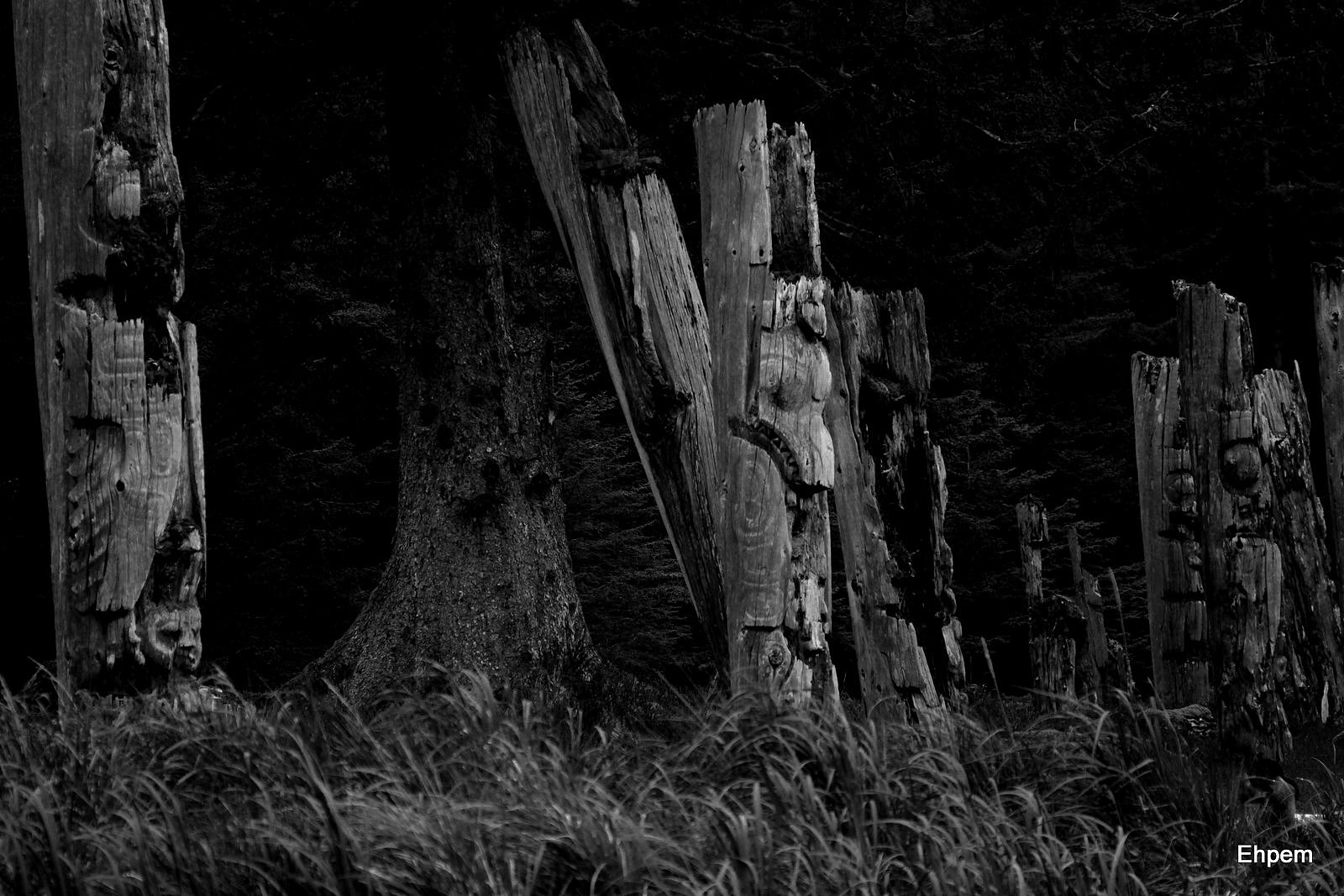
SGang Gwaay Llnagaay is a Haida village site that is listed as a UNESCO World Heritage Site. SGang Gwaay is the Haida name for the island on which the village is located though it shows on the charts as Anthony Island. Llnagaay means town or village. The name SGang Gwaay “refers to the wailing sound made when winds push through a hole in the rocks at a certain tide level” (see this link and this one for more information). The village is also known as Ninstints or Nang Sdins Llnagaay after one of the chiefs that lived here. The island is off the west side of the south end of Moresby Island, about 10km from Kilgii Gwaay, in an extremely exposed part of the coast. While the distance seems short, this stretch of water is often unpleasant with strong tides sharpening and elevating already large waves. Some days the trip is just not possible. Fortunately, the wind settled enough so that on our last day at Kilgii Gwaay we could include a trip to SGang Gwaay so that Dale Croes could see it for the first time, and so that the rest of us, and especially the Haida crew, could recharge our batteries at this very special place.
(more…)
Putting Water In
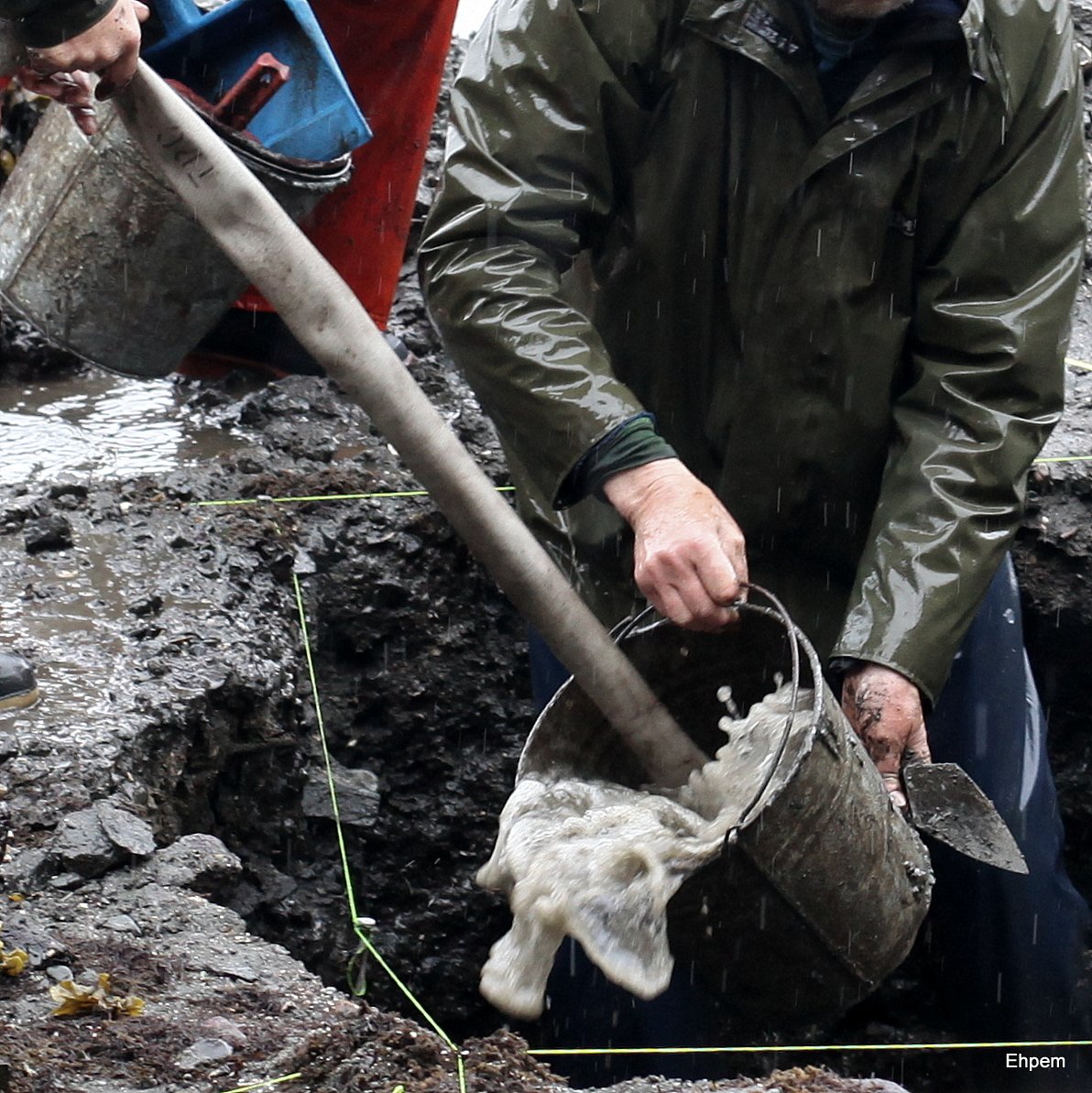
I continue the theme of water at the Kilgii Gwaay archaeological site in southern Gwaii Haanas. Yesterday’s post, Keeping Water Out, was all about our efforts to remove water from of our work space. Today’s post is all about how we put water into work space.
Keeping Water Out

Today I continue my account of working on the Kilgii Gwaaysite in southern Gwaii Haanas for two weeks in early June – yesterday’s post summarizes the importance of the site and the kinds of information it holds.
Archaeologists are often interested in water as a subject of their study – for instance the relationship between settlement patterns and proximity to potable water or the role of irrigation in the development of agriculture. At Kilgii Gwaii water is a totally dominant theme, though it plays a minor role in the research questions. Some research questions that might be of interest are why did these people situate the Kilgii Gwaay camps next to the pond? Was the pond or its mud used for some purpose to do with curing hides, soaking wood to make it more pliable for some use such as basketry or bending boat frames or perhaps for colouring some elements of basketry black? Interesting possibilities of a type that may be explored during analysis.
However, water is much more fundamental to the Kilgii Gwaay project than a few research questions about a pond. First, it is a wet site and water is a necessary part of the preservation of wood and bone. Without it, the site would be one of dozens of similar stone tool sites in Gwaii Haanas and, while interesting, it would not be highly significant. And then there are all the logistical considerations of working with water at this location.
(more…)
Top Posts & Pages – Click Thumbnail To View


Recent Comments
♦ FUJITA (藤田光学工業) H.… on Fujitar P.C 35mm F2.5 Asahifle… ehpem on Child’s Grave Kyle Hoyt on Child’s Grave ehpem on Charles Elliott Pole, Universi… Lisa Kadonaga on Charles Elliott Pole, Universi…


 burnt embers