
Tide Pool Filtered
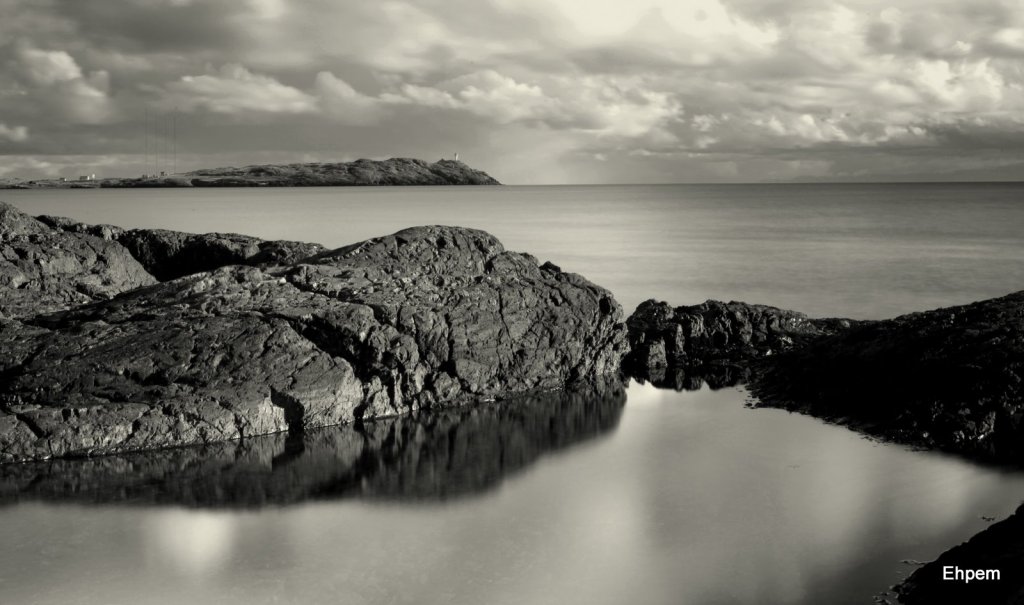
More long exposures of the water’s edge on Harling Point, but this time taken early afternoon with the aid of a neutral density filter. Two views of the same tide pool with Trial Island in the background. Once again I was ambushed by a left over white balance from the night before, tungsten I think (you would think I would learn, eh?) I did not notice it until well into the session mostly because I was thinking very hard about the filter and how to use it and so on. Anyway, it left me with blue images that, with my software, I am not able to correct back to something that looks normal (though I did arrive at a colour that is very much like a faded print or slide from the 60’s which had its own attractions). I settled on a black and white treatment of these images as the least distracting.
The ocean was very calm for this time of the year – sunny patches with small ripples on the ocean and bit of a stirring of the surface of the tide pool. Not ideal for getting a silky water appearance I don’t think, or else I need an even longer exposure for that. The light made a big difference to both Trial Island and the rock in the foreground, and over a long exposure it was a bit of a gamble as to which shots would be well lit. To my eye the top picture is better in that respect than the bottom one. But, I like the faint ripples on the surface of the tide pool in the lower picture. And the way the clouds, which were moving, are a little bit blurred, but in a way that is expected of clouds.

.

The filter I purchased is from a Canadian company called Cameron. It is a Fader ND filter – that is you can rotate an outer ring and change the density of the filter through a range of about 8 f-stops. The obvious attraction was that it was only $10 more than a regular fixed ND filter and really is like owning several ND filters. It was less than $70 at my local camera store, which for fader filters seems very cheap. Like me.
To an extent I have got what I paid for. The filter works, but is not well graduated. It has marks on one ring and an arrow on the other ring, but the filter extends a bit beyond the registration marks in one direction and not all the way in the other. Since the registration marks don’t really mean anything (they are just bigger and bigger rectangles), this is not a big deal. I spent quite a bit of time figuring out where the f-stop changes were and making my own marks so I have a rough guide as to how many f-stops I am dealing with. Also, an annoying feature which is not the Cameron filter fault, is that when screwed on over my UV filter, all the registration marks are pretty much on the underside of the lens, where they are very hard to see. I can swap out the UV filter then the fader ND works OK, but I really dislike exposing the glass to the elements. I may need a second set of registration marks on the other side of the ring for use over this filter.
When I was choosing the filter I rejected two before I found this one. The first two each had one tiny inclusion in the coating of the glass which left an extremely small raised area in the coating. This was only visible when a ceiling spot light was reflected in the filter in just the right way. I have no information that this blemish would alter image quality, but guess that it might in a very small way. Anyway, I found one that did not have this issue. If I had the right tools, I could loosen one of the filter glasses and rotate it just a bit and re-tighten and the registration marks would be in the right place as well, for whatever they are worth. Otherwise the filter seems well made. It has a larger diameter on the outer ring so that other filters can be attached without causing vignettes.
As to other filters, on my first outing I have experienced what seems to be a common problem with long exposures is that some brighter areas get very overexposed, especially this time the white areas of cloud. So, probably I also need to get a graduated filter to darken up the sky. But not till I have experimented enough to really understand this filter and how to use it. Which will take some doing I think.
.
Image taken with Canon EOS 5D MkII, Canon 50mm f1.4 lens, at ISO 100. Top image f22, 20 seconds, filter at maximum density (ca 8 f-stops). Bottom image f22, 6 seconds, filter at about 6 or 7 f-stops density.
.
.


 burnt embers
Pingback: Wide Tide Pool « burnt embers
Hey there, over all…I prefer the first image. The clouds/sky is simply wonderful not to mention, there’s more of it in the image (personally, the “sky to land” ratio is better in the first). I actually like a few things with regards to the rock in the first image (camera centre/left). The reflection is great, the texture and contrast I think are way superior in the first image. Really nice job!
I’ve got a ND8 (3 stops) and an ND400 (9 stops), love both of them. I thought about getting a variable ND filter but decided to just get these. Hope you have a great time with the filter and look forward to seeing more captures!
I think we have all left the camera in the previous day’s setting and forgot about it, it’s only natural!! I know I sure have on more than one occasion…think of it as…a learning experience. 😀
LikeLike
Hi David – thanks for your detailed comments, I really appreciate them. That missing sky in the second image was cropped out because the clouds were badly blown out. I see what you mean about the ratio, and the texture/contrast as well. Much better light as it happened.
I expect I will be having fun with the ND filter. I am still not sure about a variable or fader filter – it would be nice exactly what I am getting. But, mostly what I am looking for is length of exposure so probably it does not matter if I am not sure what I have when I put it on the camera as I will have a range of options. I liked the water in your recent photo which must have been using your ND8 (I would guess) in your Snowmaggeddon post.
Yeah, a learning experience. Over and over again.
LikeLike
By the time I got home, walked over to the river, composed the image…an ND filter just wasn’t needed!! 😀
LikeLike
I know what you mean. I wanted to take pictures when I got home at 5pm today – but I would have been pushing the ISO to the limit I think, it was like night time with those thick low snow clouds. It feels like winter around here today.
LikeLike
I like both images. They’re beautiful. Very peaceful. 🙂
LikeLike
That is a huge compliment – what more could I ask for than that people find peace in my photographs? Thanks so much 🙂
LikeLike
I like both photos…and with some creative cropping you could use them for your aerial miniature landscapes!
LikeLike
David, you anticipate my own thinking! These kinds of shots lend themselves very well to miniature landscapes.
LikeLike
I prefer the detail in the sky on the first shot to the second, but I’m quibbling. I like both shots. i have not heard of the Fader filter, so I’ll have to look into that, it sounds interesting.Have you tried using the camera bracketing function for shots like this? I’m not too familiar with the 5D, but most high end cameras have Auto Bracketing functions that can come in handy.
LikeLike
Hi Ken – so far I have only spent about one hour with that filter taking pictures (and an couple more figuring out how it works and so on). I wonder how bracketing would work with a 20 or 30 second exposure. It is an interesting idea because 2 f-stop difference on 30 second exposure would be 2 minutes in one direction and 7 or 8 seconds in the other (I think). I wonder if the camera can handle that. Will have to try. So far I have not used the bracketing feature on my camera at all. It brackets with 3 shots total and that can be up to 2 f-stops in each direction of the metered reading. I think that some Nikons will bracket with 5 shots, but probably over the same range of exposures. Since the camera only takes up to 30 second exposures before you have to use the bulb setting, I am thinking maybe it won’t bracket longer than that. If it did, that would be a cool work around for the 30 second limit.
LikeLike
Thanks for sharing all this information. I just got some new equipment and know just what you mean about it taking some time to learn what all it does. I like the top photo. It looks dreamlike and surreal to me.
LikeLike
Hi Danita, there really is so much to learn. I doubt I will ever properly understand my camera. And then these accessories are just multipliers of the camera’s complexity. How do they work in x, y and z modes could occupy a very large amount of study time.
LikeLike
I loved the first one! 🙂
LikeLike
Thanks Nandini 🙂
LikeLike
Me too. The top one. Really nice long exposure.
LikeLike
Hi Simone – thanks for coming to visit my blog, I appreciate it. And for your comments too, they are most welcome. I have been having fun with long exposures. I appreciate having this filter now so that I don’t have to do all of those shots early in the morning, or when the light is failing. But, for really long exposures it looks like I will still need to be out at those times. Or get another filter.
LikeLike
I prefer the top one. I like how the water looks silky in the tidal pool.
LikeLike
Hi Doug – I too prefer the top one. For that reason, and that the exposure is long enough, or else the breeze was intermittent enough, to have a shadow show in it too. Also, the quality of the pool surface is similar to the ocean, but distinguishable. And, the rock has better light.
LikeLike