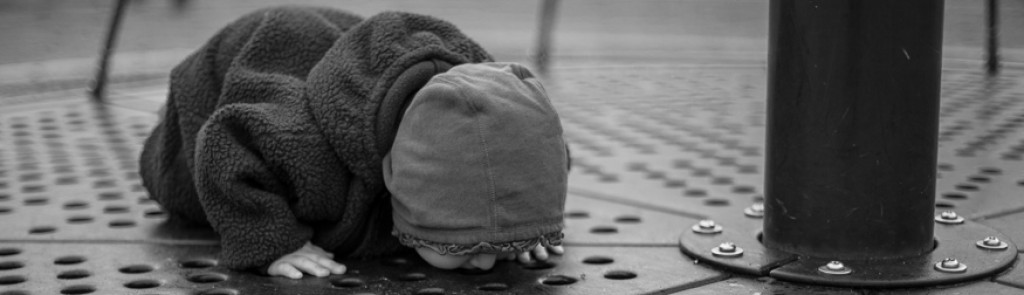
First Click

This is the first shot I took with my latest film camera purchase, a medium format Mamiya M645 Super. This film was in one of the film backs, with 5 exposures left, so I shot it first. The tonal range may be influenced by the film having sat in the camera for many years.
It took me a while to get over inertia and actually take a picture and it did not happen until I was out on a photo walk a couple of weeks ago with Gary of FilmAdvance. He suggested, probably correctly, that I was reverting to type by making the first shot a detail from a First Nations totem pole. These three versions of the same shot include the full frame and two crops from the negative to illustrate the detail that is found on a medium format negative.
The camera is huge when compared to my go-to pocket camera, the Olympus XA/XA2. The film backs alone are bigger than those cameras, come to that so is the lens, so is the view finder and the you could probably fit two XAs into the body of the Mamiya. It is a very modular camera allowing for changing pretty much everything about it. There is a large selection of lenses still readily available on the second-hand market, several view finders, including a vertical one and one with light metering, a hand crank or a power winder, and backs can be had for 120 and 220 film, as well as Polaroid.
Around Front

A few weeks ago I posted a shot called Around Back, a view of the backside of the J&J Wonton Noodle House on Fort Street.
It is one of my favourite places to eat, and thus when a family member was visiting from out of town, we had a family meal there.
The cooking area has a glass wall and of course a picture seemed necessary. The server said it was just fine, the guys were used to it.
So here are the two pictures I took with the Olympus XA2 of our meal being prepared.
Reflecting View III
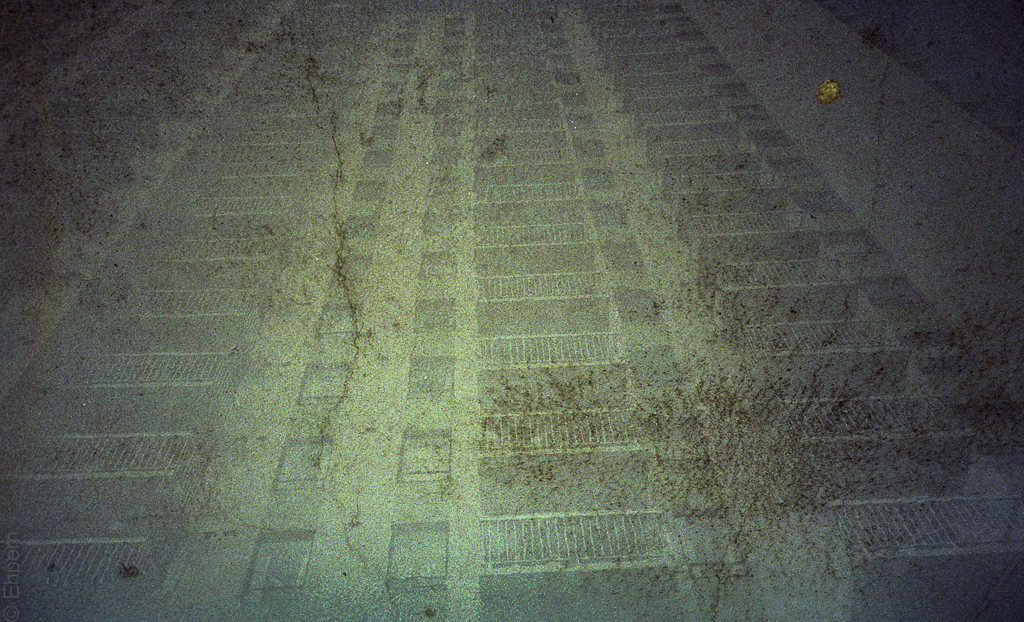
Another in a short series showing View Towers reflected in very thin and intermittent puddles.
This one too was made with expired Kodak Gold 200 on the Olympus XA2.
Ross Bay Sunset

I was wishing I had a different camera with me when I came on this sunset.
So I took just one shot with the point and shoot, and backed it up with my camera phone.
In the end, the Olympus XA2 handled it just fine – better than I expected.
Reflecting View II
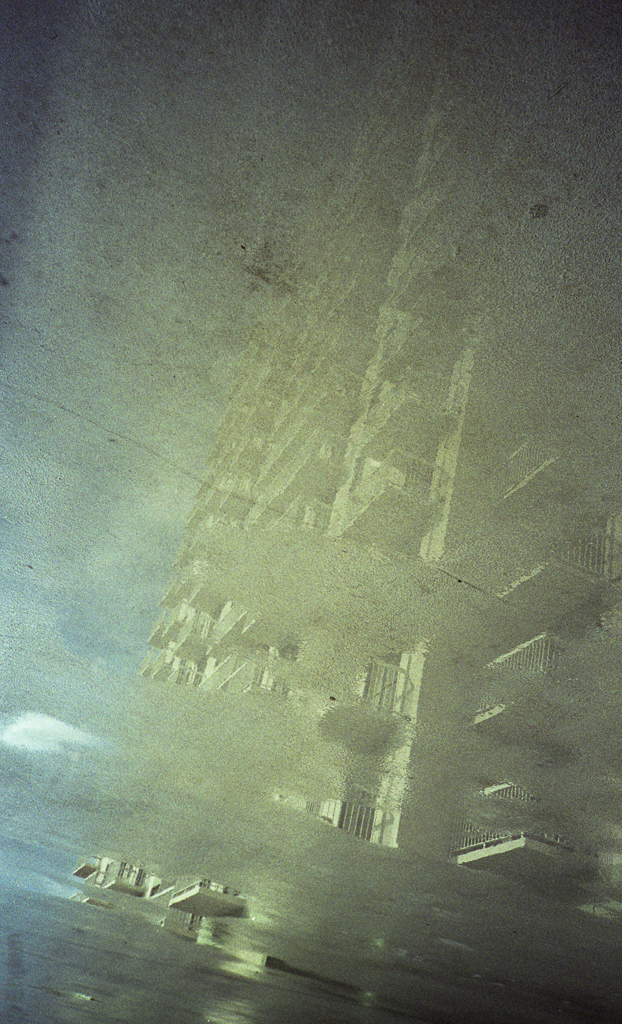 Today’s shot follows from Reflecting View – it seems to be shaping up as a short series of View Towers reflected in very thin and intermittent puddles.
This one too was made with expired Kodak Gold 200 on the Olympus XA2.
Found on Bedrock

This building is in the Songhees development in Vic West. Sadly, the buildings that are on the waterfront in this prominent inner harbour development are hideous 80s-style pink and grey unimaginative stucco-clad warts on an otherwise beautiful harbour. This building, which is worthy of a prominent position on the waterfront, is hidden behind the warts. I had never even noticed it before, not often walking in this area, and when I do, I follow the waterfront walkway. Which should teach me something.
This shot was taken while walking around, cameras in hand, with Gary of the FilmAdvance photo blog. Inspired by the bad design along the waterfront, Gary led our conversation to a discussion of Deiter Rams’ 10 principles of good design. I had not heard of them before, so he sent me this link, with the comment “read them and consider how badly designed most DSLRs are.” Gary is right, and I think this provides an explanation for why I have found shooting film to be liberating in many ways. Film cameras are by and large good design. Cameras like the Olympus XA models are more than good, they are in the genius category. Using them gives me so much pleasure with everything in the right place, and only the essentials, all of which work. In fact, they work better in most common photography situations than the more complex SLRs, even the well designed ones. And that pleasure, combined with the lack of obstacles like too-deep electronic menus and buttons in the wrong places and waaaay too many choices help me to be more creative, to focus on what I am doing and not how I am doing it. I am grateful for this enlightenment as I had wondered why film had jump-started my rusty old creative engine. Nice to have a stroll with cameras in hand combined with good conversation – photography, creativity, exercise, intellectual stimulation all in one package. That must hit most of the principles of good design.
This building is shot with expired Kodak Gold 200 film on my Olympus XA2 point and shoot. The film has colour shifted a fair bit. For this shot, conversion to black and white works a lot better for me than the colour (see below). For some of the photos, like yesterday’s Reflecting View, the colour works better than black and white.
Reflecting View
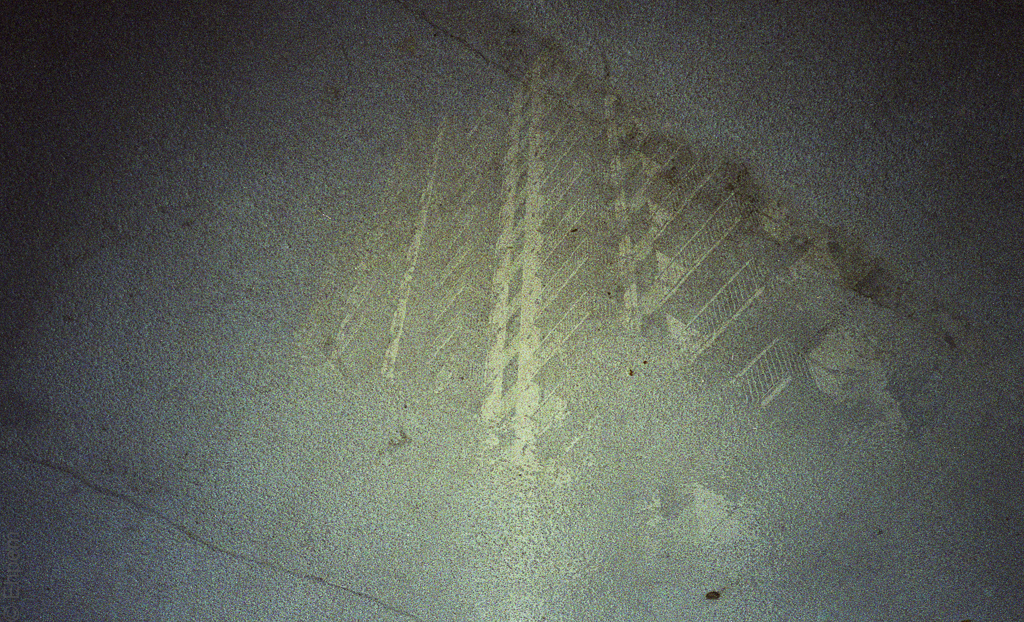
Contrary to appearances, this is a single exposure. It is made on film of a weak reflection of View Towers in a very thin puddle resting on concrete which adds a lot of texture and “grain”. If I could market this as a Lomography plug-in I might be able to afford even more camera gear. This shot has been helped quite a bit by long expired film that my mother had purchased probably in the 90’s.There was some serious colour shifting and extra graininess to the film which works out just fine in this case.
View Towers is a constant source of interest to me and for such an ugly building it has seen a lot of photography, and not just by me. I have recently met a fellow Victoria photo blogger and analogue enthusiast Gary, who blogs at Filmadvance.com. It is striking how much overlap in subject matter there is between our blogs. And not because Victoria is a smallish town, but because we frequently are drawn to the same things. For example, as I was scanning these photos on Monday evening, which I had taken on Sunday, Gary emailed to let me know he had posted a View Towers shot (or as he put it “I’ll see your View Towers and raise you one!”). I was amused by the timing, and even more so to find it was a reflection of the building. This is my answer to that email.
Top Posts & Pages – Click Thumbnail To View


Recent Comments
♦ FUJITA (藤田光学工業) H.… on Fujitar P.C 35mm F2.5 Asahifle… ehpem on Child’s Grave Kyle Hoyt on Child’s Grave ehpem on Charles Elliott Pole, Universi… Lisa Kadonaga on Charles Elliott Pole, Universi…


 burnt embers